Loading...
Done
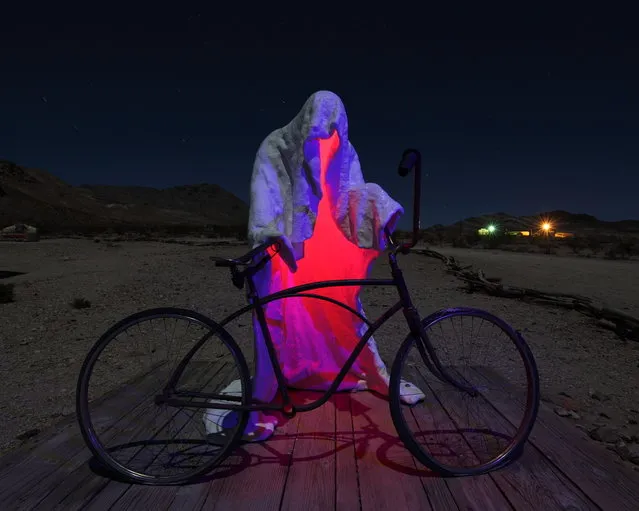
Goldwell Open Air Museum: Last Supper

Just outside of a Nevada ghost town, Rhyolite, is the Goldwell Open Air Museum. The museum was created by a group of Belgian artists and consists of seven outdoor sculptures dramatically using the Mojae Desert as a backdrop. The Last Supper, created by the late artist Charles Szukalski, is a piece that was due to last only a couple of years but withstood time and nature since 1984. Men from the local community were covered in linen and plaster to create the eerie forms, reminiscent of Da Vinci's last supper. It is a truly unique environment and piece of art in the great American desert.
Details
03 Feb 2013 13:13:00


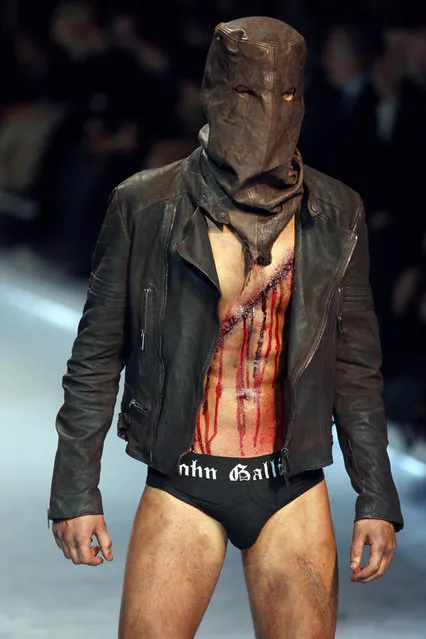
Fashion designer John Galliano brought another batch of his Mad Max-inspired fashion to the Ready-To-Wear show in Paris today. You have the bloody chiseled bodies, the bizarre headgear and the decorative nooses. Maybe fetishizing the collapse of civilization is one step towards making peace with it? Or maybe it's just a weird run-off from our current end-of-days obsession. Either way, enjoy our gallery of buff men in survivalist rags.
Details
28 Mar 2013 10:47:00
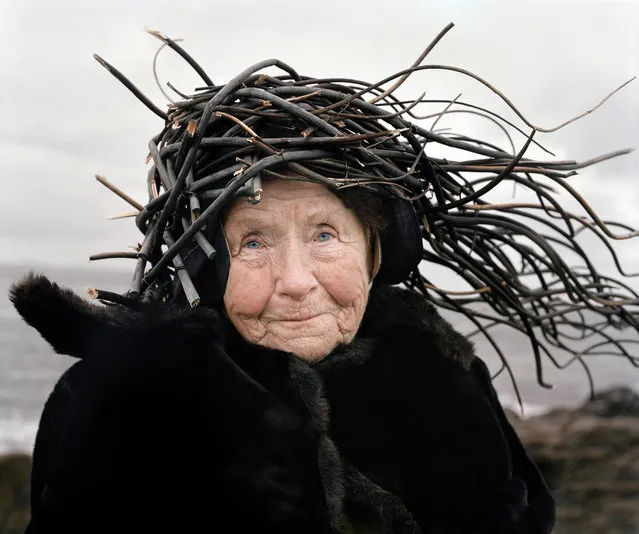
Eyes As Big As Plates – Norway And Finland

Eyes as Big as Plates is a whimsical series by Finnish photographer Riitta Ikonen and Norwegian photographer Karoline Hjorth that features senior citizens donning organic materials like twigs and grass. Ikonen says that the collaborative project originally began as "a play on characters and protagonists from Norwegian folklore" but has since evolved into a collection of images exploring "mental landscapes" that reflect a return of body to nature with the use of scavenged materials.
Details
08 Apr 2013 09:53:00
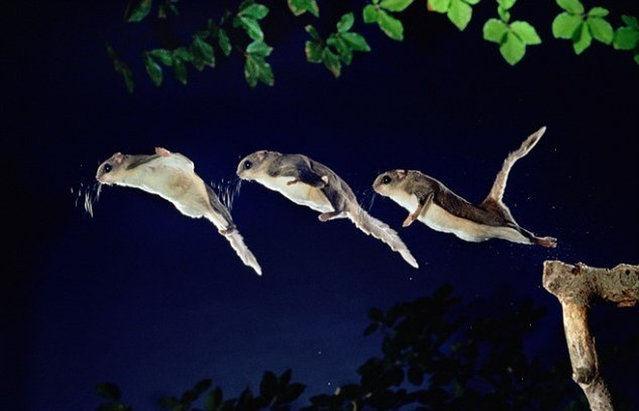
 Flying Squirrel

Flying squirrels are not capable of powered flight like birds or bats; instead, they glide between trees. They are capable of obtaining lift within the course of these flights, with flights recorded to 90 meters (295 ft). The direction and speed of the animal in midair is varied by changing the positions of its two arms and legs, largely controlled by small cartilaginous wrist bones. This changes the tautness of the patagium, a furry parachute-like membrane that stretches from wrist to ankle. It has a fluffy tail that stabilizes in flight. The tail acts as an adjunct airfoil, working as an air brake before landing on a tree trunk.
Details
07 Aug 2012 16:29:00
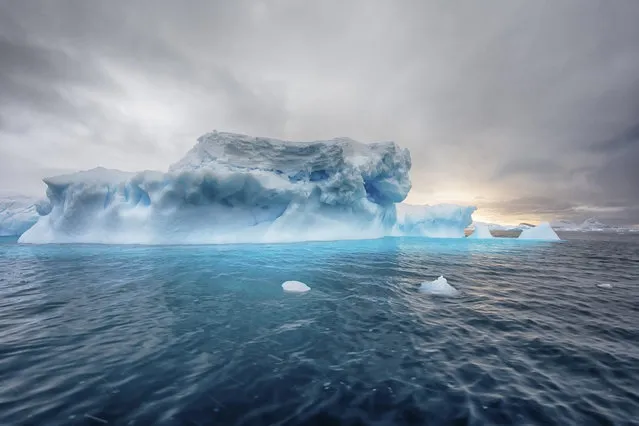
A serene turquoise glow glimmers from underneath these powerful icebergs. Stood in the middle of Antarctica, the giant icebergs appear to be from an unearthly world. These stunning photographs were captured by American photographer Michael Leggero. “My images show pure nature, as that is how I describe Antarctica, simply pure nature”, says the 43 year old, of Carthage, New York. “It is the only place on our planet that humans have not left a presence behind”. (Photo by Michael Leggero/Hotspotmedia/Visual Press Agency)

A serene turquoise glow glimmers from underneath these powerful icebergs. Stood in the middle of Antarctica, the giant icebergs appear to be from an unearthly world. These stunning photographs were captured by American photographer Michael Leggero. “My images show pure nature, as that is how I describe Antarctica, simply pure nature”, says the 43 year old, of Carthage, New York. “It is the only place on our planet that humans have not left a presence behind”. (Photo by Michael Leggero/Hotspotmedia/Visual Press Agency)
Details
07 Aug 2014 10:32:00
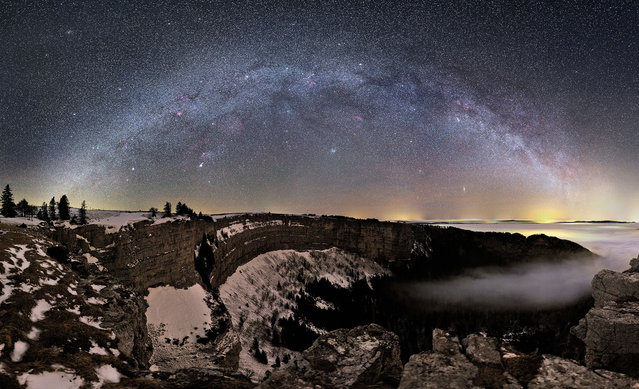
Milky Way over Switzerland

Milky Way over Switzerland

The Milky Way is the galaxy in which Earth is contained. This name derives from its appearance as a dim “milky” glowing band arching across the night sky, in which the naked eye cannot distinguish individual stars. The term “Milky Way” is a translation of the Classical Latin via lactea, from the Hellenistic Greek γαλαξίας κύκλος (pr. galaxías kýklos, “milky circle”). The Milky Way appears like a band because it is a disk-shaped structure being viewed from inside. The fact that this faint band of light is made up of stars was proven in 1610 when Galileo Galilei used his telescope to resolve it into individual stars. In the 1920s, observations by astronomer Edwin Hubble showed that the Milky Way is just one of many galaxies.


Details
20 Jun 2012 10:11:00
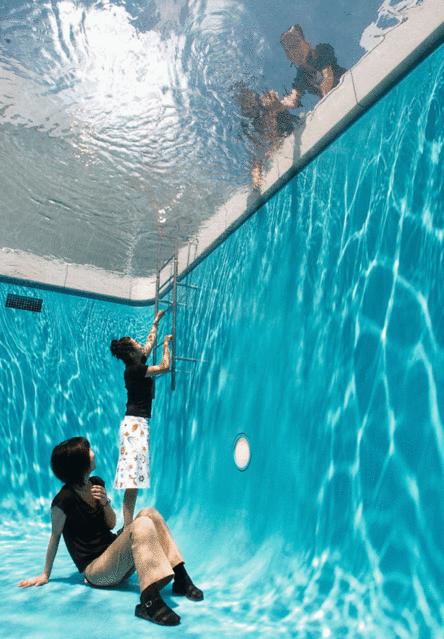
Swimming Pool Art Installation by Leandro Erlich

In one of the Museum’s courtyards is a swimming pool framed by a limestone deck. When seen from the deck, the pool appears to be filled with deep, shimmering water. In fact, however, a layer of water only some 10 centimeters deep is suspended over transparent glass. Below the glass is an empty space with aquamarine walls that viewers can enter. The work sets up an unfolding sequence of experiences—we view the pool through the glass wall enclosing the courtyard; from the deck, looking down into the pool; and from the interior of the pool, looking up. The Swimming Pool might hence be considered a place where, slowly, with time, different perspectives and perceptions of self and others all come to intersect.
Details
25 Aug 2012 07:31:00
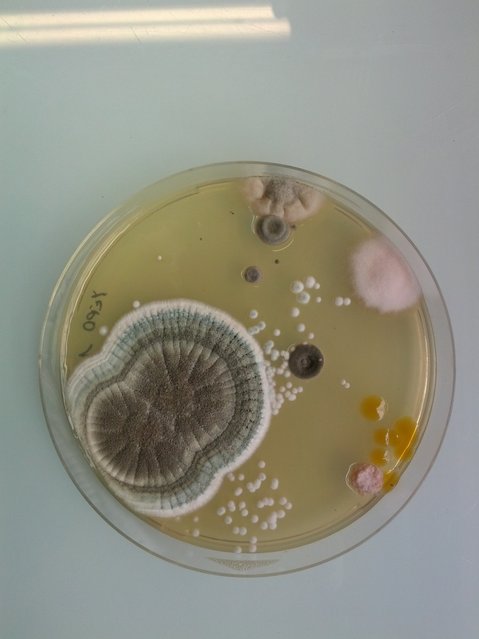
Magical Contamination By Antoine Bridier-Nahmias

Modern art is truly fascinating. Not in a way that it produces some novel things that will fascinate future generations for decades and even centuries to come. No, that is very far from the truth. On the contrary, modern art is essentially anything (yes, any little thing) that is a bit unusual and was created by a famous person. Let’s take the creation of Antoine Bridier-Nahmias for example. His brainchild is a set of pictures of petri dishes that were contaminated by various cultures of fungi. If this is art, I missed my chance of becoming famous when I accidentally left a piece of bread in a bag in a cupboard for about six months, and didn’t take a picture of the rather shocking results that awaited me when I finally discovered it. (Photo by Antoine Bridier-Nahmias)
Details
12 Dec 2014 13:03:00