2016 Rio Olympics, Weightlifting, Final, Women's 63kg, Riocentro, Pavilion 2, Rio de Janeiro, Brazil on August 9, 2016. Marina Rodriguez (CUB) of Cuba competes. (Photo by Stoyan Nenov/Reuters)
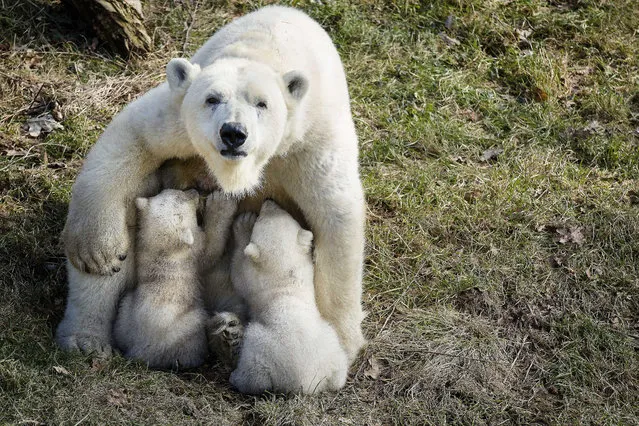
Polar bear twins make their first public appearance with their mother “Freedom” at Ouwehands Zoo Rhenen, in Rhenen, The Netherlands, 19 February 2015. The twins, who were born in November 2014, have not been named because their gender has not yet been determined. (Photo by Bart Maat/EPA)
A ballet dancer attends a photo shooting as activists from the environmentalist group Greenpeace unfurl a giant banner on the Eiffel Tower which reads “Liberty, Equality, Fraternity” in a call on French citizens to vote against the National Front (FN) presidential candidate Marine Le Pen, in Paris, France May 5, 2017. (Photo by Gonzalo Fuentes/Reuters)
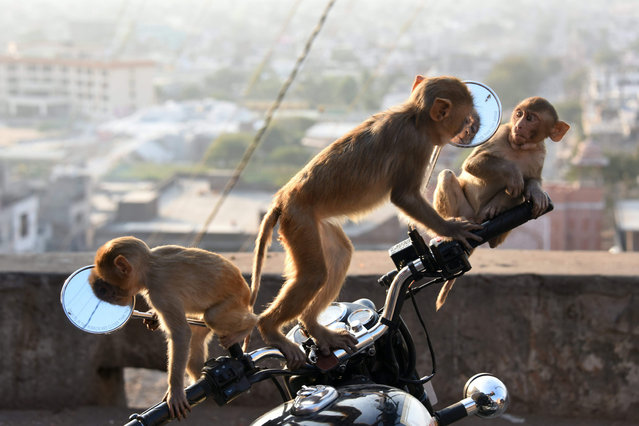
This photo take on December 16, 2016 shows macaques monkeys playing on a motorbike in the grounds of a temple in Jaipur in the Indian state of Rajasthan. (Photo by Dominique Faget/AFP Photo)
People with a South Korean flag waves as fireworks get off outside the stadium during the opening ceremony of the Pyeongchang 2018 Winter Olympic Games at the Pyeongchang Stadium on February 9, 2018. (Photo by Martin Bernetti/AFP Photo)
Trick rider Kendel Sampson performs during the trick riding session of the RAM Rodeo in Warkworth, Ontario, on August 1, 2013. The teenage Encore Presentation Trick Riders perform daring stunts every rodeo season in towns throughout Canada. (Photo by Norm Betts/Barcroft Media)
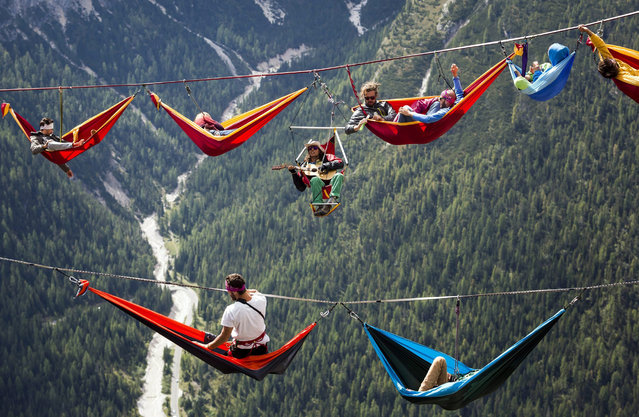
A picture made available on 17 September 2014 shows extreme athletes resting in hammocks on webbings stretched between rocks during the International Highline Meeting in Monte Piana, near Misurina, in the northern Italian Alps, Italy, 08 September 2014. (Photo by Balazs Mohai/EPA)
This Thursday, January 22, 2015 photo made with a long exposure shows the glow from a Noctiluca scintillans algal bloom along the seashore in Hong Kong. The luminescence, also called Sea Sparkle, is triggered by farm pollution that can be devastating to marine life and local fisheries, according to University of Georgia oceanographer Samantha Joye. Noctiluca itself does not produce neurotoxins like other similar organisms do. But its role as both prey and predator tends can eventually magnify the accumulation of toxins in the food chain, according to R. Eugene Turner at Louisiana State University. (Photo by Kin Cheung/AP Photo)