Loading...
Done
A girl plays with colourful papers at the 23rd Sziget (Island) Festival on Shipyard Island in Budapest, Hungary, 13 August 2015. (Photo by Balazs Mohai/EPA)

A girl plays with colourful papers at the 23rd Sziget (Island) Festival on Shipyard Island in Budapest, Hungary, 13 August 2015. The festival is one of the biggest cultural events of Europe, offering art exhibitions, theatrical and circus performances and music concerts. Almost 200 performers from 47 countries will entertain the hundreds of thousands of visitors from 11 to 18 August. (Photo by Balazs Mohai/EPA)
Details
15 Aug 2015 11:47:00
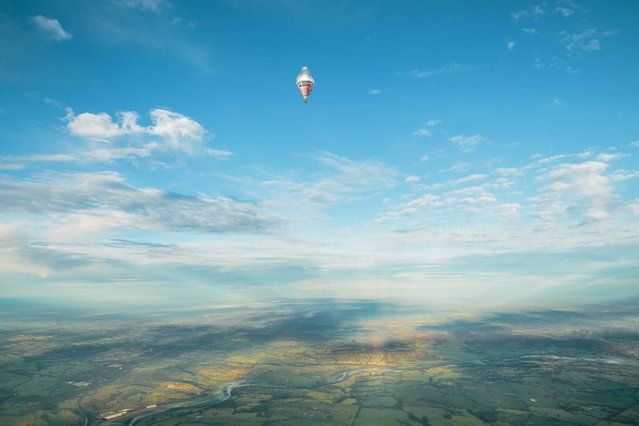
A handout picture provided by the press service of MORTON Group of Companies, show the balloon of Russian adventurer Fedor Konyukhov in the sky during his solo round-the-world balloon flight just after taking off from a spot near Northam, 96 kilometres north-east of Perth in Western Australia, 12 July 2016. Fedor Konyukhov took off from Northam on 12 July 2016 in attempt to beat the record of 13 days of American aviator Steve Fossett. (Photo by EPA/Morton Press Service)

A handout picture provided by the press service of MORTON Group of Companies, show the balloon of Russian adventurer Fedor Konyukhov in the sky during his solo round-the-world balloon flight just after taking off from a spot near Northam, 96 kilometres north-east of Perth in Western Australia, 12 July 2016. Fedor Konyukhov took off from Northam on 12 July 2016 in attempt to beat the record of 13 days of American aviator Steve Fossett. (Photo by EPA/Morton Press Service)
Details
13 Jul 2016 13:43:00
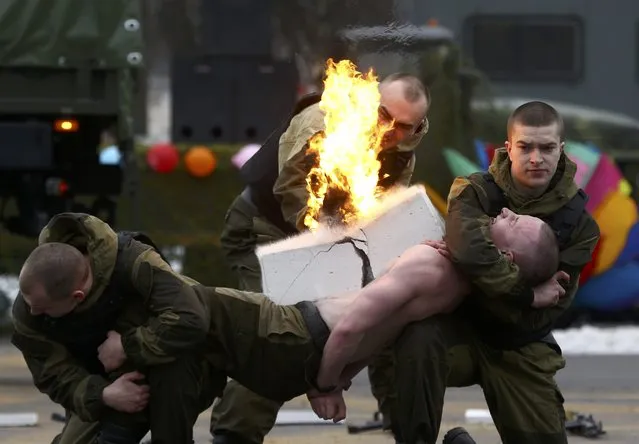
Servicemen of the Belarussian Interior Ministry's special forces unit perform during Maslenitsa celebrations, a pagan holiday marking the end of winter  celebrated with pancake eating and shows of strength, at their base in Minsk, Belarus February 19, 2017. (Photo by Vasily Fedosenko/Reuters)

Servicemen of the Belarussian Interior Ministry's special forces unit perform during Maslenitsa celebrations, a pagan holiday marking the end of winter celebrated with pancake eating and shows of strength, at their base in Minsk, Belarus February 19, 2017. (Photo by Vasily Fedosenko/Reuters)
Details
21 Feb 2017 00:04:00
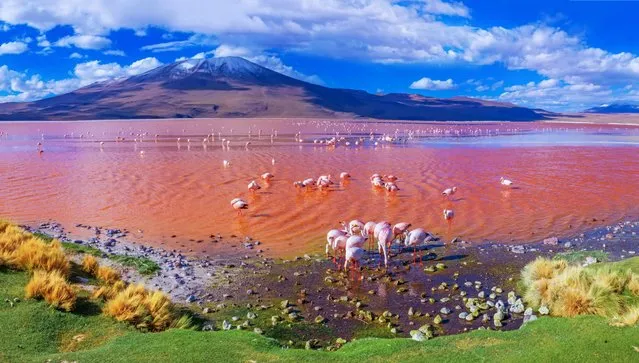
Flamingoes in Laguna Colorada, Altiplano, Bolivia, South America in 2018. (Photo by Oksana Belikova/Rex Features/Shutterstock)

Flamingoes in Laguna Colorada, Altiplano, Bolivia, South America in 2018. (Photo by Oksana Belikova/Rex Features/Shutterstock)
Details
06 Aug 2023 04:24:00
Young couple in BDSM action on the leather sofa. (Photo by Alamy Stock Photo)

Young couple in BDSM action on the leather sofa. (Photo by Alamy Stock Photo)
Details
11 Dec 2023 23:08:00
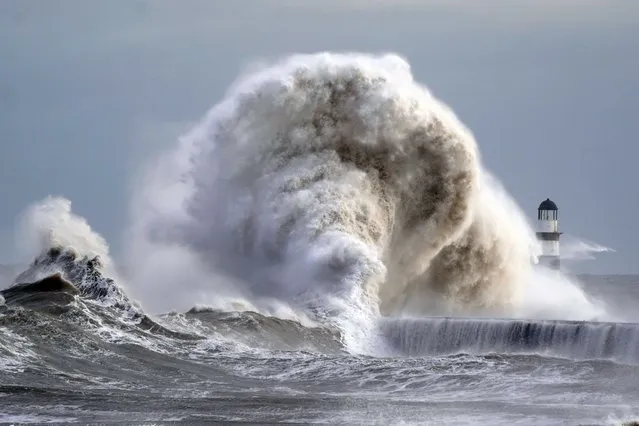
Waves crash against the lighthouse in Seaham Harbour, County Durham in northeast England on Friday, November 24, 2023. (Photo by Owen Humphreys/PA Images via Getty Images)

Waves crash against the lighthouse in Seaham Harbour, County Durham in northeast England on Friday, November 24, 2023. (Photo by Owen Humphreys/PA Images via Getty Images)
Details
26 Jan 2024 09:07:00
A hot-air balloon flies over Metropolitan Park during the International Hot-Air Balloon Festival in Leon, state of Guanajuato, Mexico, on November 16, 2024. (Photo by Henry Romero/Reuters)

A hot-air balloon flies over Metropolitan Park during the International Hot-Air Balloon Festival in Leon, state of Guanajuato, Mexico, on November 16, 2024. (Photo by Henry Romero/Reuters)
Details
04 Jan 2025 03:53:00
On August 31, 2012, a long filament of solar material that had been hovering in the sun's atmosphere, the corona, erupted out into space at 4:36 p.m. EDT. The coronal mass ejection, or CME, traveled at over 900 miles per second. The CME did not travel directly toward Earth, but did connect with Earth's magnetic environment, or magnetosphere, causing aurora to appear on the night of Monday, September 3. (Photo by NASA/GSFC/SDO)

On August 31, 2012, a long filament of solar material that had been hovering in the sun's atmosphere, the corona, erupted out into space at 4:36 p.m. EDT. The coronal mass ejection, or CME, traveled at over 900 miles per second. The CME did not travel directly toward Earth, but did connect with Earth's magnetic environment, or magnetosphere, causing aurora to appear on the night of Monday, September 3. (Photo by NASA/GSFC/SDO via The Atlantic)
Details
14 Sep 2012 09:01:00