Loading...
Done
In this July 24, 2016 photo, a pilgrim takes a bath in a sacred mud pool during the annual Voodoo celebration in Plaine-du-Nord, Haiti, Saturday, July 23, 2016. Pilgrims come to bathe in the mud and make offerings expecting a miracle. (Photo by Dieu Nalio Chery/AP Photo)

In this July 24, 2016 photo, a pilgrim takes a bath in a sacred mud pool during the annual Voodoo celebration in Plaine-du-Nord, Haiti, Saturday, July 23, 2016. Pilgrims come to bathe in the mud and make offerings expecting a miracle. (Photo by Dieu Nalio Chery/AP Photo)
Details
30 Jul 2016 10:59:00
A resident removes mud on a street brought by monsoon rains in San Mateo, Rizal, Philippines, August 14, 2016. (Photo by Erik De Castro/Reuters)

A resident removes mud on a street brought by monsoon rains in San Mateo, Rizal, Philippines, August 14, 2016. (Photo by Erik De Castro/Reuters)
Details
16 Aug 2016 09:58:00
A woman receives a traditional cleansing in the church of San Simon in Iztapa, Chimaltenango, Guatemala, October 28, 2015. (Photo by Jorge Dan Lopez/Reuters)

A woman receives a traditional cleansing in the church of San Simon in Iztapa, Chimaltenango, Guatemala, October 28, 2015. People in Guatemala revere San Simon, also known by his Mayan name Maximon o Ry Laj Man, on October 28 annually. For some devotees, San Simon is synonymous with prosperity and happiness, while others associate him with witchcraft, paganism and a protector for drunkards. Since the 19th century, devotees have offered money, liquor or tobacco in exchange for his blessings. (Photo by Jorge Dan Lopez/Reuters)
Details
01 Nov 2015 08:03:00
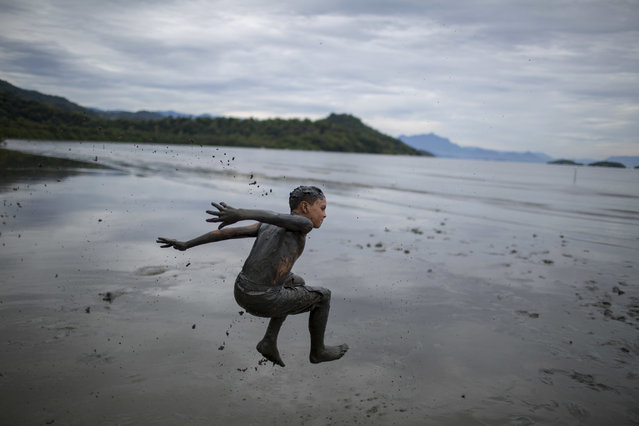
A boy jumps into a pool of mud during the traditional “Bloco da Lama” or “Mud Street” carnival party, in Paraty, Brazil, Saturday, February 25, 2017. Legend has it the “bloco” was born in 1986 after local teens hiking in a nearby mangrove forest smeared themselves with mud to discourage mosquitoes and then wandered through Paraty. The party grew year after year, but revelers eventually were banned from parading in the colonial downtown after shopkeepers complained pristine white walls were stained with the hard-to-remove mud. (Photo by Mauro Pimentel/AP Photo)

A boy jumps into a pool of mud during the traditional “Bloco da Lama” or “Mud Street” carnival party, in Paraty, Brazil, Saturday, February 25, 2017. Legend has it the “bloco” was born in 1986 after local teens hiking in a nearby mangrove forest smeared themselves with mud to discourage mosquitoes and then wandered through Paraty. The party grew year after year, but revelers eventually were banned from parading in the colonial downtown after shopkeepers complained pristine white walls were stained with the hard-to-remove mud. (Photo by Mauro Pimentel/AP Photo)
Details
28 Mar 2017 09:07:00
People play with foam at a water park in Yantai, Shandong province, China June 16, 2107. (Photo by Reuters/Stringer)

People play with foam at a water park in Yantai, Shandong province, China June 16, 2107. (Photo by Reuters/Stringer)
Details
17 Jun 2017 08:46:00
Sumo wrestler Kaiho eats a “chanko” meal in Nagoya, Japan on July 18, 2017. After ending practice at 10:30 a.m., the wrestlers mingle with fans, sign autographs and pose for photos before the first of their two daily meals. (Photo by Issei Kato/Reuters)

Sumo wrestler Kaiho eats a “chanko” meal in Nagoya, Japan on July 18, 2017. After ending practice at 10:30 a.m., the wrestlers mingle with fans, sign autographs and pose for photos before the first of their two daily meals. (Photo by Issei Kato/Reuters)
Details
20 Jul 2017 07:49:00
Two sheep fight in a competition in Zhangjiakou, Hebei province, China on August 1, 2017. (Photo by Reuters/China Stringer Network)

Two sheep fight in a competition in Zhangjiakou, Hebei province, China on August 1, 2017. (Photo by Reuters/China Stringer Network)
Details
06 Aug 2017 07:57:00
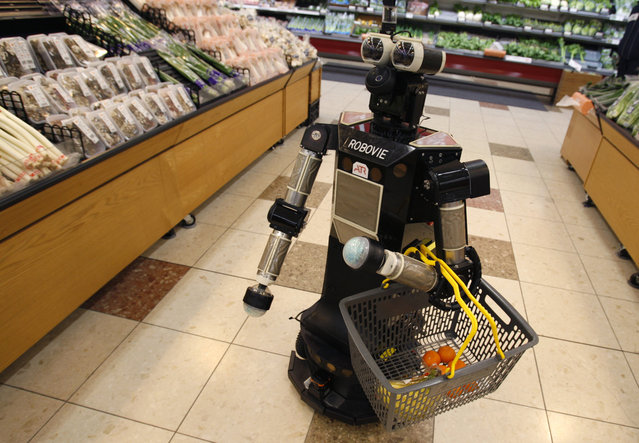
A robot named “Robovie-II”, developed by Japanese robotics research institution ATR, moves around at a grocery store during a shopping assisting experiment by utilizing the robot in an ubiquitous network technology platform in Kyoto, western Japan January 6, 2010. The robot greets the shopper at the entrance of the store, follows him to the shelves while holding a grocery basket and reminds him of the items on a shopping list, which the shopper would have entered beforehand in a specialized mobile device. The experiment is aimed to gather data in order to provide livelihood support for the elderly by using robots and network technologies, ATR's researcher Satoshi Koizumi said. (Photo by Yuriko Nakao/Reuters)

A robot named “Robovie-II”, developed by Japanese robotics research institution ATR, moves around at a grocery store during a shopping assisting experiment by utilizing the robot in an ubiquitous network technology platform in Kyoto, western Japan January 6, 2010. (Photo by Yuriko Nakao/Reuters)
Details
02 Feb 2018 06:54:00