Loading...
Done
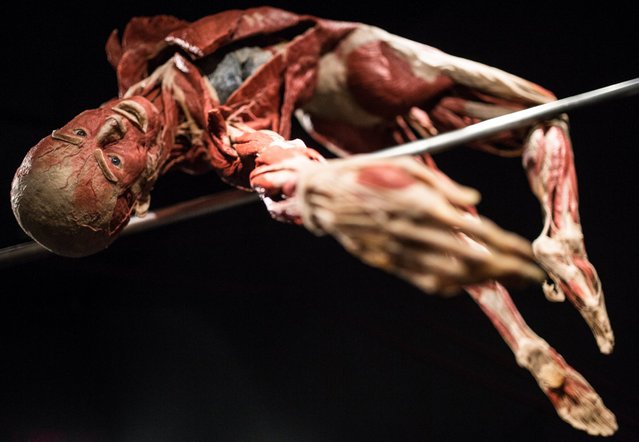
A plastinated body presented as a pole vaulter is exhibited at the Menschen Museum, Museum of Humans, in Berlin, August 29, 2016. The museum was caught up in a legal dispute with the district office of Berlin-Mitte for years before it was able to meet the requirements made by the court. (Photo by Sophia Kembowski/DPA Photo via Newscom)

A plastinated body presented as a pole vaulter is exhibited at the Menschen Museum, Museum of Humans, in Berlin, August 29, 2016. The museum was caught up in a legal dispute with the district office of Berlin-Mitte for years before it was able to meet the requirements made by the court. (Photo by Sophia Kembowski/DPA Photo via Newscom)
Details
30 Aug 2016 12:15:00
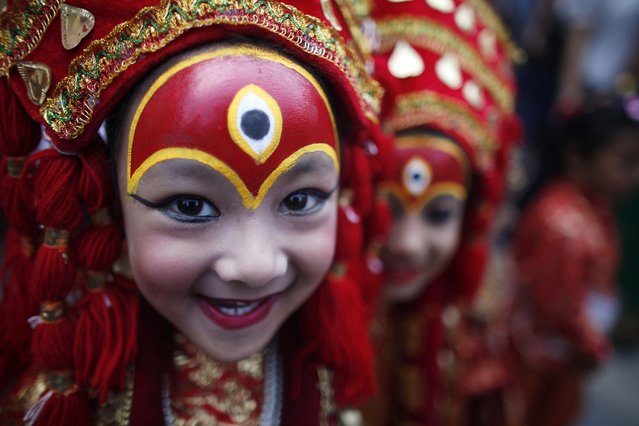
A young Nepalese girl dressed as a Kumari or living Goddess, smiles for camera as she waits for Kumari puja at Hanuman Dhoka, Basantapur Durbar Square in Katmandu, Nepal, Tuesday, Sept 17, 2013. More than hundred girls under the age of nine gathered for Kumari puja, a tradition of worshiping young pre-pubescent girls as manifestations of the divine female energy. The ritual holds a strong religious significance in Newar community. It is a community affair held primarily to save small girls from diseases and bad luck in the years to come. (AP Photo/Niranjan Shrestha)

The festival marks the end of the monsoon season and beginning of autumn. More than hundred girls under the age of nine gathered for the tradition of worshiping young pre-pubescent girls as manifestations of the divine female energy. The ritual holds a strong religious significance in Newar community. It is a community affair held primarily to save small girls from diseases and bad luck in the years to come. Photo: A young Nepalese girl dressed as a Kumari or living Goddess, smiles for camera as she waits for Kumari puja at Hanuman Dhoka, Basantapur Durbar Square in Katmandu, Nepal, Tuesday, September 17, 2013. (Photo by Niranjan Shrestha/AP Photo)
Details
18 Sep 2013 09:33:00
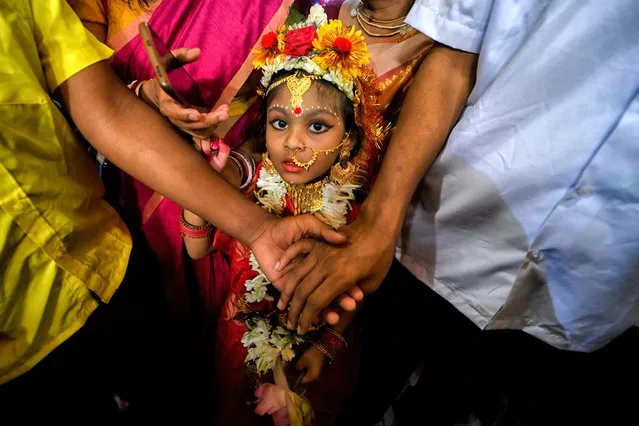
A little girl seen waiting in a queue to participate in the Kumari Puja ritual in Kolkata, India on March 30, 2023. Kumari Puja is an Indian Hindu Tradition mainly celebrated during the Durga Puja / Basanti Puja / Navratri according to Hindu calendar. Kumari actually describes a young virgin girl from the age 1 to 16 who is getting worshipped during the transition of Ashtami / Navami tithi of Durga Puja / Navaratri according to Hindu mythology. Young girls seen being worshipped during the Kumari Puja by their mothers at Adyapith Temple, It is believed that Kumari Puja grant many blessings to the worshipers and as well as the little Girl too. Devotees believe it will overcome all barriers, dangers for the little girls in the coming future and also, she will be empowered to handle any stress and obstruction in her coming life. (Photo by Avishek Das/SOPA Images/Rex Features/Shutterstock)

A little girl seen waiting in a queue to participate in the Kumari Puja ritual in Kolkata, India on March 30, 2023. Kumari Puja is an Indian Hindu Tradition mainly celebrated during the Durga Puja / Basanti Puja / Navratri according to Hindu calendar. Kumari actually describes a young virgin girl from the age 1 to 16 who is getting worshipped during the transition of Ashtami / Navami tithi of Durga Puja / Navaratri according to Hindu mythology. (Photo by Avishek Das/SOPA Images/Rex Features/Shutterstock)
Details
25 Apr 2023 03:26:00
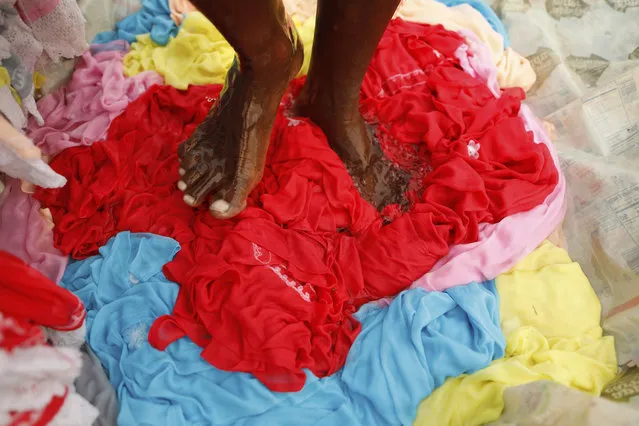
A dhobi, or a washerman washes cloths on the banks of the River Gomti in Lucknow, India, Saturday, September 12, 2020. Dhobis are traditional laundry workers who wash clothes by hand and dry them in the sun, an occupation which has been in existence for generations. Most cities in India have a Dhobi Ghat, or washermen's area, where the city's pile of clothes is laundered. This practice is still popular in India, despite of modern technology. Around 1,000 families work in Lucknow's Dhobi Ghat. However, in light of the novel coronavirus, their wages have decreased drastically. With each family earning around US$100-200 per month. (Photo by Rajesh Kumar Singh/AP Photo)

A dhobi, or a washerman washes cloths on the banks of the River Gomti in Lucknow, India, Saturday, September 12, 2020. Dhobis are traditional laundry workers who wash clothes by hand and dry them in the sun, an occupation which has been in existence for generations. Most cities in India have a Dhobi Ghat, or washermen's area, where the city's pile of clothes is laundered. This practice is still popular in India, despite of modern technology. Around 1,000 families work in Lucknow's Dhobi Ghat. However, in light of the novel coronavirus, their wages have decreased drastically. With each family earning around US$100-200 per month. (Photo by Rajesh Kumar Singh/AP Photo)
Details
25 Sep 2020 00:03:00
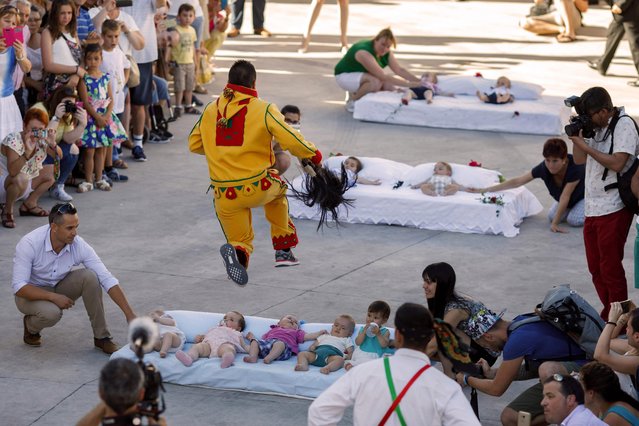
A man dressed up as the devil jumps over babies lying on a mattress in the street during “El Colacho”, the “baby jumping festival” in the village of Castrillo de Murcia, near Burgos on June 18, 2017. Baby jumping (El Colacho) is a traditional Spanish practice dating back to 1620 that takes place annually to celebrate the Catholic feast of Corpus Christi. During the act – known as El Salto del Colacho (the devil's jump) or simply El Colacho – men dressed as the Devil jump over babies born in the last twelve months of the year who lie on mattresses in the street. (Photo by Cesar Manso/AFP Photo)

A man dressed up as the devil jumps over babies lying on a mattress in the street during “El Colacho”, the “baby jumping festival” in the village of Castrillo de Murcia, near Burgos on June 18, 2017. Baby jumping (El Colacho) is a traditional Spanish practice dating back to 1620 that takes place annually to celebrate the Catholic feast of Corpus Christi. During the act – known as El Salto del Colacho (the devil's jump) or simply El Colacho – men dressed as the Devil jump over babies born in the last twelve months of the year who lie on mattresses in the street. (Photo by Cesar Manso/AFP Photo)
Details
20 Jun 2017 07:29:00
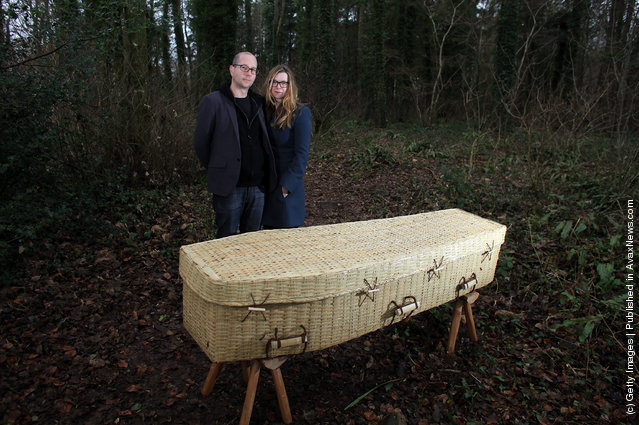
Eco-Friendly Coffins

Claire and Rupert Callender of the Green Funeral Company pose for a photograph with a environmentally friendly coffin in woodland close to their office at Dartington Hall Estate on February 4, 2011 near Torquay, England. The Devon-based company operates as funeral directors and undertakers throughout the South West, offers an ecological alternative to traditional funerals, with coffins made from ecologically friendly materials such as wicker and bamboo, and can arrange funerals that encompass diverse religious and spiritual beliefs everything from a Catholic Requiem Mass, to a Pagan ritual at a stone circle on Bodmin Moor. (Photo by Matt Cardy/Getty Images)
Details
16 Aug 2011 11:04:00
Dirndl Flying

A woman dressed in a dirndl, a kind of traditional Bavarian clothing, jumps into Lake Schlier on July 30, 2006 in Schliersee, Germany. The event called "Dirndlfliegen" ("Dirndl Flying") was sponsored by a local fashion store and a big Austrian Dirndl manufacturer. While these kind of events had been held in Austria before, this was the first of its kind in Germany. 29 women and one man wearing a wig participated in the event that held a new Dirndl as the grand prize. (Photo by Andreas Leder/Getty Images)
Details
08 Sep 2011 14:13:00
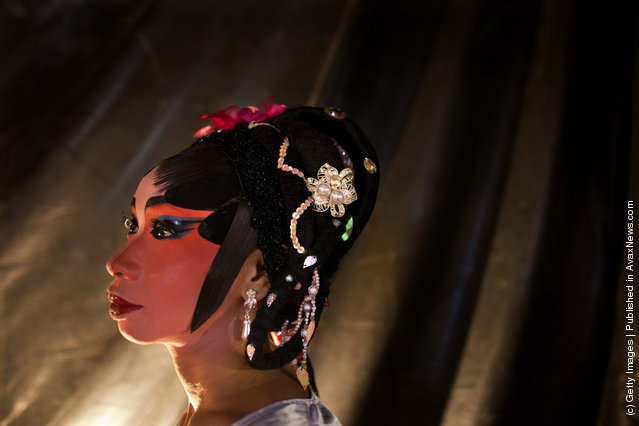
Behind The Scenes At The Chinese Opera In Thailand

Wanwisa, a Lao Yi Lai Heng Chinese opera performer waits backstage at the Plub Plachai temple on January 25, 2012 in Bangkok, Thailand. The traditional Chinese art form involving music, singing, martial arts and acting has a history of more than 500 years. There are about 30 members working with the group doing specials shows all week to celebrate the Chinese New year. The Chinese opera is popular in many parts of China, Malaysia, Singapore, Thailand and Macau. (Photo by Paula Bronstein/Getty Images)
Details
28 Jan 2012 12:14:00