Loading...
Done
A crow attacks a passerby, in a series of crow attacks on residents at a neighbourhood in Singapore on February 14, 2023. (Photo by Leonard Phuah/Shin Min Daily/Singapore Press Holding Media Trust via Reuters)

A crow attacks a passerby, in a series of crow attacks on residents at a neighbourhood in Singapore on February 14, 2023. (Photo by Leonard Phuah/Shin Min Daily/Singapore Press Holding Media Trust via Reuters)
Details
26 Feb 2023 03:58:00
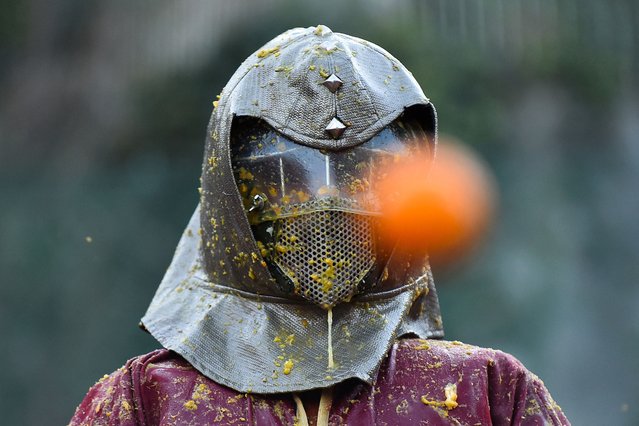
A person participates in the annual “Battle of the Oranges” in the northern city of Ivrea, Italy on February 19, 2023. (Photo by Massimo Pinca/Reuters)

A person participates in the annual “Battle of the Oranges” in the northern city of Ivrea, Italy on February 19, 2023. (Photo by Massimo Pinca/Reuters)
Details
04 Jun 2024 03:58:00
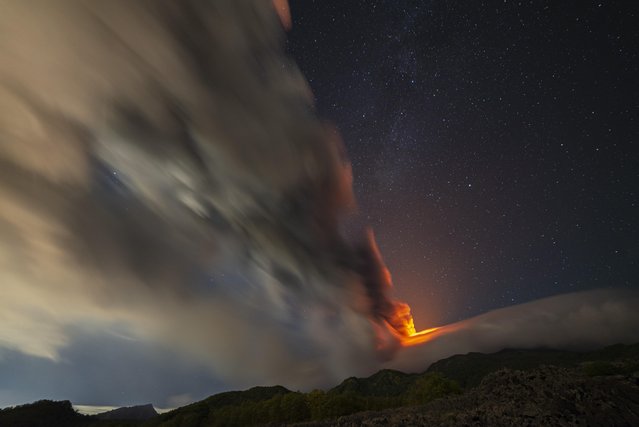
Smoke billows from Mt. Etna volcano, as seen from an area near the village of Sant'Alfio, north of Catania, Sicily, southern Italy, Sunday, November 12, 2023. (Photo by Salvatore Allegra/AP Photo)

Smoke billows from Mt. Etna volcano, as seen from an area near the village of Sant'Alfio, north of Catania, Sicily, southern Italy, Sunday, November 12, 2023. (Photo by Salvatore Allegra/AP Photo)
Details
28 Jan 2025 05:07:00
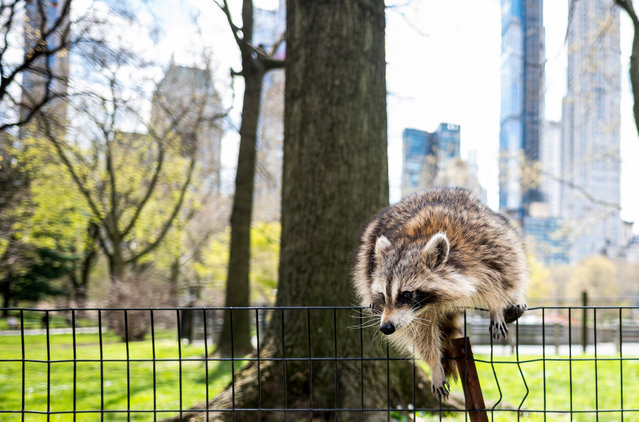
A racoon jumps over a fence in almost deserted Central Park in Manhattan on April 16, 2020 in New York City. Gone are the softball games, horse-drawn carriages and hordes of tourists. In their place, pronounced birdsong, solitary walks and renewed appreciation for Central Park's beauty during New York's coronavirus lockdown. The 843-acre (341-hectare) park – arguably the world's most famous urban green space – normally bustles with human activity as winter turns to spring, but this year due to Covid-19 it's the wildlife that is coming out to play. (Photo by Johannes Eisele/AFP Photo)

A racoon jumps over a fence in almost deserted Central Park in Manhattan on April 16, 2020 in New York City. Gone are the softball games, horse-drawn carriages and hordes of tourists. In their place, pronounced birdsong, solitary walks and renewed appreciation for Central Park's beauty during New York's coronavirus lockdown. The 843-acre (341-hectare) park – arguably the world's most famous urban green space – normally bustles with human activity as winter turns to spring, but this year due to Covid-19 it's the wildlife that is coming out to play. (Photo by Johannes Eisele/AFP Photo)
Details
14 Dec 2025 07:04:00
A general view of atmosphere at the annual VOLT Festival in Sopron, 208 kms west of Budapest, Hungary on June 26, 2017. (Photo by Mudra László/Rockstar Photographers)

A general view of atmosphere at the annual VOLT Festival in Sopron, 208 kms west of Budapest, Hungary on June 26, 2017. (Photo by Mudra László/Rockstar Photographers)
Details
28 Jun 2017 08:23:00
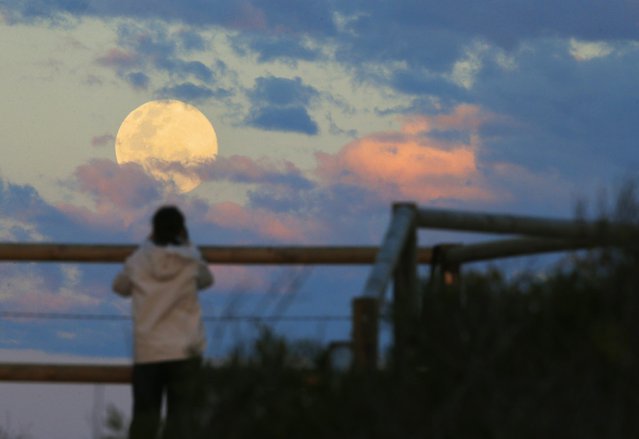
Sydney resident Virginia Maddock watches the supermoon rise off the Sydney beachside suburb of Wanda, August 10, 2014. The astronomical event occurs when the moon is closest to the Earth in its orbit, making it appear much larger and brighter than usual. (Photo by Jason Reed/Reuters)

Sydney resident Virginia Maddock watches the supermoon rise off the Sydney beachside suburb of Wanda, August 10, 2014. Sunday’s moon was at its closest approach to Earth, appearing bigger and brighter than any other moon this year. The moon was 221,765 miles away and looked 16 percent larger and 30 percent brighter than usual. (Photo by Jason Reed/Reuters)
Details
11 Aug 2014 11:50:00
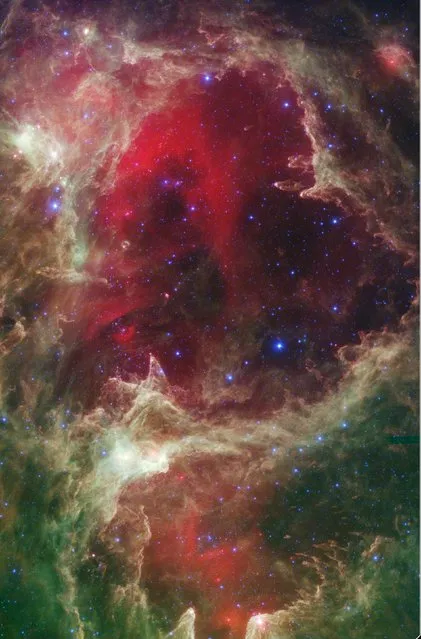
An infrared portrait from NASA's Spitzer Space Telescope which shows generations of stars is seen in this undated NASA handout image released February 14, 2013. In this wispy star-forming region, called W5, the oldest stars can be seen as blue dots in the centers of the two hollow cavities (other blue dots are background and foreground stars not associated with the region). Red shows heated dust that pervades the region's cavities, while green highlights dense clouds. (Photo by NASA/Reuters/JPL-Caltech/Harvard-Smithsonian/Handout)

An infrared portrait from NASA's Spitzer Space Telescope which shows generations of stars is seen in this undated NASA handout image released February 14, 2013. In this wispy star-forming region, called W5, the oldest stars can be seen as blue dots in the centers of the two hollow cavities (other blue dots are background and foreground stars not associated with the region). Red shows heated dust that pervades the region's cavities, while green highlights dense clouds. (Photo by NASA/Reuters/JPL-Caltech/Harvard-Smithsonian/Handout)
Details
03 Mar 2013 08:44:00
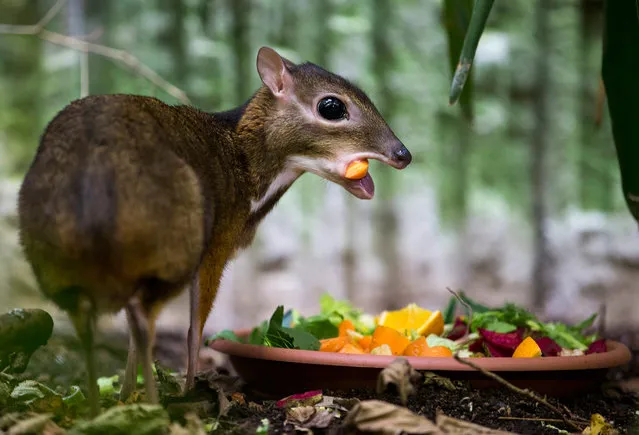
A chevrotain or mouse deer feeds in its enclosure at Zurich Zoo, Zurich, Switzerland, October 17, 2012. (Photo by Patrick B. Kraemer/AP)

A chevrotain or mouse deer feeds in its enclosure at Zurich Zoo, Zurich, Switzerland, October 17, 2012. (Photo by Patrick B. Kraemer/AP)
Details
27 Oct 2012 12:21:00