Loading...
Done
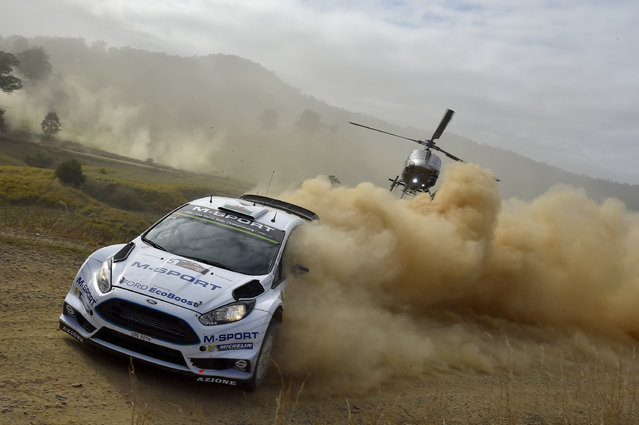
Elfyn Evans of Great Britain and Daniel Barritt of Great Britain compete in their M-Sport WRT Ford Fiesta RS WRC during Day One of the WRC Australia on September 11, 2015 in Coffs Harbour, Australia. (Photo by Massimo Bettiol/Getty Images)


Elfyn Evans of Great Britain and Daniel Barritt of Great Britain compete in their M-Sport WRT Ford Fiesta RS WRC during Day One of the WRC Australia on September 11, 2015 in Coffs Harbour, Australia. (Photo by Massimo Bettiol/Getty Images)
Details
12 Sep 2015 15:50:00
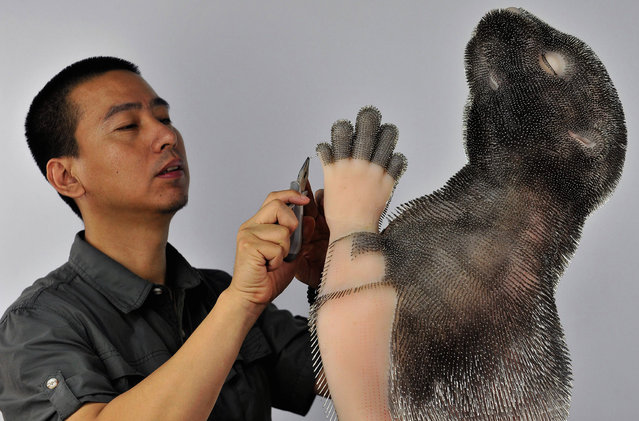
Professor Xie Yong works on an art installation of a beaver, which is made out of plastic and around 300,000 needles, in Shenyang, Liaoning province, July 23, 2013. The needles, according to Xie, represent the pain felt by animals when their fur is taken off to produce clothing. (Photo by Reuters/Stringer)

Professor Xie Yong works on an art installation of a beaver, which is made out of plastic and around 300,000 needles, in Shenyang, Liaoning province, July 23, 2013. The needles, according to Xie, represent the pain felt by animals when their fur is taken off to produce clothing. (Photo by Reuters/Stringer)
Details
27 Jul 2013 09:15:00


Archie, a Chinese Crested dog, sits with his tongue out before the start of the 20th Annual Ugliest Dog Competition at the Sonoma-Marin Fair June 20, 2008 in Petaluma, California. Owners of ugly dogs travel to Petaluma from all over the country to participate in the annual contest. (Photo by Justin Sullivan/Getty Images)
Details
24 Mar 2011 09:03:00


“The Siege of Sidney Street, popularly known as the “Battle of Stepney”, was a notorious gunfight in London's East End on the 2nd of January 1911. Preceded by the Houndsditch Murders, it ended with the deaths of two members of a supposedly politically-motivated gang of burglars supposedly led by Peter Piatkow, a.k.a. “Peter the Painter”, and sparked a major political row over the involvement of the then Home Secretary, Winston Churchill”. – Wikipedia

Photo: Scots Guards and police on duty during the “Siege of Sidney Street” in east London. (Photo by Central Press/Getty Images). 3rd January 1911
Details
03 Apr 2011 09:47:00


“Nicholas II (Russian: Николай II, Николай Александрович Романов, tr. Nikolay II, Nikolay Alexandrovich Romanov) (18 May [O.S. 6 May] 1868 – 17 July 1918) was the last Emperor of Russia, Grand Prince of Finland, and titular King of Poland. His official title was Nicholas II, Emperor and Autocrat of All the Russias and he is known as Saint Nicholas the Passion-Bearer by the Russian Orthodox Church. Nicholas II, his wife, his son, his four daughters, the family's medical doctor, the Tsar's valet, the Empress' lady-in-waiting and the family's cook were murdered in the same room by the Bolsheviks on the night of 16/17 July 1918”. – Wikipedia

Photo: Tsar Nicholas II (1868–1918) with his wife. (Photo by W. & D. Downey/Getty Images). Circa 1900
Details
12 May 2011 07:26:00
Caoimhe Cooburn-Gray poses for a picture on St. Patrick's day in Dublin, Ireland March 17, 2016. (Photo by Clodagh Kilcoyne/Reuters)

Caoimhe Cooburn-Gray poses for a picture on St. Patrick's day in Dublin, Ireland March 17, 2016. Saint Patrick's Day is a cultural and religious celebration held on 17 March, the traditional death date of Saint Patrick (c. AD 385–461), the foremost patron saint of Ireland. Celebrations generally involve public parades and festivals, céilithe, and the wearing of shamrocks, as well as green or orange attire. (Photo by Clodagh Kilcoyne/Reuters)
Details
18 Mar 2016 12:39:00
Elaine Vandiver shares a moment with a two-year old alpaca as they touch noses as she washes him at her farm at 1560 Stateline Road Monday, May 11, 2015, in Walla Walla, Wash. (Photo by Michael Lopez/Walla Walla Union-Bulletin via AP Photo)

Elaine Vandiver shares a moment with a two-year old alpaca as they touch noses as she washes him at her farm at 1560 Stateline Road Monday, May 11, 2015, in Walla Walla, Wash. (Photo by Michael Lopez/Walla Walla Union-Bulletin via AP Photo)
Details
16 May 2015 12:27:00
While the lido was described as bringing “modernism to the masses” on the British coast it was just the latest example of a trend that had been developing since Victorian times – transforming seaside towns into resorts for leisure and entertainment. In the latter half of the nineteenth century, the fashion was for local authorities to build great piers stretching from the promenade out into the sea

While the lido was described as bringing “modernism to the masses” on the British coast it was just the latest example of a trend that had been developing since Victorian times – transforming seaside towns into resorts for leisure and entertainment. In the latter half of the nineteenth century, the fashion was for local authorities to build great piers stretching from the promenade out into the sea. The Eastbourne Pier, pictured here in May 1931, was erected between 1866 and 1870 to an ingenious design by Eugenius Birch, which saw the structure sitting on special cups allowing the supporting struts to “move” in bad weather. Arranged on the pier's 1,000-foot length were kiosks, a theatre, a ballroom and a camera obscura. 1931. (Photo by Aerofilms Collection via “A History of Britain From Above”)
Details
25 Feb 2014 12:59:00