Loading...
Done
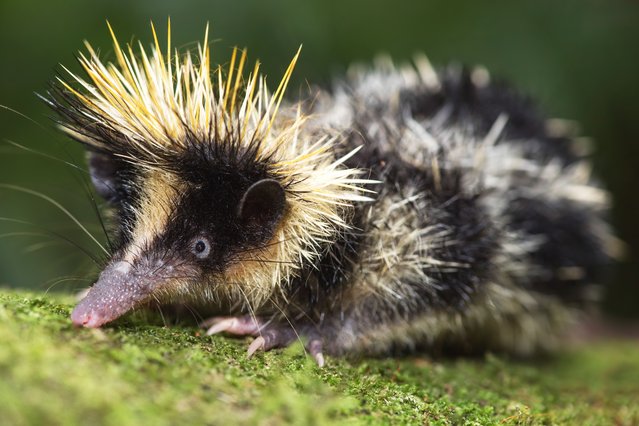
This spiky tenrec was spotted in Madagascar’s Mantadia National Park in the last decade of September 2025. Mostly nocturnal and rarely seen, it puffs out its spines when threatened. Spiky tenrecs are excellent swimmers — unlike most spiny mammals, some species of tenrec can forage in streams and rivers, using their spines for protection while hunting aquatic insects and small prey. (Photo by Dale Morris/Solent News & Photo Agency)

This spiky tenrec was spotted in Madagascar’s Mantadia National Park in the last decade of September 2025. Mostly nocturnal and rarely seen, it puffs out its spines when threatened. Spiky tenrecs are excellent swimmers — unlike most spiny mammals, some species of tenrec can forage in streams and rivers, using their spines for protection while hunting aquatic insects and small prey. (Photo by Dale Morris/Solent News & Photo Agency)
Details
05 Oct 2025 04:02:00
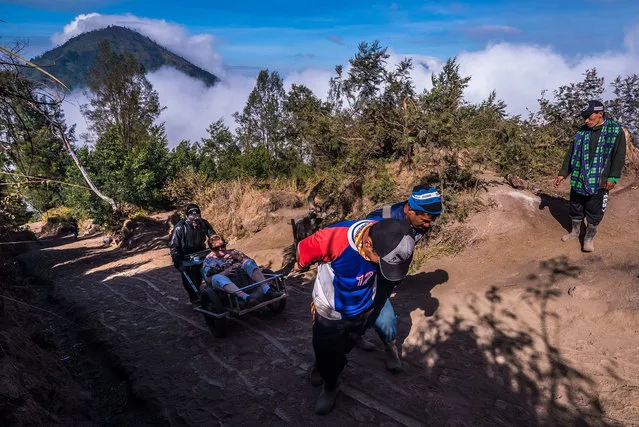
Miners pulling up lazy tourists to the rim of Kawah Ijen (Ijen Volcano), East Java, Indonesia on September 21, 2017. They will earn as much as they would bring down a load of sulfur. Nomadic Explorer, Cultural Lifestyle Photographer Claudio Sieber captured striking images of miners working at Ijen volcanic range in East Java, Indonesia. The sulphur miners risk their lives daily as they climb the active volcano carrying heavy loads, which they sell to sugar refineries. Shortly after midnight curious tourists are flocking in hundreds through the gate of Ijen's foothills to be right on time, driven by the images others took before them. Kawah Ijen is the one of the world's largest acidic volcanic crater lake; famous for its turquoise color as well as the unreal atmosphere it offers during darkness. A dusty path zigzags 3 kilometers up to the crater rim. This doesn't mean anything challenging; in particular, special sights have to be deserved anyway. The irritating smell of sulfur announces the near of the crater's existence. Arriving on the crater's rim the reward for the torture becomes visible. Blue fire darts its tongues through the fumes of sulfur dioxide. Somehow, the spectacle isn't as romantic as expected, since it is also the rough working space of approx. 150 sulfur miners who start their shift at 1 am. Lately, harvesting the abundance of devil's gold received international attention. This did obviously not really improve a miner's lifestyle; neither did it contribute to a better wage. (Photo by Claudio Sieber/Barcroft Images)

Miners pulling up lazy tourists to the rim of Kawah Ijen (Ijen Volcano), East Java, Indonesia on September 21, 2017. They will earn as much as they would bring down a load of sulfur. Nomadic Explorer, Cultural Lifestyle Photographer Claudio Sieber captured striking images of miners working at Ijen volcanic range in East Java, Indonesia. The sulphur miners risk their lives daily as they climb the active volcano carrying heavy loads, which they sell to sugar refineries. (Photo by Claudio Sieber/Barcroft Images)
Details
02 Oct 2017 08:31:00
Samurai Flyer

David Sharp, an engineer with Lockheed Martin, displays the “Samurai Flyer”, an aviation design inspired by the maple seed, during the Association for Unmanned Vehicle Systems International Conference August 16, 2011 in Washington, DC. Lockheed Martin unveiled the new design and demonstrated vertical takeoff and landing, stable hover, and on-board video streaming of the aircraft during their demonstration. (Photo by Win McNamee/Getty Images)
Details
17 Aug 2011 11:56:00
The face of a graduating student is displayed on a tablet attached to a robot during a “cyber graduation” ceremony at a school on May 22, 2020 in Taguig, Metro Manila, Philippines. Robots represented some 179 graduating students of the Senator Rene Cayetano Science and Technology High School during a graduation ceremony that was streamed online, as mass gatherings remain prohibited in the country under the Philippine government's lockdown to curb the spread of the coronavirus. The robots were developed by alumni of the school's robotics club, which used tablets to display the faces of the graduating students as they “marched” on stage to receive their diplomas. The Philippines' Department of Health has so far reported 13,434 cases of the coronavirus in the country, with at least 846 recorded fatalities. (Photo by Ezra Acayan/Getty Images)

The face of a graduating student is displayed on a tablet attached to a robot during a “cyber graduation” ceremony at a school on May 22, 2020 in Taguig, Metro Manila, Philippines. Robots represented some 179 graduating students of the Senator Rene Cayetano Science and Technology High School during a graduation ceremony that was streamed online, as mass gatherings remain prohibited in the country under the Philippine government's lockdown to curb the spread of the coronavirus. The robots were developed by alumni of the school's robotics club, which used tablets to display the faces of the graduating students as they “marched” on stage to receive their diplomas. The Philippines' Department of Health has so far reported 13,434 cases of the coronavirus in the country, with at least 846 recorded fatalities. (Photo by Ezra Acayan/Getty Images)
Details
24 May 2020 00:07:00
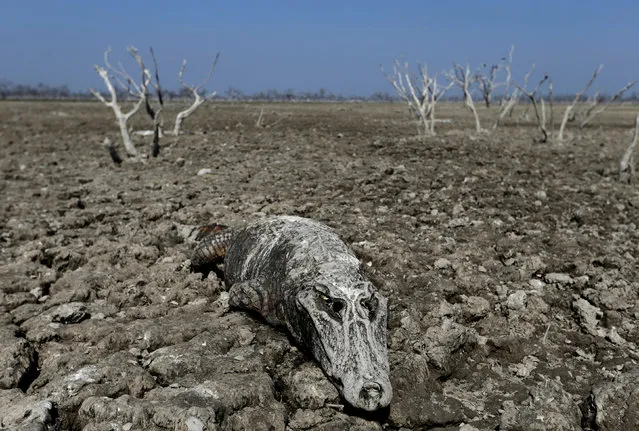
The carcass of a yacare caiman lies in the dried-up river bed of the Pilcomayo river in Boqueron, Paraguay, August 14, 2016. In Paraguay, alongside the Pilcomayo River, black vultures flew over a shrinking pond where a group of crocodilian reptiles known as yacare caimans sought refuge. Water from the river, which divides Paraguay and Argentina in the area of the Gran Chaco, was scarce. This is not an uncommon sight in the region of General Diaz, about 700 kilometres (435 miles) northwest of the country's capital Asuncion, where the Pilcomayo's waters form lakes and streams that give life to capybaras, birds and caimans. “The river's situation is critical. No water is forecast to enter the basin until December, as happens every year”, said Alcides Gonzalez, a resident of the area. (Photo by Jorge Adorno/Reuters)

The carcass of a yacare caiman lies in the dried-up river bed of the Pilcomayo river in Boqueron, Paraguay, August 14, 2016. In Paraguay, alongside the Pilcomayo River, black vultures flew over a shrinking pond where a group of crocodilian reptiles known as yacare caimans sought refuge. Water from the river, which divides Paraguay and Argentina in the area of the Gran Chaco, was scarce. This is not an uncommon sight in the region of General Diaz, about 700 kilometres (435 miles) northwest of the country's capital Asuncion, where the Pilcomayo's waters form lakes and streams that give life to capybaras, birds and caimans. (Photo by Jorge Adorno/Reuters)
Details
03 Nov 2016 12:40:00
Amazon tablet Kindle Fire

The new Amazon tablet called the Kindle Fire is displayed on September 28, 2011 in New York City. The Fire, which will be priced at $199, is an expanded version of the company's Kindle e-reader that has 8GB of storage and WiFi. The Fire gives users access to streaming video, as well as e-books, apps and music, and has a Web browser. In addition to the Fire, Bezos introduced four new Kindles including a Kindle touch model. (Photo by Spencer Platt/Getty Images)
Details
29 Sep 2011 11:03:00
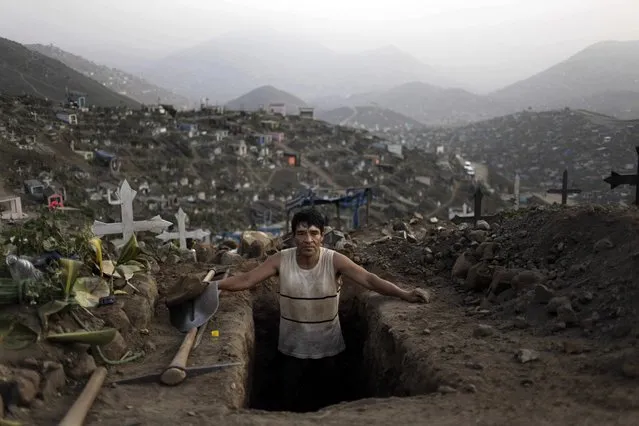
FILE- In this Sept. 9, 2013 file photo, grave digger Juan Luis Cabrera takes a break from his work at the "Nueva Esperanza" cemetery in Lima, Peru. (AP Photo/Rodrigo Abd, File)

Cemetery overcrowding is an issue that resonates around the world, particularly in its most cramped cities and among religions that forbid or discourage cremation. The reality of relying on finite land resources to cope with the endless stream of the dying has brought about creative solutions... (Photo by Rodrigo Abd/AP Photo)
Details
17 Oct 2014 12:16:00
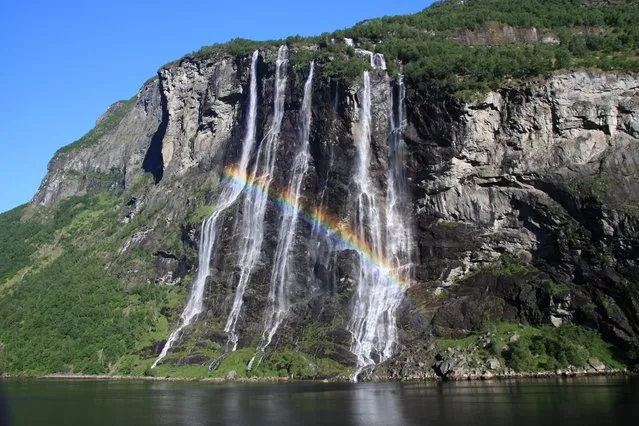
Seven Sisters Waterfall, Norway

The Seven Sisters is the 39th tallest waterfall in Norway. The waterfall consists of seven separate streams, and the tallest of the seven has a free fall that measures 250 metres (820 ft). The waterfall is located along the Geirangerfjorden in Stranda Municipality in Møre og Romsdal county, Norway. The waterfall is located just south of the historic Knivsflå farm, across the fjord from the old Skageflå farm. The falls are about 6.5 kilometres (4.0 mi) west of the village of Geiranger. It is part of the Geiranger World Heritage Site.
Details
11 Dec 2013 10:13:00