Loading...
Done
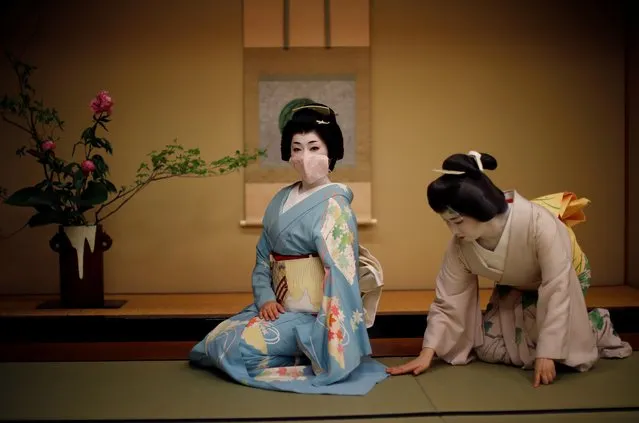
Mayu adjusts Koiku’s kimono, as Koiku wears a protective face mask while posing for a photograph, before they work at a party where they will entertain with other geisha at Japanese luxury restaurant Asada in Tokyo, Japan, June 23, 2020. The coronavirus pandemic has made Tokyo's geisha fear for their centuries-old profession as never before. Though the number of geisha - famed for their witty conversation, beauty and skill at traditional arts - has been falling for years, they were without work for months due to Japan's state of emergency and now operate under awkward social distancing rules. Engagements are down 95 percent, and come with new rules: no pouring drinks for customers or touching them even to shake hands, and sitting 2 meters apart. Masks are hard to wear with their elaborate wigs, so they mostly don't. “I was just full of anxiety”, said Mayu, 47. “I went through my photos, sorted my kimonos ... The thought of a second wave is terrifying”. (Photo by Kim Kyung-Hoon/Reuters)

Mayu adjusts Koiku’s kimono, as Koiku wears a protective face mask while posing for a photograph, before they work at a party where they will entertain with other geisha at Japanese luxury restaurant Asada in Tokyo, Japan, June 23, 2020. (Photo by Kim Kyung-Hoon/Reuters)
Details
23 Jul 2020 00:03:00
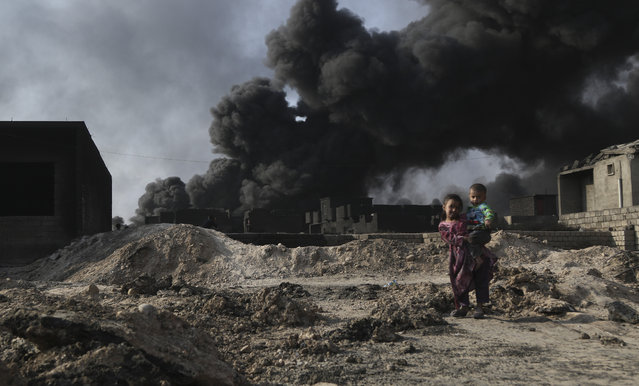
A girl holds her brother in her arm as black smoke rises after an oil well set on fire in the center of al-Kayyara town to the south of Daesh terror organization-held Mosul in Iraq on October 25, 2016. The oil well in the center of al-Kayyara town, which was set alight by retreating Daesh militants in advance of the Iraqi army's takeover of the town on August 24, 2016 has still not entirely been put out. The raw petrol which is still alight is creating black clouds above the city. The residents and wildlife beneath this polluting smoke cloud may find their health at risk. The effects of the fire in the town center on unprotected civilians' health can easily be seen on the hands and faces of children playing on the street. (Photo by dris Okuducu/Anadolu Agency/Getty Images)

A girl holds her brother in her arm as black smoke rises after an oil well set on fire in the center of al-Kayyara town to the south of Daesh terror organization-held Mosul in Iraq on October 25, 2016. The oil well in the center of al-Kayyara town, which was set alight by retreating Daesh militants in advance of the Iraqi army's takeover of the town on August 24, 2016 has still not entirely been put out. The raw petrol which is still alight is creating black clouds above the city. The residents and wildlife beneath this polluting smoke cloud may find their health at risk. The effects of the fire in the town center on unprotected civilians' health can easily be seen on the hands and faces of children playing on the street. (Photo by dris Okuducu/Anadolu Agency/Getty Images)
Details
27 Oct 2016 11:54:00
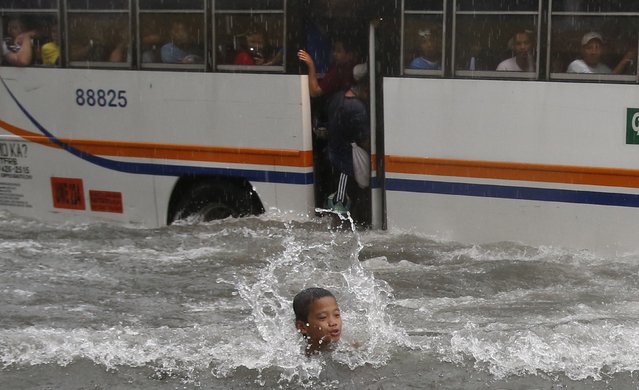
A boy plays at a flooded street in front of a passing bus as tropical storm Fung-Wong battered the Philippine capital Manila September 19, 2014. Heavy rain in the Philippine capital, Manila, caused flooding in many areas on Friday, shutting schools, government offices and financial markets as a tropical storm made landfall to the north. Thousands of residents in low-lying areas were moved to higher ground, officials said, as flood waters rose quickly after the equivalent of half a month's usual rain fell in six hours. (Photo by Erik De Castro/Reuters)

A boy plays at a flooded street in front of a passing bus as tropical storm Fung-Wong battered the Philippine capital Manila September 19, 2014. Heavy rain in the Philippine capital, Manila, caused flooding in many areas on Friday, shutting schools, government offices and financial markets as a tropical storm made landfall to the north. Thousands of residents in low-lying areas were moved to higher ground, officials said, as flood waters rose quickly after the equivalent of half a month's usual rain fell in six hours. (Photo by Erik De Castro/Reuters)
Details
19 Sep 2014 09:39:00
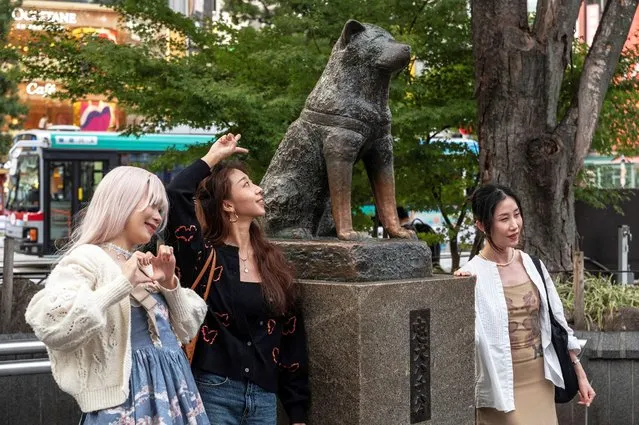
This photo taken on November 6, 2023 shows people posing for photos next to the statue of “Hachiko” in front of Shibuya station in central Tokyo, ahead of the 100th anniversary of the legendary dog's birth this month. A century since its birth, the tale of the loyal companion who had waited at the Shibuya train station for its master to come home – not knowing he had already died – continues to inspire the public, who have made the statue a singular landmark at a glitzy hub of Tokyo's street culture. (Photo by Richard A. Brooks/AFP Photo)

This photo taken on November 6, 2023 shows people posing for photos next to the statue of “Hachiko” in front of Shibuya station in central Tokyo, ahead of the 100th anniversary of the legendary dog's birth this month. A century since its birth, the tale of the loyal companion who had waited at the Shibuya train station for its master to come home – not knowing he had already died – continues to inspire the public, who have made the statue a singular landmark at a glitzy hub of Tokyo's street culture. (Photo by Richard A. Brooks/AFP Photo)
Details
27 Nov 2023 00:06:00
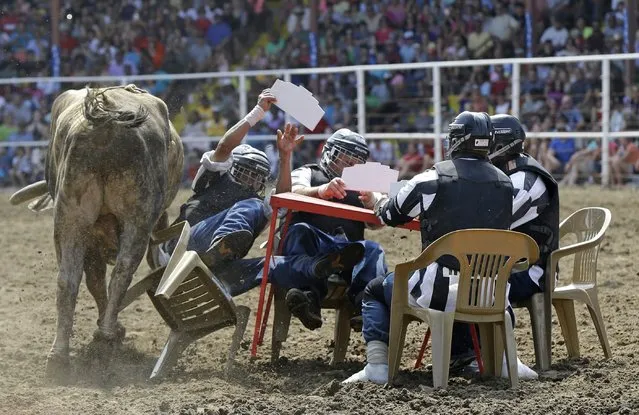
A bull rams inmates seated at a card table in the Convict Poker event at the Angola Prison Rodeo in Angola, La., Saturday, April 26, 2014. Those competing in the rodeo have to pass a physical to be deemed strong and healthy enough, and thousands of others work year-round making arts and crafts to sell at the event, according to the prison's athletic director. (Photo by Gerald Herbert/AP Photo)

A bull rams inmates seated at a card table in the Convict Poker event at the Angola Prison Rodeo in Angola, La., Saturday, April 26, 2014. Those competing in the rodeo have to pass a physical to be deemed strong and healthy enough, and thousands of others work year-round making arts and crafts to sell at the event, according to the prison's athletic director. (Photo by Gerald Herbert/AP Photo)
Details
28 Apr 2014 08:34:00
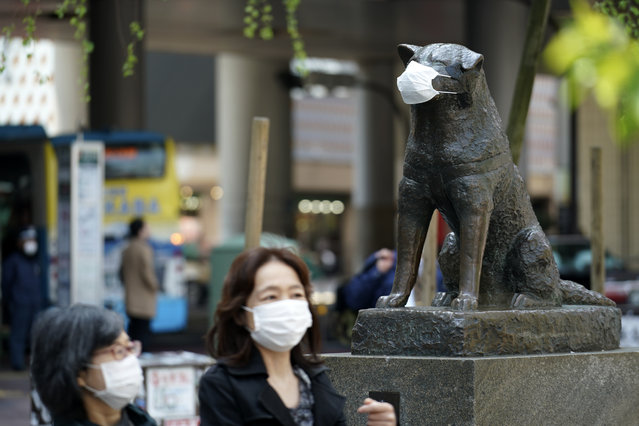
A statue of a Japanese Akita dog named “Hachiko” wearing a face mask is seen near Shibuya Station Wednesday, April 8, 2020, in Tokyo. Japanese Prime Minister Shinzo Abe declared a state of emergency on Tuesday for Tokyo and six other prefectures to ramp up defenses against the spread of the new coronavirus. Hachiko has waited for his owner University of Tokyo Prof. Eizaburo Ueno at the same place by the station every afternoon, expecting him to return home for nearly 11 years even after Ueno's death at work. (Photo by Eugene Hoshiko/AP Photo)

A statue of a Japanese Akita dog named “Hachiko” wearing a face mask is seen near Shibuya Station Wednesday, April 8, 2020, in Tokyo. Japanese Prime Minister Shinzo Abe declared a state of emergency on Tuesday for Tokyo and six other prefectures to ramp up defenses against the spread of the new coronavirus. Hachiko has waited for his owner University of Tokyo Prof. Eizaburo Ueno at the same place by the station every afternoon, expecting him to return home for nearly 11 years even after Ueno's death at work. (Photo by Eugene Hoshiko/AP Photo)
Details
15 Apr 2020 00:05:00
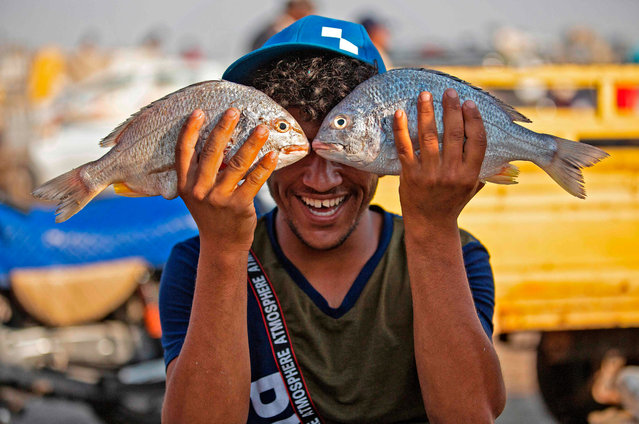
A youth poses while holding two fishes before his face in Iraq's southern port city of al-Faw, 90 kilometres south of Basra near the Shatt al-Arab and the Gulf, on May 18, 2020. In Iraq, a national lockdown to halt the COVID-19 coronavirus pandemic has found some unexpected fans: local businesses who no longer have to compete with Turkish, Iranian or Chinese imports. Those countries, as well as Saudi Arabia, Jordan and Kuwait, typically flood Iraqi markets with inexpensive products at prices local producers can't compete with. (Photo by Hussein Faleh/AFP Photo)

A youth poses while holding two fishes before his face in Iraq's southern port city of al-Faw, 90 kilometres south of Basra near the Shatt al-Arab and the Gulf, on May 18, 2020. In Iraq, a national lockdown to halt the COVID-19 coronavirus pandemic has found some unexpected fans: local businesses who no longer have to compete with Turkish, Iranian or Chinese imports. Those countries, as well as Saudi Arabia, Jordan and Kuwait, typically flood Iraqi markets with inexpensive products at prices local producers can't compete with. (Photo by Hussein Faleh/AFP Photo)
Details
02 Jul 2020 00:01:00
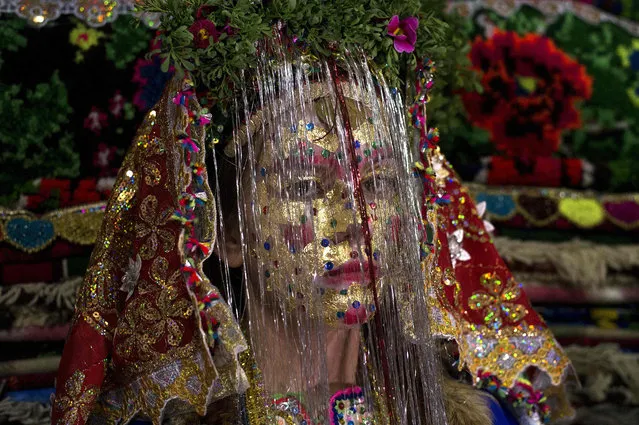
Emilia Pechinkova, a 24-years-old Bulgarian Pomak (Bulgarian speaking Muslims) bride poses for a photograph following the “gelina” or face painting ceremony carried out by female guests and relatives in preparation for her three-day wedding ceremony in the village of Draginovo, 100 kms southeast of Sofia on April 22, 2016. Bulgaria's Muslim population is one of the highest in the European Union. (Photo by Nikolay Doychinov/AFP Photo)

Emilia Pechinkova, a 24-years-old Bulgarian Pomak (Bulgarian speaking Muslims) bride poses for a photograph following the “gelina” or face painting ceremony carried out by female guests and relatives in preparation for her three-day wedding ceremony in the village of Draginovo, 100 kms southeast of Sofia on April 22, 2016. Bulgaria's Muslim population is one of the highest in the European Union. During the Communist regime religious rituals were not tolerated, and Muslims were forced to abandon wearing their traditional wedding outfits. Recently, more young Pomak women want to include traditional wedding customs that were forbidden during the regime, regardless of their secular lifestyles and the high cost of such a wedding. (Photo by Nikolay Doychinov/AFP Photo)
Details
25 Apr 2016 09:55:00