Loading...
Done
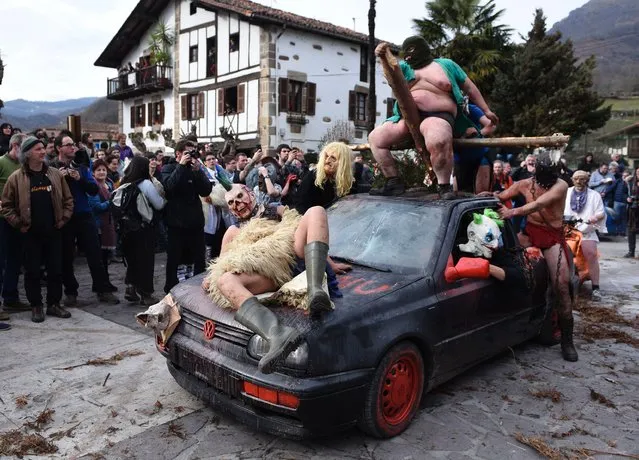
Disguised participants strike poses on a car during the ancient carnival of Ituren, in the northern Spanish Navarra province on January 30, 2017. The yearly three day festivities, revolving mainly around agriculture and principally sheep hearding, run on the last Sunday, Monday and Tuesday of January where Navarra Valley locals from two villages dress up and participate in a variety of activites as they perform a pilgrimage through each village. (Photo by Ander Gillenea/AFP Photo)

Disguised participants strike poses on a car during the ancient carnival of Ituren, in the northern Spanish Navarra province on January 30, 2017. The yearly three day festivities, revolving mainly around agriculture and principally sheep hearding, run on the last Sunday, Monday and Tuesday of January where Navarra Valley locals from two villages dress up and participate in a variety of activites as they perform a pilgrimage through each village. (Photo by Ander Gillenea/AFP Photo)
Details
31 Jan 2017 10:00:00
A motorcyclist dodges in the annual water-splashing festival to mark the New Year of the Dai minority in Menglian, Yunnan province April 13, 2015. Picture taken April 13, 2015. (Photo by Wong Campion/Reuters)

A motorcyclist dodges in the annual water-splashing festival to mark the New Year of the Dai minority in Menglian, Yunnan province April 13, 2015. (Photo by Wong Campion/Reuters)
Details
15 Apr 2015 13:03:00
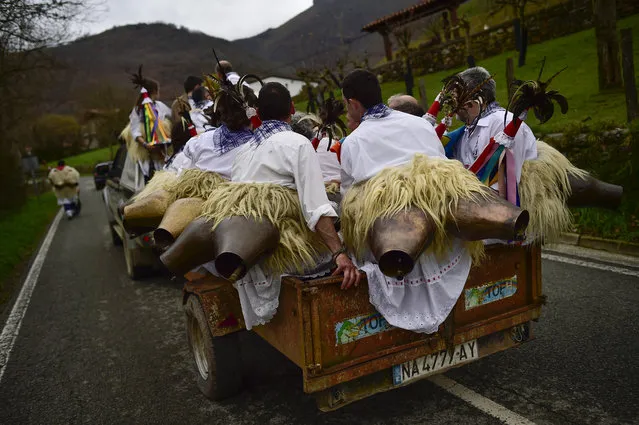
Joaldunaks return in a trailer to their town at the end of Carnival between of the Pyrenees villages of Ituren and Zubieta, northern Spain, Monday, February 1, 2016. In one of the most ancient carnivals in Europe, dating from before the Roman empire, companies of Joaldunak (cowbells) made up of residents of two towns, Ituren and Zubieta, parade the streets costumed in sandals, lace petticoats, sheepskins around the waist and shoulders, coloured neckerchiefs, conical caps with ribbons and a hyssop of horsehair in their right hands and cowbells hung across their lower back. (Photo by Alvaro Barrientos/AP Photo)

Joaldunaks return in a trailer to their town at the end of Carnival between of the Pyrenees villages of Ituren and Zubieta, northern Spain, Monday, February 1, 2016. In one of the most ancient carnivals in Europe, dating from before the Roman empire, companies of Joaldunak (cowbells) made up of residents of two towns, Ituren and Zubieta, parade the streets costumed in sandals, lace petticoats, sheepskins around the waist and shoulders, coloured neckerchiefs, conical caps with ribbons and a hyssop of horsehair in their right hands and cowbells hung across their lower back. (Photo by Alvaro Barrientos/AP Photo)
Details
02 Feb 2016 13:07:00
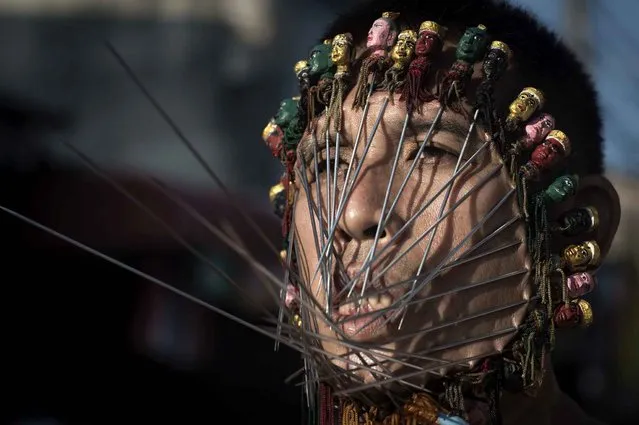
A devotee of the Chinese Jui Tui Shrine has his face pierced with metal rods during a street procession during the annual Vegetarian Festival in the southern Thai town of Phuket on October 19, 2015. During the festival, which begins on the first evening of the ninth lunar month and lasts nine days, religious devotees slash themselves with swords, pierce their cheeks with sharp objects and commit other painful acts to purify themselves, taking on the sins of the community. (Photo by Nicolas Asfouri/AFP Photo)

A devotee of the Chinese Jui Tui Shrine has his face pierced with metal rods during a street procession during the annual Vegetarian Festival in the southern Thai town of Phuket on October 19, 2015. During the festival, which begins on the first evening of the ninth lunar month and lasts nine days, religious devotees slash themselves with swords, pierce their cheeks with sharp objects and commit other painful acts to purify themselves, taking on the sins of the community. (Photo by Nicolas Asfouri/AFP Photo)
Details
21 Oct 2015 08:05:00
Models wait backstage prior to the Viktor&Rolf Spring-Summer 2022 Haute Couture fashion collection, in Paris, Wednesday, January 26, 2022. (Photo by Thibault Camus/AP Photo)

Models wait backstage prior to the Viktor&Rolf Spring-Summer 2022 Haute Couture fashion collection, in Paris, Wednesday, January 26, 2022. (Photo by Thibault Camus/AP Photo)
Details
26 Feb 2023 04:14:00
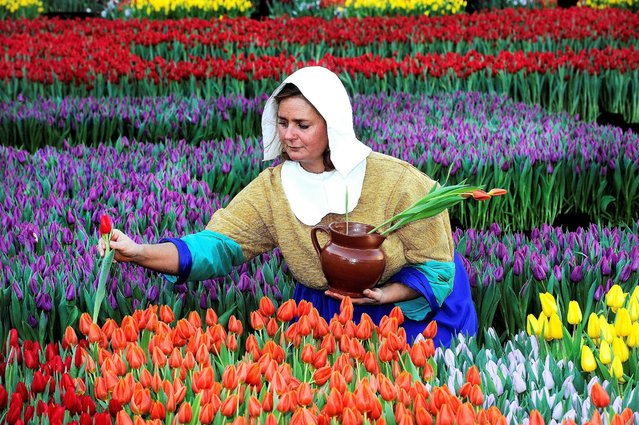
A woman dressed as The Milkmaid (Het Melkmeisje), after a painting by Dutch painter Johannes Vermeer, picks up tulips at the National Tulip Day on the Dam, Amsterdam, the Netherlands, 16 January 2016. The event is the official start of the international tulip season which runs until the end of April. (Photo by Evert Elzinga/EPA)

A woman dressed as “The Milkmaid” (Het Melkmeisje), after a painting by Dutch painter Johannes Vermeer, picks up tulips at the National Tulip Day on the Dam, Amsterdam, the Netherlands, 16 January 2016. The event is the official start of the international tulip season which runs until the end of April. (Photo by Evert Elzinga/EPA)
Details
18 Jan 2016 08:06:00
An Indian woman reacts while performing yoga at a railway station on International Women's Day, organised by Heal-Station in association with Western Railway, in Mumbai, India, 08 March 2023. International Women's Day (IWD) is observed annually on 08 March worldwide to highlight women's rights, as well as issues such as violence and abuse against women. The theme of IWD 2023 is “DigitALL: Innovation and technology for gender equality”. According to the United Nations, 37 percent of women around the world do not use the internet, leading to a digital gender gap that widens economic and social inequalities. (Photo by Divyakant Solanki/EPA/EFE/Rex Features/Shutterstock)

An Indian woman reacts while performing yoga at a railway station on International Women's Day, organised by Heal-Station in association with Western Railway, in Mumbai, India, 08 March 2023. (Photo by Divyakant Solanki/EPA/EFE/Rex Features/Shutterstock)
Details
15 Mar 2023 00:42:00
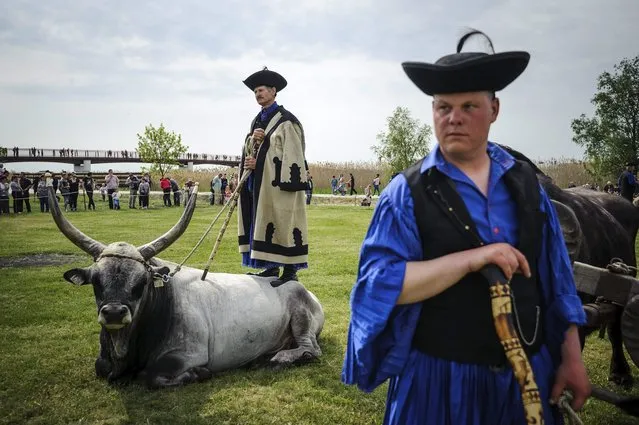
A herdsman stands on the back of a grey bull during a ceremony of driving sheep from their winter habitat to their summer pasture in the puszta or Hungarian steppe of Hortobagy, 183 kms east of Budapest, Hungary, 23 April 2016. Sheep are traditionally driven to their summer pasture at around St. George's Day in the Hortobagy region, because livestock breeding people traditionally consider St. George's Day the beginning of spring. (Photo by Zsolt Czegledi/EPA)

A herdsman stands on the back of a grey bull during a ceremony of driving sheep from their winter habitat to their summer pasture in the puszta or Hungarian steppe of Hortobagy, 183 kms east of Budapest, Hungary, 23 April 2016. Sheep are traditionally driven to their summer pasture at around St. George's Day in the Hortobagy region, because livestock breeding people traditionally consider St. George's Day the beginning of spring. (Photo by Zsolt Czegledi/EPA)
Details
24 Apr 2016 09:27:00