Loading...
Done
Participants re-enact the “Battle of Five Armies” from J.R.R. Tolkien's novel “The Hobbit” in a forest near the town of Doksy, Czech Republic June 6, 2015. According to event organizers, hundreds of enthusiasts dressed as characters such as elves, dwarves, goblins and orcs from the book “The Hobbit” re-enacted the clash. (Photo by David W. Cerny/Reuters)

Participants re-enact the “Battle of Five Armies” from J.R.R. Tolkien's novel “The Hobbit” in a forest near the town of Doksy, Czech Republic June 6, 2015. According to event organizers, hundreds of enthusiasts dressed as characters such as elves, dwarves, goblins and orcs from the book “The Hobbit” re-enacted the clash. (Photo by David W. Cerny/Reuters)
Details
10 Jul 2015 11:33:00
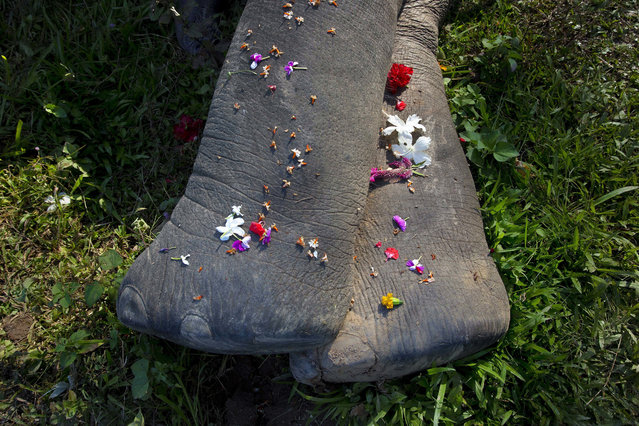
Villagers offer flowers to a wild tusker, laying dead in a field in Panbari villagein Panbari village on the outskirts of Gauhati, India, Thursday, November 2, 2017. According to a veterinarian the tusker died of food poisoning. Scarcity of food and illegal encroachment of forest areas have forced these wild elephant to move to populated areas for food. (Photo by Anupam Nath/AP Photo)

Villagers offer flowers to a wild tusker, laying dead in a field in Panbari villagein Panbari village on the outskirts of Gauhati, India, Thursday, November 2, 2017. According to a veterinarian the tusker died of food poisoning. Scarcity of food and illegal encroachment of forest areas have forced these wild elephant to move to populated areas for food. (Photo by Anupam Nath/AP Photo)
Details
10 Nov 2017 08:43:00
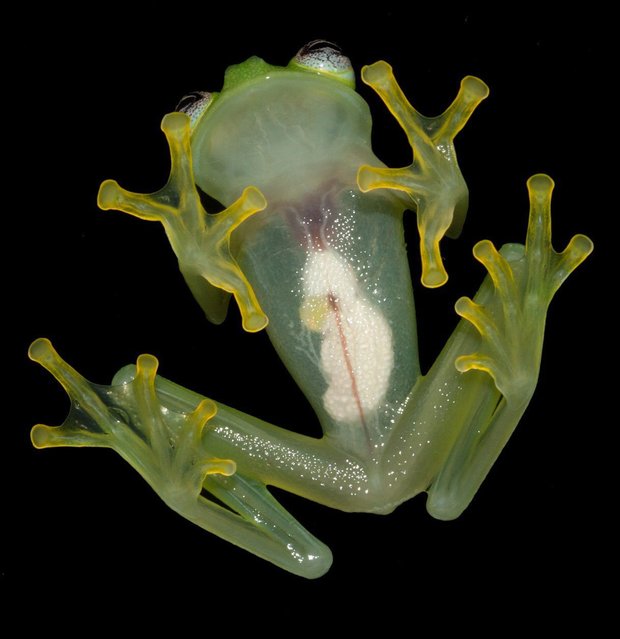
A handout photograph provided by Brian Kubicki of Costa Rican Amphibian Research Center on 26 April 2016 shows a “Crystal frog”, Hyalinobatrachium dianae (H. diane). This frog was discovered by US biologist Brian Kubicki and Costa Ricans Stanley Salazar and Robert Puschendorf in a rainy forest of Costa Rican caribbean after 40 years without notice of any new example of this kind. (Photo by Brian Kubicki/EPA/Costa Rican Amphibian Research Center)

A handout photograph provided by Brian Kubicki of Costa Rican Amphibian Research Center on 26 April 2016 shows a “Crystal frog”, Hyalinobatrachium dianae (H. diane). This frog was discovered by US biologist Brian Kubicki and Costa Ricans Stanley Salazar and Robert Puschendorf in a rainy forest of Costa Rican caribbean after 40 years without notice of any new example of this kind. (Photo by Brian Kubicki/EPA/Costa Rican Amphibian Research Center)
Details
02 May 2015 15:23:00
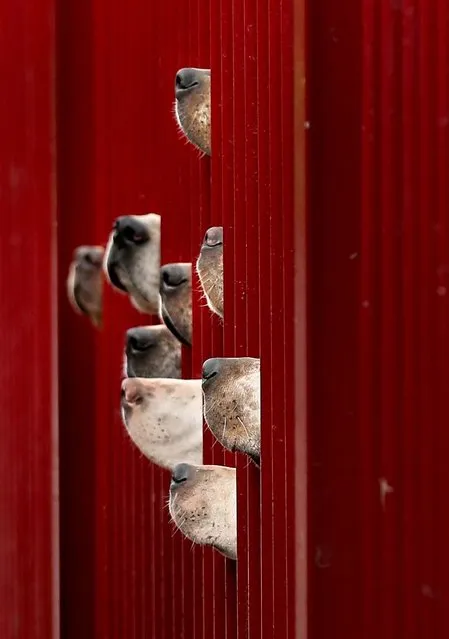
Hounds of The Cheshire Forest Hunt push their snouts through the bars of their kennels as they eagerly await their morning walk in preparation for the start of the new hunting season, in Knutsford, England, on Oktober 31, 2013. The hunting season traditionally starts around November 1st. Although a ban on hunting has been in force since February 2005, many supporters of fox hunting are continuing to call for a repeal of the ban, saying the current law is hard to interpret and enforce.  (Photo by Christopher Furlong/Getty Images)

Hounds of The Cheshire Forest Hunt push their snouts through the bars of their kennels as they eagerly await their morning walk in preparation for the start of the new hunting season, in Knutsford, England, on Oktober 31, 2013. The hunting season traditionally starts around November 1st. Although a ban on hunting has been in force since February 2005, many supporters of fox hunting are continuing to call for a repeal of the ban, saying the current law is hard to interpret and enforce. (Photo by Christopher Furlong/Getty Images)
Details
02 Nov 2013 12:34:00
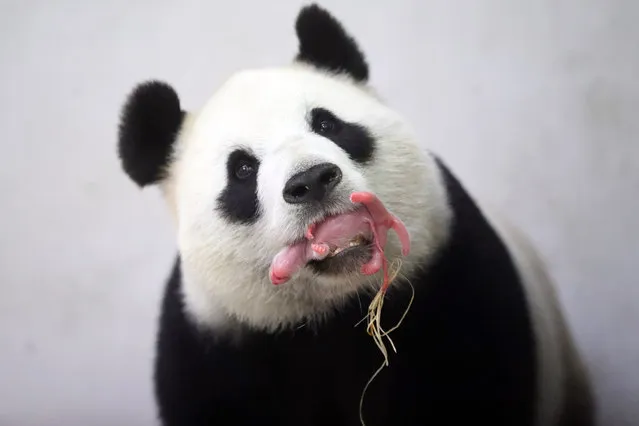
In this image provided by the Pairi Daiza park, giant panda Hao Hao holds her newborn baby in her mouth at the park in Brugelette, Belgium, on Thursday, June 2, 2016. With the help of the Chinese government Hao Hao and her mate Xing Hui arrived in Belgium two years ago and Pairi Daiza adapted its park to build a bamboo forest for them. (Photo by Benoit Bouchez/Pairi Daiza via AP Photo)

In this image provided by the Pairi Daiza park, giant panda Hao Hao holds her newborn baby in her mouth at the park in Brugelette, Belgium, on Thursday, June 2, 2016. With the help of the Chinese government Hao Hao and her mate Xing Hui arrived in Belgium two years ago and Pairi Daiza adapted its park to build a bamboo forest for them. (Photo by Benoit Bouchez/Pairi Daiza via AP Photo)
Details
03 Jun 2016 12:35:00
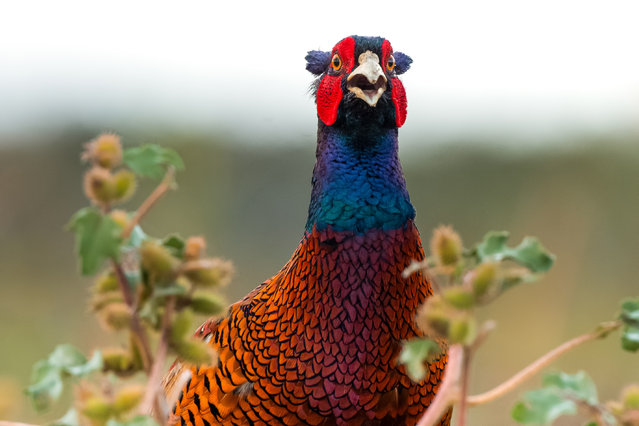
A pheasant is seen among grasses in Bursa, Turkiye on October 07, 2024. Pheasants mostly live in forested areas, thickets and wetlands. Unlike females, male pheasants have a much more remarkable structure with their long tails and feathers in bright and variable colors. Also, they feed on fruits, grains, seeds and invertebrates. (Photo by Alper Tuydes/Anadolu via Getty Images)

A pheasant is seen among grasses in Bursa, Turkiye on October 07, 2024. Pheasants mostly live in forested areas, thickets and wetlands. Unlike females, male pheasants have a much more remarkable structure with their long tails and feathers in bright and variable colors. Also, they feed on fruits, grains, seeds and invertebrates. (Photo by Alper Tuydes/Anadolu via Getty Images)
Details
27 Oct 2024 04:43:00
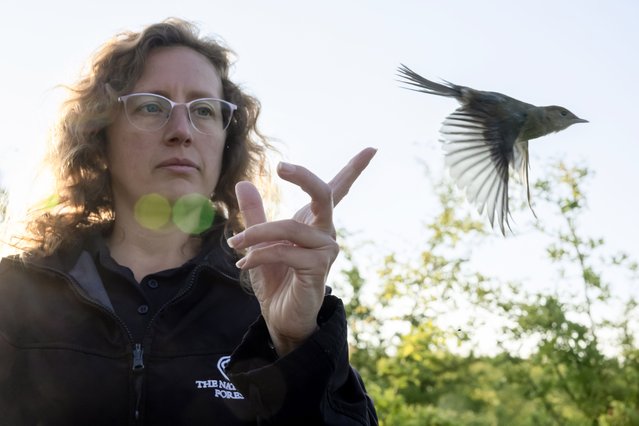
A juvenile blackcap is recorded in the soft light of morning at Minorca, UK, a former open-cast mine near Moira in the National Forest on June 18, 2025. Dr Heather Gilbert, research and evidence manager, checks mist nets among wildflowers and young trees as part of long-term monitoring that shows bird numbers have increased by 48 per cent over 30 years. (Photo by Rod Kirkpatrick/RKP Photography)

A juvenile blackcap is recorded in the soft light of morning at Minorca, UK, a former open-cast mine near Moira in the National Forest on June 18, 2025. Dr Heather Gilbert, research and evidence manager, checks mist nets among wildflowers and young trees as part of long-term monitoring that shows bird numbers have increased by 48 per cent over 30 years. (Photo by Rod Kirkpatrick/RKP Photography)
Details
29 Jun 2025 03:58:00
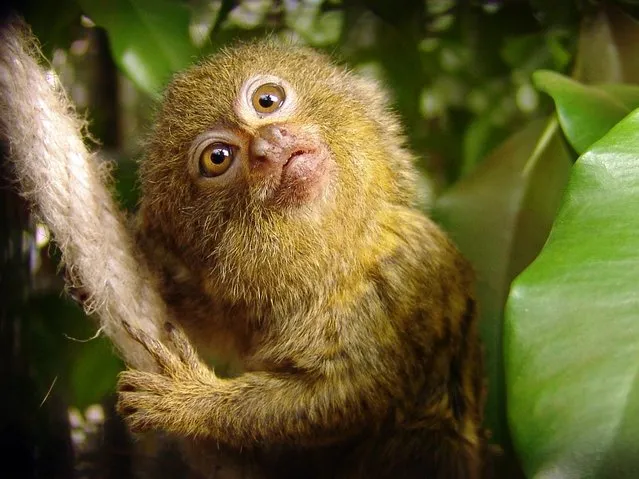
Pygmy Marmoset - The Smallest Monkey

The pygmy marmoset (Cebuella pygmaea) is a small New World monkey native to rainforests of the western Amazon Basin in South America. It is notable for being the smallest monkey in the world at just over 100 grams (3.5 oz). It is generally found in evergreen and river edge forests and is a gum-feeding specialist
Details
29 Jan 2014 12:59:00