Loading...
Done
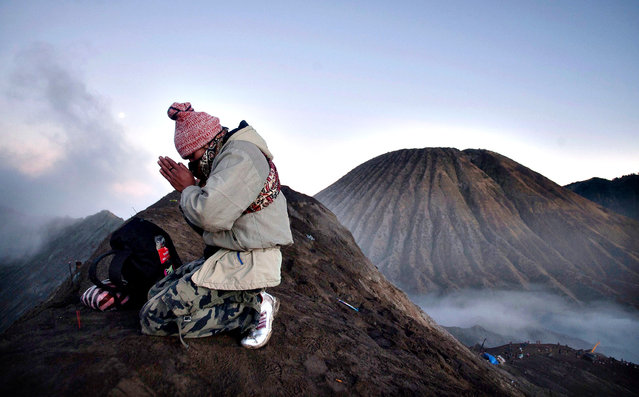
A Tengger tribesman prays at Mount Bromo during the annual Kasada ceremony in East Java on August 12, 2014. The Kasada ceremony is a festival held every 14th day of the Kasada month in the traditional Hindu lunar calender to honour Sang Hyang Widhi (God Almighty) and is based on the legend of Roro Anteng and Joko Seger from the Majapahit Kingdom, from which their Tengger tribe name originates. (Photo by Juni Kriswanto/AFP Photo)

A Tengger tribesman prays at Mount Bromo during the annual Kasada ceremony in East Java on August 12, 2014. The Kasada ceremony is a festival held every 14th day of the Kasada month in the traditional Hindu lunar calender to honour Sang Hyang Widhi (God Almighty) and is based on the legend of Roro Anteng and Joko Seger from the Majapahit Kingdom, from which their Tengger tribe name originates. Hundreds of worshippers from the Tengger tribe offer food and livestock as a symbolic sacrifice which they throw into the crater for the blessings of safety and prosperity to their familyies and community. (Photo by Juni Kriswanto/AFP Photo)
Details
16 Aug 2014 11:19:00
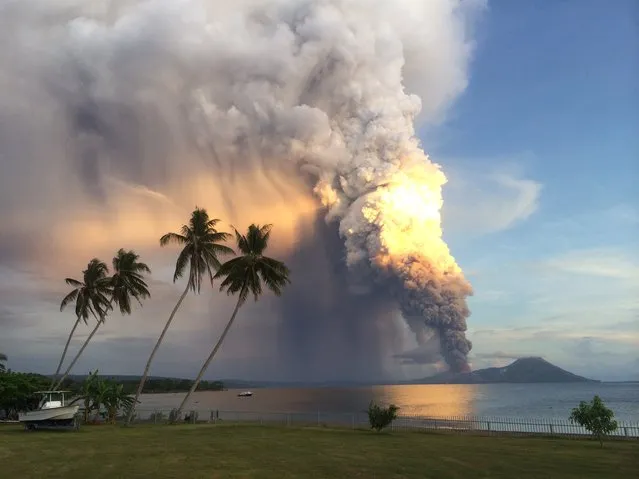
A photo taken on August 29, 2014, shows Mount Tavurvur erupting in eastern Papua New Guinea, spewing rocks and ash into the air, forcing the evacuation of local communities and international flights to be re-routed. Mount Tavurvur, which destroyed the town of Rabaul when it erupted simultaneously with nearby Mount Vulcan in 1994, rumbled to life early in the morning on the tip of the remote island of New Britain. (Photo by Oliver Bluett/AFP Photo)

A photo taken on August 29, 2014, shows Mount Tavurvur erupting in eastern Papua New Guinea, spewing rocks and ash into the air, forcing the evacuation of local communities and international flights to be re-routed. Mount Tavurvur, which destroyed the town of Rabaul when it erupted simultaneously with nearby Mount Vulcan in 1994, rumbled to life early in the morning on the tip of the remote island of New Britain. (Photo by Oliver Bluett/AFP Photo)
Details
30 Aug 2014 10:51:00
Members of the Russian Red Army Choir perform at Water Front Theatre in Beirut September 13, 2014. (Photo by Jamal Saidi/Reuters)

Members of the Russian Red Army Choir perform at Water Front Theatre in Beirut September 13, 2014. (Photo by Jamal Saidi/Reuters)
Details
20 Sep 2014 10:09:00
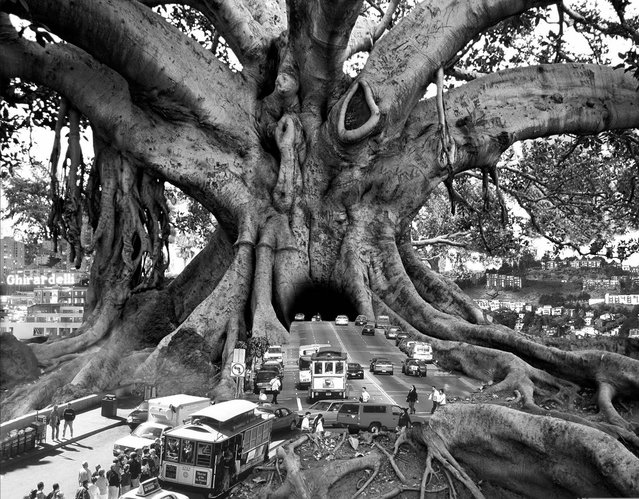
Art By Thomas Barbey

Thomas Barbèy grew up in Geneva, Switzerland, across the street from the “Caran D’ache” factory, the largest manufacturer of art supplies. He started drawing seriously at the age of 13, using black “encre de Chine” and gouaches for color.
Details
04 Feb 2013 11:36:00


“Snowflake (c. 1964 – November 24, 2003) was an albino gorilla. He was the only known albino gorilla so far, and the most popular resident of the Barcelona Zoo in Catalonia, Spain. Originally named Nfumu Ngui in Fang language ("white gorilla") by his captor, he was then nicknamed Floquet de Neu (Catalan for little snowflake) by his keeper Jordi Sabater Pi. On his arrival to Barcelona where he was given an official reception by the then Mayor of Barcelona, Josep Maria de Porcioles, in November 1966, he was called Blancanieves (“Snow White”) in the newspaper Tele/Exprés. But he became famous with the name given to him by Sabater when National Geographic Magazine featured him on the main page in March 1967, with the English name Snowflake. This name spread among the press (Stern, Life, Paris-Match) and was later translated to Spanish as Copito de Nieve. Sabater himself called the gorilla Floquet or Copi, and in the later years Nfumu. The asteroid 95962 Copito, discovered by Catalan astronomer J. Manteca, is named in his honour”.
Details
07 Mar 2011 15:50:00
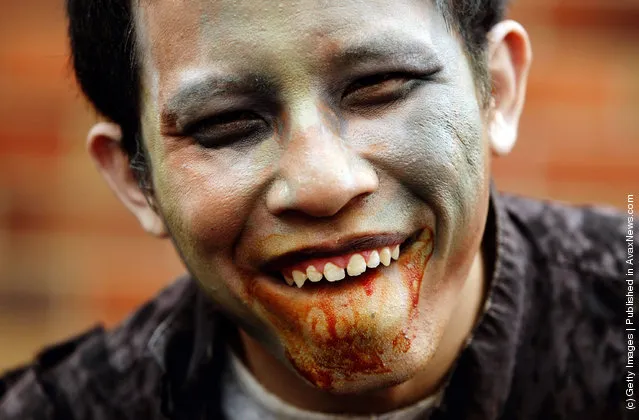
Men and women dressed as a zombie poses during the Thrill The World 2009 event

A man dressed as a zombie poses during the Thrill The World 2009 event, which sees fans from all over the world dance simultaneous to Michael Jackson's “Thriller” at Luna Park on October 25, 2009 in Sydney, Australia. (Photo by Brendon Thorne/Getty Images)
Details
19 Oct 2011 10:16:00
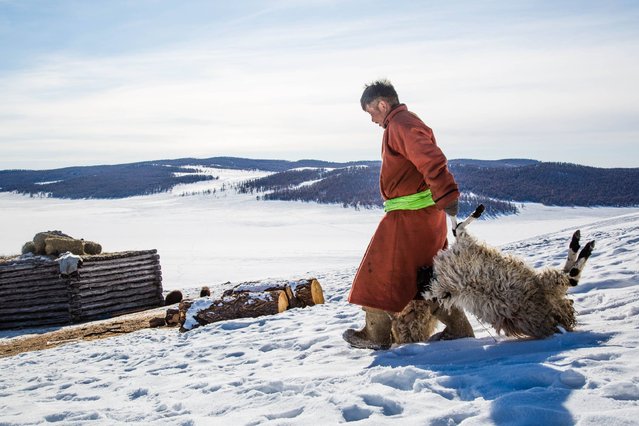
This handout photo taken on February 12, 2017 and released on February 16 by the International Federation of Red Cross and Red Crescent Societies (IFRC) shows Mongolian herder Munkhbat Bazarragchaa (C) dragging two sheep – which recently died due to the weather - to a pile of dead animals behind his “ger” in Khuvsgul province, northern Mongolia. Thousands of Mongolian herders face disastrous livestock losses from dreaded severe weather  known as the “dzud”, the Red Cross said on February 16, 2017 in launching an international emergency aid appeal. (Photo by Mirva Helenius/AFP Photo/IFRC)

This handout photo taken on February 12, 2017 and released on February 16 by the International Federation of Red Cross and Red Crescent Societies (IFRC) shows Mongolian herder Munkhbat Bazarragchaa (C) dragging two sheep – which recently died due to the weather - to a pile of dead animals behind his “ger” in Khuvsgul province, northern Mongolia. Thousands of Mongolian herders face disastrous livestock losses from dreaded severe weather known as the “dzud”, the Red Cross said on February 16, 2017 in launching an international emergency aid appeal. (Photo by Mirva Helenius/AFP Photo/IFRC)
Details
17 Feb 2017 11:40:00
In this Friday, February 1, 2019, photo, Filipino-Chinese display piggy banks at the start of celebrations leading to next week's Lunar New Year in Chinatown, Manila, Philippines. This year is the Year of the Earth Pig on the Lunar calendar and is supposed to represent abundance, diligence and generosity. (Photo by Bullit Marquez/AP Photo)

In this Friday, February 1, 2019, photo, Filipino-Chinese display piggy banks at the start of celebrations leading to next week's Lunar New Year in Chinatown, Manila, Philippines. This year is the Year of the Earth Pig on the Lunar calendar and is supposed to represent abundance, diligence and generosity. (Photo by Bullit Marquez/AP Photo)
Details
09 Feb 2019 00:05:00