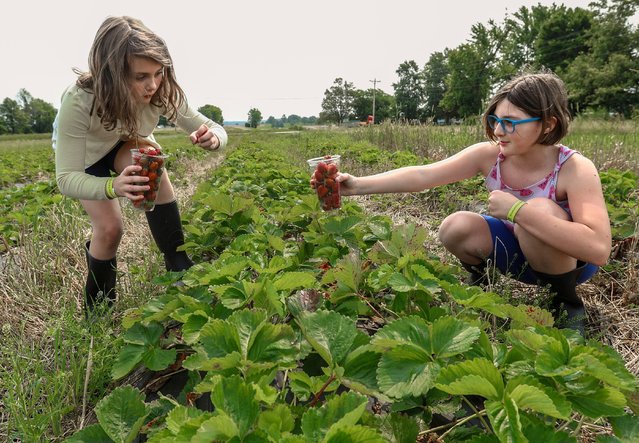
Emily clement, 9, left, and her sister, Mallory, 9, pick strawberries together at the Trunnell's Farm Market strawberry field, Saturday, May 31, 2025, in Owensboro, Ky. (Photo by USA Today)
Male members of the Zeleziar folk dance group whip and water the local girls dressed in traditional clothing, during Easter in Bociar, Slovakia on April 1, 2024. Boys and younger men visit the houses of young girls, whip them with fresh-cut decorated wickers and sprinkle water on them. By tradition, the whipping should give the girls strength, health, and abundance throughout the whole year. (Photo by Robert Nemeti/Anadolu via Getty Images)
Tattoo enthusiasts pose for a photo during the 14th Expotattoo Colombia Fair in Medellin, Colombia, on May 26, 2024. (Photo by Jaime Saldarriaga/AFP Photo)
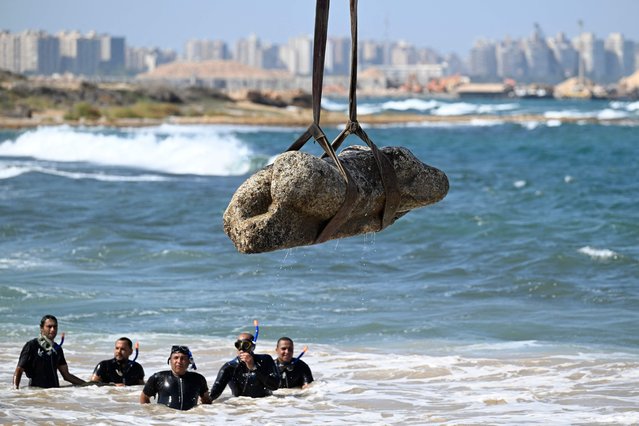
Divers watch as a crane pulls a piece of stone from the waters at Abu Qir bay in Alexandria on August 21, 2025, as part of an event organized by the Ministry of Tourism and Antiquities to recover sunken antiquities. (Photo by Khaled Desouki/AFP Photo)
Passengers embrace each other at the entrance to Istanbul's Ataturk airport, early Wednesday, June 29, 2016 following their evacuation after a blast. Suspected Islamic State group extremists have hit the international terminal of Istanbul's Ataturk airport, killing dozens of people and wounding many others, Turkish officials said Tuesday. (Photo by Emrah Gurel/AP Photo)
A participant in the Crazy Races extreme sports game competes in the cross-country obstacle race in Ufa, Russia on September 21, 2015. (Photo by TASS/Barcroft Media)
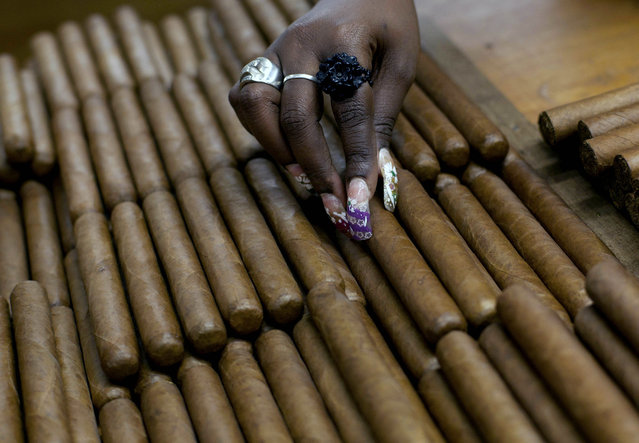
This March 1, 2013 file photo shows a worker selecting cigars at the H. Upmann cigar factory, where people can take tours as part of the 15th annual Cigar Festival in Havana, Cuba. (Photo by Ramon Espinosa/AP Photo)
This Thursday, January 22, 2015 photo made with a long exposure shows the glow from a Noctiluca scintillans algal bloom along the seashore in Hong Kong. The luminescence, also called Sea Sparkle, is triggered by farm pollution that can be devastating to marine life and local fisheries, according to University of Georgia oceanographer Samantha Joye. Noctiluca itself does not produce neurotoxins like other similar organisms do. But its role as both prey and predator tends can eventually magnify the accumulation of toxins in the food chain, according to R. Eugene Turner at Louisiana State University. (Photo by Kin Cheung/AP Photo)