Loading...
Done
Cartoon Skeletons By Hyungkoo Lee

Korean artist Hyungkoo Lee has created a series (Homo Animatus) of works featuring skeletal representations of familiar cartoon characters. He uses resin, aluminum sticks, stainless steel wires, springs, and oil paint. If you look closely, you will see the bones of our favorite childhood friends like Canis Latrans Animatus (Wile E. Coyote), Geococcyx Animatus (Roadrunner), Lepus Animatus (Bugs Bunny), Felis Catus Animatus (Tom), Mus Animatus (Jerry), Anas Animatus (Donald Duck) and his three nephews, Animatus H, D and L ( Huey, Dewey and Louie)
Details
06 May 2013 12:42:00
Mummies

Dried and shrivelled corpses, some fully clothed and some in coffins, line the wall of a vault of the Pantheon Cemetery on the summit of Cerro del Trozado in Mexico. They were removed from the crypts because of non-payment of cemetery fees. The hot dry air stopped the bodies from rotting. Most of them were placed here between the turn of the century and WW I. (Photo by Three Lions/Getty Images). Circa 1955
Details
29 Aug 2011 13:46:00


Back dropped by planet Earth the International Space Station (ISS) is seen from NASA space shuttle Endeavour after the station and shuttle began their post-undocking relative separation May 29, 2011 in space. After 20 years, 25 missions and more than 115 million miles in space, NASA space shuttle Endeavour is on the last leg of its final flight to the International Space Station before being retired and donated to the California Science Center in Los Angeles. Capt. Mark E. Kelly, U.S. Rep. Gabrielle Giffords' (D-AZ) husband, has lead mission STS-134 as it delivered the Express Logistics Carrier-3 (ELC-3) and the Alpha Magnetic Spectrometer (AMS-2) to the International Space Station. (Photo by NASA via Getty Images)
Details
01 Jun 2011 06:47:00
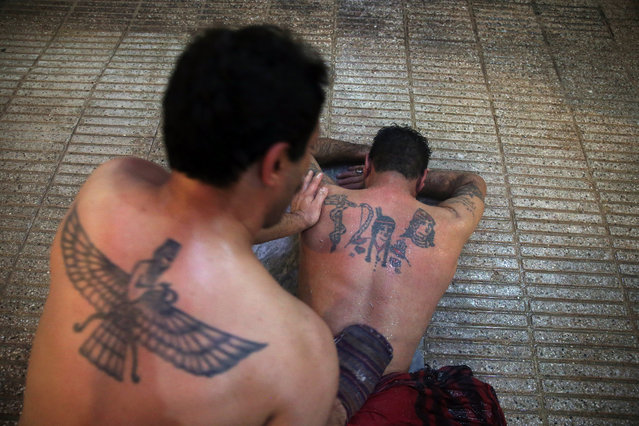
In this Friday, January 9, 2015 photo, bathhouse worker Omid Riahi, 39, scrubs a man to remove dead skin, at the Ghebleh public bathhouse, in Tehran, Iran. The steamy air and curved tiled walls of Iran's famed public bathhouses, some rinsing and massaging patrons for hundreds of years, slowly may wash away as interest in them wanes. (Photo by Ebrahim Noroozi/AP Photo)

In this Friday, January 9, 2015 photo, bathhouse worker Omid Riahi, 39, scrubs a man to remove dead skin, at the Ghebleh public bathhouse, in Tehran, Iran. The steamy air and curved tiled walls of Iran's famed public bathhouses, some rinsing and massaging patrons for hundreds of years, slowly may wash away as interest in them wanes. The bathhouses, known as “hammams” in Persian, find themselves in rough financial times as modern conveniences now allow showers and baths in most homes across the Islamic Republic. (Photo by Ebrahim Noroozi/AP Photo)
Details
03 Apr 2015 12:40:00
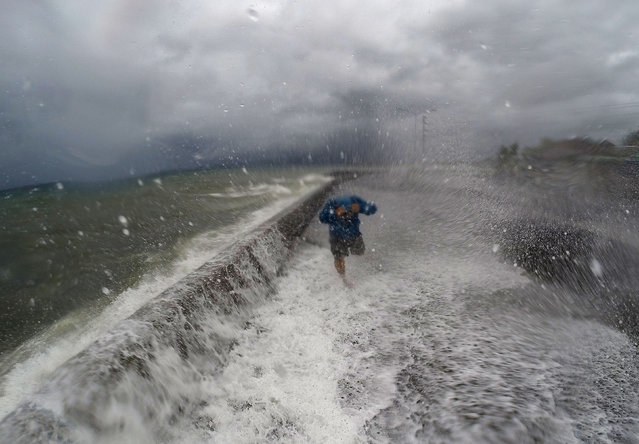
A resident walks past big waves spilling over a wall onto a coastal road in the city of Legaspi in Albay province, south of Manila on December 14, 2015, as typhoon Melor approaches the city. More than 700,000 people fled the central Philippines amid threats of giant waves, floods and landslides as powerful Typhoon Melor approached the archipelago nation, officials said December 14. (Photo by Charism Sayat/AFP Photo)

A resident walks past big waves spilling over a wall onto a coastal road in the city of Legaspi in Albay province, south of Manila on December 14, 2015, as typhoon Melor approaches the city. More than 700,000 people fled the central Philippines amid threats of giant waves, floods and landslides as powerful Typhoon Melor approached the archipelago nation, officials said December 14. (Photo by Charism Sayat/AFP Photo)
Details
15 Dec 2015 11:34:00
A woman poses for a picture as bunches of paprika hang on the walls of her house to dry in the village of Donja Lakosnica, Serbia October 6, 2016. Donja Lokosnica is the Serbian “capital of paprika”, since almost all of the 1300 inhabitants are involved in growing paprika. As autumn approaches, the whole village turns red, because of many threads of dried peppers, that hang around Lokosnica, waiting for their winter use. Each of these paprika threads is handmade, still dried according to traditional techniques, assisted solely by the sun and fresh air. (Photo by Marko Djurica/Reuters)

A woman poses for a picture as bunches of paprika hang on the walls of her house to dry in the village of Donja Lakosnica, Serbia October 6, 2016. Donja Lokosnica is the Serbian “capital of paprika”, since almost all of the 1300 inhabitants are involved in growing paprika. As autumn approaches, the whole village turns red, because of many threads of dried peppers, that hang around Lokosnica, waiting for their winter use. Each of these paprika threads is handmade, still dried according to traditional techniques, assisted solely by the sun and fresh air. (Photo by Marko Djurica/Reuters)
Details
08 Oct 2016 12:04:00
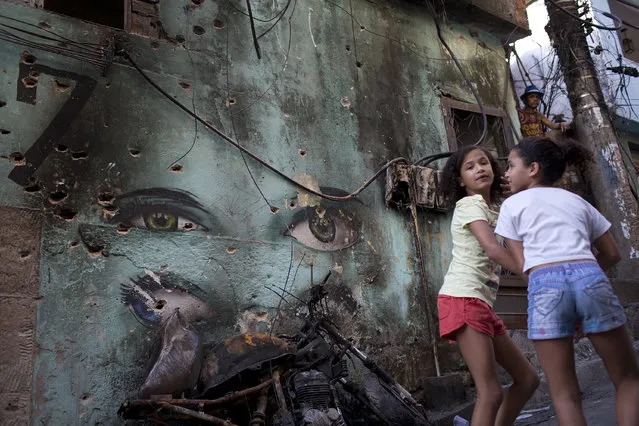
In this September 27, 2017 file photo, girls walk past a wall riddled with bullet holes from shootings between rival drug traffickers, at the Rocinha slum, in Rio de Janeiro, Brazil. Violence is on the rise in Rio's slums after several years of decline, and the killings of kids have shocked even residents long inured to deaths from gangs and police. (Photo by Silvia Izquierdo/AP Photo)

In this September 27, 2017 file photo, girls walk past a wall riddled with bullet holes from shootings between rival drug traffickers, at the Rocinha slum, in Rio de Janeiro, Brazil. Violence is on the rise in Rio's slums after several years of decline, and the killings of kids have shocked even residents long inured to deaths from gangs and police. (Photo by Silvia Izquierdo/AP Photo)
Details
16 Oct 2017 09:13:00
Picture shows a mural painting in Ferrol, on September 2, 2018, during the annual street art festival “Meninas de Canido” set up in 2008 to breathe new life in a dying neighborhood. Angry at the announced death of his neighborhood, Canido, in Ferrol, Eduardo Hermida painted his version of Velazquez's “Meninas” on a wall. An act of protest that gave birth to a festival and gave new colors to this city of Galicia. (Photo by Miguel Riopa/AFP Photo)

Picture shows a mural painting in Ferrol, on September 2, 2018, during the annual street art festival “Meninas de Canido” set up in 2008 to breathe new life in a dying neighborhood. Angry at the announced death of his neighborhood, Canido, in Ferrol, Eduardo Hermida painted his version of Velazquez's “Meninas” on a wall. An act of protest that gave birth to a festival and gave new colors to this city of Galicia. (Photo by Miguel Riopa/AFP Photo)
Details
02 Nov 2018 00:01:00