Loading...
Done
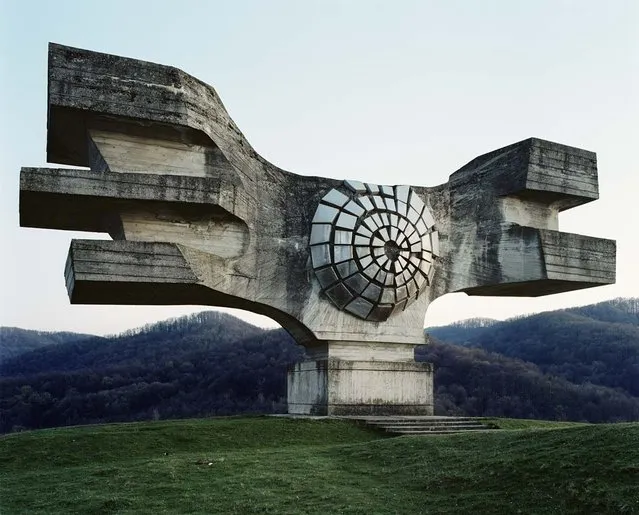
The monument of Ilirska Bistrica was designed by Janez Lenassi and built in 1965. It is dedicated to Slovenian soldiers that fell in World War II. (Photo by Jan Kempenaers)

The brutalist war memorials found throughout the former Yugoslavia were weird enough when they were built in the 1960s and 70s. Today, separated by the end of an architectural movement and the disintegration of the country, they seem almost alien. Belgian photographer Jan Kempenaers treats them purely as artistic objects in his book, “Spomenik”, named for the Serb-Croat word for monument. Known for photographing geographical oddities, Kempenaers was captivated by the spomenik after seeing them in an art encyclopedia. After hearing that many had been destroyed or abandoned, he set out to record what was left. (Photo by Jan Kempenaers)
Details
18 Aug 2014 09:07:00
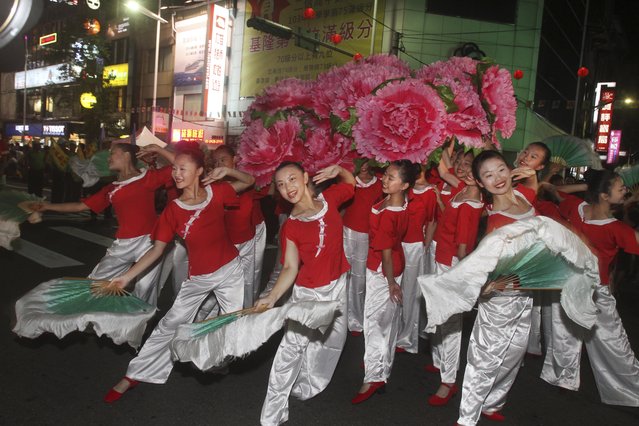
In this photo made late Saturday, August 9, 2014, in Keelung, Taiwan, a traditional Chinese dance troupe performs during a parade marking the beginning of the Chinese folklore's mid-summer's Ghost Month Festival. (Photo by Chiang Ying-ying/AP Photo)

In this photo made late Saturday, August 9, 2014, in Keelung, Taiwan, a traditional Chinese dance troupe performs during a parade marking the beginning of the Chinese folklore's mid-summer's Ghost Month Festival. Fourteen days into the seventh month of the lunar calendar, August 9, in 2014, marks the traditional Chinese Ghost Month where the gates of the underworld are opened and spirits of the deceased are set free to roam the world of the living. The month long festivities are aimed to please the roaming spirits. (Photo by Chiang Ying-ying/AP Photo)
Details
12 Aug 2014 11:57:00
Larissa Neto, a muse of the Unidos da Tijuca Samba School, poses as she wears a carnival dress in Sao Goncalo near Rio de Janeiro, Brazil, February 3, 2016. (Photo by Ricardo Moraes/Reuters)

Larissa Neto, a muse of the Unidos da Tijuca Samba School, poses as she wears a carnival dress in Sao Goncalo near Rio de Janeiro, Brazil, February 3, 2016. Rio de Janeiro's carnival parades are known the world over for the glitz and glamour, high-tech allegorical floats and shimmering bodies, which battle it out each year for the championship title. Each school is fronted by the Queen of the Drums, who dances alongside the raging percussion, and her court of sparkling, sculpted dancers known as “muses”. (Photo by Ricardo Moraes/Reuters)
Details
05 Feb 2016 10:52:00
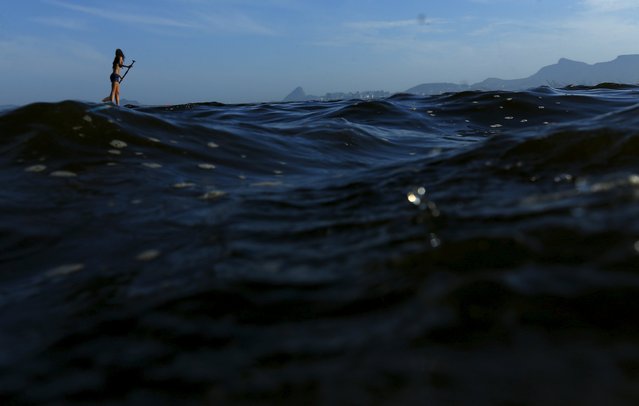
A girl paddles on her stand-up board on the waters of Guanabara bay at Bica beach in Rio de Janeiro Brazil, January 10, 2016. (Photo by Ricardo Moraes/Reuters)

A girl paddles on her stand-up board on the waters of Guanabara bay at Bica beach in Rio de Janeiro Brazil, January 10, 2016. Few features capture the beauty, or the problems, of one of the world's most dramatic urban landscapes like Guanabara Bay - the finger-like inlet that forms the shoreline and harbor for Rio de Janeiro. The bay, which carves into southeast Brazil from the Atlantic Ocean, literally gave Rio its name when Portuguese mariners mistook it for a “rio”, or “river”. Four centuries later, the bay is preparing to welcome another sort of seafarer – Olympic sailors, who will navigate the bay when the 2016 Rio Olympics kick off in August. (Photo by Ricardo Moraes/Reuters)
Details
28 Apr 2016 12:13:00
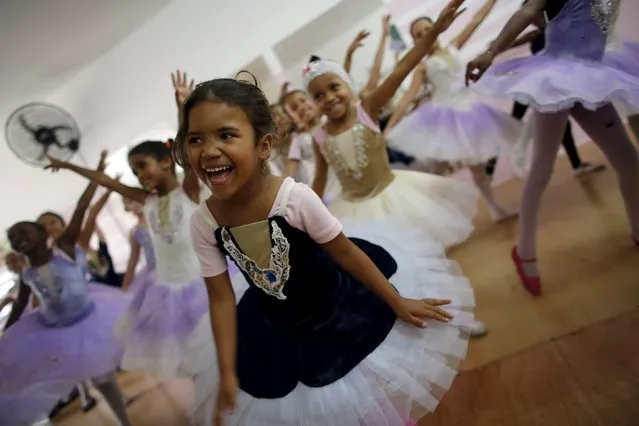
Young girls take ballet lessons at the New Dreams dance studio in the Luz neighborhood known to locals as Cracolandia (Crackland) in Sao Paulo, Brazil, August 14, 2015. (Photo by Nacho Doce/Reuters)

Young girls take ballet lessons at the New Dreams dance studio in the Luz neighborhood known to locals as Cracolandia (Crackland) in Sao Paulo, Brazil, August 14, 2015. For the young girls learning to jump and plie, the dance studio provides a way forward and out of the difficult environment they have grown up in. Brazil is one of the world's highest consuming countries of crack cocaine, and Cracolandia, or “Crack Land”, located in the outskirts of Sao Paulo, is one of the most intense and brutal hubs. (Photo by Nacho Doce/Reuters)
Details
18 Aug 2015 13:59:00
“So you're on a boat in Bahamas and then this pig swims by begging for food”. (Photo and caption by Lisa Larsen/Public Domain)

The Bahamas, the Commonwealth nation of hundreds of islands roughly the size of Connecticut and with population of just a bit over Anaheim, is known for its crystal waters and pristine beaches. This is possibly one of the world’s most beautiful havens of nature, yet people are coming here to see pigs. It is unclear when the pigs first appeared on Exuma Island or where they come from. There’s talk about a daring escape from a shipwreck, or sailors releasing the swine on purpose. In all probability, there were no pigs on this tropical paradise before European settlers came, so their mere presence is the work of human. The intriguing feat of nature, however, is that this population of pigs developed a fine aptitude for swimming. Here: “So you're on a boat in Bahamas and then this pig swims by begging for food”. (Photo and caption by Lisa Larsen/Public Domain)
Details
03 Sep 2015 11:53:00
Two styles of cleaned bird's nest, Yan Zhan (L) and Su Zhan (R) await repacking at a processing plant in Kuala Lumpur, February 17, 2015. Prized in China for is alleged health benefits for hundreds of years, nests made from swiftlets' saliva are being mixed into coffee and cereal as the Southeast Asian producers of the delicacy seek to broaden its appeal, and their profit margins. (Photo by Olivia Harris/Reuters)

Two styles of cleaned bird's nest, Yan Zhan (L) and Su Zhan (R) await repacking at a processing plant in Kuala Lumpur, February 17, 2015. Prized in China for is alleged health benefits for hundreds of years, nests made from swiftlets' saliva are being mixed into coffee and cereal as the Southeast Asian producers of the delicacy seek to broaden its appeal, and their profit margins. The nests are among the world's most expensive foods, selling for up to $2,500 a kg and the swiftlets that weave them are indigenous to Indonesia, Malaysia, Thailand and Vietnam. (Photo by Olivia Harris/Reuters)
Details
24 Feb 2015 13:57:00
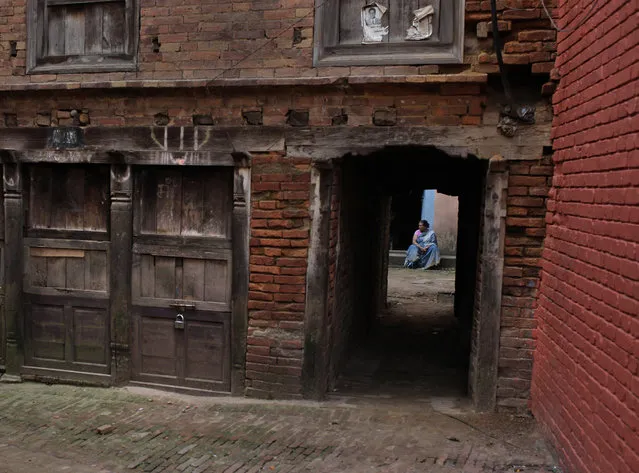
A Nepalese woman sits inside her house in an alley of Bhaktapur, 12 kilometers (7.5 miles) east of Kathmandu, Monday, May 25, 2015, one month after the deadly 7.8 magnitude earthquake hit Nepal. (Photo by Niranjan Shrestha/AP Photo)

A Nepalese woman sits inside her house in an alley of Bhaktapur, 12 kilometers (7.5 miles) east of Kathmandu, Monday, May 25, 2015, one month after the deadly 7.8 magnitude earthquake hit Nepal. Two powerful earthquakes devastated Nepal on April 25 and May 12, killing nearly 8,700 people and injuring 16,800 others. The quakes and aftershocks also triggered many landslides in the Himalayan nation, which boasts eight of the world's highest mountains gets about half a million tourists every year, with many coming to trek the Himalayan nation's scenic mountain trails. (Photo by Niranjan Shrestha/AP Photo)
Details
27 May 2015 00:06:00