A bucket of water is splashed on a woman during the Songkran water festival to celebrate the Thai New Year, in Prachinburi Province, Thailand, April 13, 2024. (Photo by Wason Wanichakorn/AP Photo)
Jasmine Paolini hits a forehand during her first-round US Open match on Sunday, August 24, 2025 at USTA Billie Jean King National Tennis Center in the Flushing neighborhood of the Queens borough of New York City. (Photo by Ray Giubilo)
Monae' Nichols of the United States competes in the preliminary round of the long jump competition during ATHLOS NYC25 on October 09, 2025 at Times Square in New York City. (Photo by Emilee Chinn/Athlos/Getty Images)
Participants compete to do nothing during the Space-out competition at World Expo 2025 on September 27, 2025 in Osaka, Japan. For 90 minutes, participants sat in silence, trying to remain in a dazed state without distraction. The winner was determined not by activity but by calmness maintaining the most stable heart rate amid the lively crowds of the Osaka Expo site. (Photo by Tomohiro Ohsumi/Getty Images)
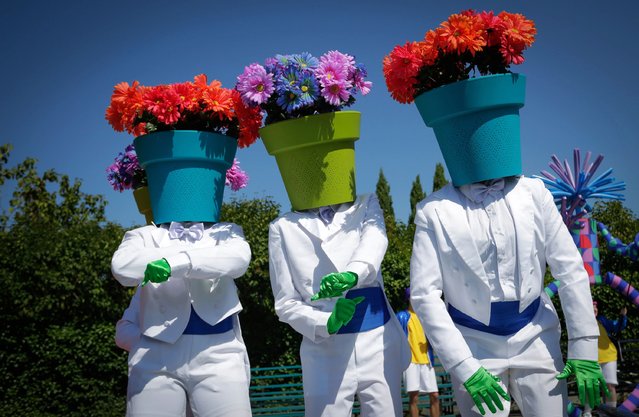
Performers dressed with flower pots on their heads perform during a media preview of the Pacific National Exhibition Fair in Vancouver, British Columbia, Canada, August 15, 2024. Marking its 114th year, the Pacific National Exhibition (PNE) Fair, one of the longest running events in Canada, runs from Aug. 17 to Sept. 2 here this year. (Photo by Xinhua News Agency/Rex Features/Shutterstock)
On August 31, 2012, a long filament of solar material that had been hovering in the sun's atmosphere, the corona, erupted out into space at 4:36 p.m. EDT. The coronal mass ejection, or CME, traveled at over 900 miles per second. The CME did not travel directly toward Earth, but did connect with Earth's magnetic environment, or magnetosphere, causing aurora to appear on the night of Monday, September 3. (Photo by NASA/GSFC/SDO via The Atlantic)
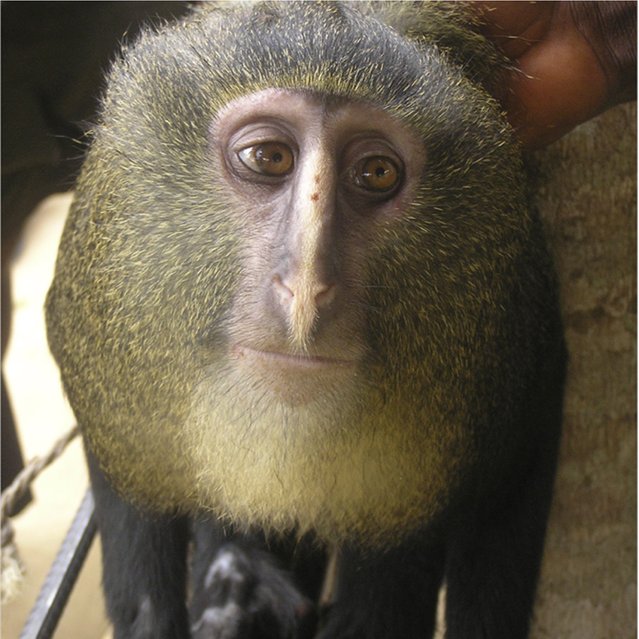
A new species of monkey found in the Democratic Republic of the Congo and identified as Lesula (Cercopithecus lomamiensis) is seen in this undated photograph from an article published September 12, 2012 in the science journal PLOS One. The monkey was first seen in 2007 by researchers John and Terese Hart of the Peabody Museum of Natural History at Yale Research Project. The finding of C. lomamiensis represents only the second new species of African monkey to be discovered in the past 28 years, according to the research article. (Photo by Hart J. A., Detwiler K. M., Gilbert C. C./Reuters)