Loading...
Done
Danish football fans react to their team's first goal as they watch the UEFA EURO 2020 semi-final football match between England and Denmark on the giant screen in Tivoli in Copenhagen, on July 7, 2021. (Photo by Mads Claus Rasmussen/Ritzau Scanpix via AFP Photo)

Danish football fans react to their team's first goal as they watch the UEFA EURO 2020 semi-final football match between England and Denmark on the giant screen in Tivoli in Copenhagen, on July 7, 2021. (Photo by Mads Claus Rasmussen/Ritzau Scanpix via AFP Photo)
Details
08 Jul 2021 10:32:00
A skater observes pancakes snow on the frozen Lake des Rousses in Les Rousses, central-eastern France, on January 1, 2025. This phenomenon forms when slushy ice in water clumps into round, pancake-like shapes due to waves or currents. (Photo by Fabrice Coffrini/AFP Photo)

A skater observes pancakes snow on the frozen Lake des Rousses in Les Rousses, central-eastern France, on January 1, 2025. This phenomenon forms when slushy ice in water clumps into round, pancake-like shapes due to waves or currents. (Photo by Fabrice Coffrini/AFP Photo)
Details
17 Apr 2025 00:08:00
The Brocken specter or mountain spectre phenomenon, where the shadow of an observer is magnified and cast on a cloud opposite from the sun or bright light source, is observed on the Howgills, outside Sedbergh, Britain, on December 26, 2024. (Photo by Suzanne Plunkett/Reuters)

The Brocken specter or mountain spectre phenomenon, where the shadow of an observer is magnified and cast on a cloud opposite from the sun or bright light source, is observed on the Howgills, outside Sedbergh, Britain, on December 26, 2024. (Photo by Suzanne Plunkett/Reuters)
Details
19 Apr 2025 00:25:00
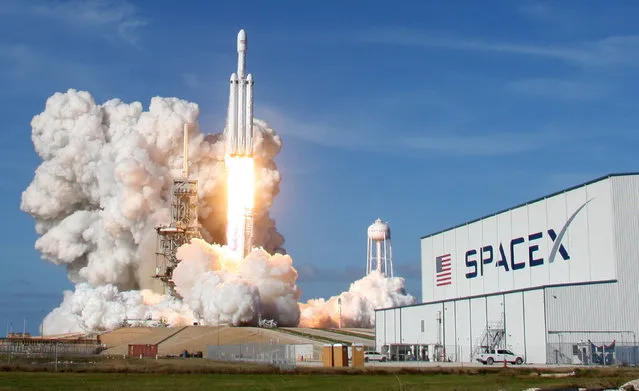
A SpaceX Falcon Heavy rocket lifts off from historic launch pad 39-A at the Kennedy Space Center in Cape Canaveral, Florida, February 6, 2018. (Photo by Thom Baur/Reuters)

A SpaceX Falcon Heavy rocket lifts off from historic launch pad 39-A at the Kennedy Space Center in Cape Canaveral, Florida, February 6, 2018. The world' s most powerful rocket, SpaceX' s Falcon Heavy, blasted off Tuesday on its highly anticipated maiden test flight, carrying CEO Elon Musk' s cherry red Tesla roadster to an orbit near Mars. Screams and cheers erupted at Cape Canaveral, Florida as the massive rocket fired its 27 engines and rumbled into the blue sky over the same NASA launchpad that served as a base for the US missions to Moon four decades ago. (Photo by Thom Baur/Reuters)
Details
07 Feb 2018 08:40:00


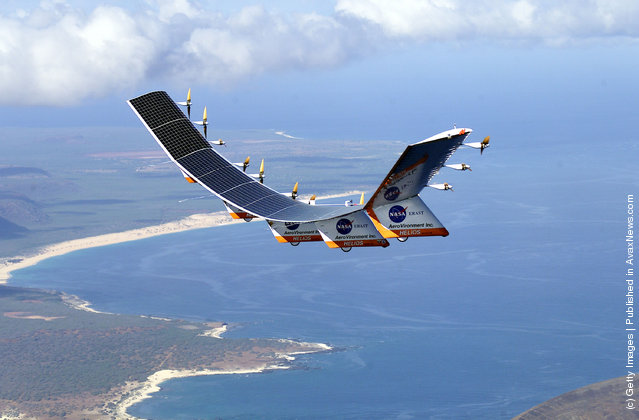
“NASA's Pathfinder, Pathfinder Plus, Centurion and Helios Prototype were an evolutionary series of solar- and fuel-cell-system-powered unmanned aerial vehicles. AeroVironment, Inc. developed the vehicles under NASA's Environmental Research Aircraft and Sensor Technology (ERAST) program. They were built to develop the technologies that would allow long-term, high-altitude aircraft to serve as “atmospheric satellites”, to perform atmospheric research tasks as well as serve as communications platforms”. – Wikipedia

Photo: The solar-electric Helios Prototype flying wing is flies over the Hawaiian islands of Niihau and Lehua during the first solar-powered test flight July 14, 2001 from the U.S. Navy's Pacific Missile Range Facility on Kauai, HI. The 18-hour flight was a functional checkout of the aircraft's systems and performance in preparation for an attempt to reach sustained flight at 100,000 feet altitude later in the summer. (Photo Courtesy of NASA/Getty Images)
Details
14 Jul 2011 09:24:00
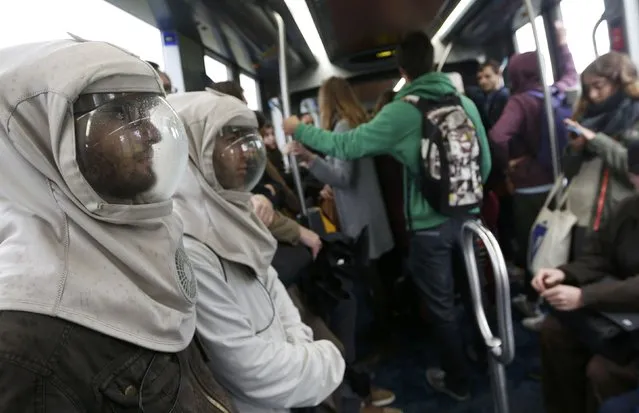
French twins Thomas and Vincent (L) Seris take the tram in Bordeaux, November 12, 2014. Born with Xeroderma Pigmentosum (XP), the twins cannot be exposed to the sun and its ultraviolet (UV) light, which could provoke precocious cancers due to an autosomal recessive genetic disorder of DNA repair. (Photo by Regis Duvignau/Reuters)

French twins Thomas and Vincent (L) Seris take the tram in Bordeaux, November 12, 2014. Born with Xeroderma Pigmentosum (XP), the twins cannot be exposed to the sun and its ultraviolet (UV) light, which could provoke precocious cancers due to an autosomal recessive genetic disorder of DNA repair. Colloquially referred to as Children of the Night (Les Enfants de la Lune) the Seris twins are among 70 to 80 people in France who suffer from the genetic defect. The French association “Les Enfants de la Lune” reports that there are between five and ten thousand such cases in the world. Thomas and Vincent have been testing a new protective mask for the last year which is transparent and ventilated and developed by several hospitals in France. (Photo by Regis Duvignau/Reuters)
Details
01 Feb 2015 10:27:00
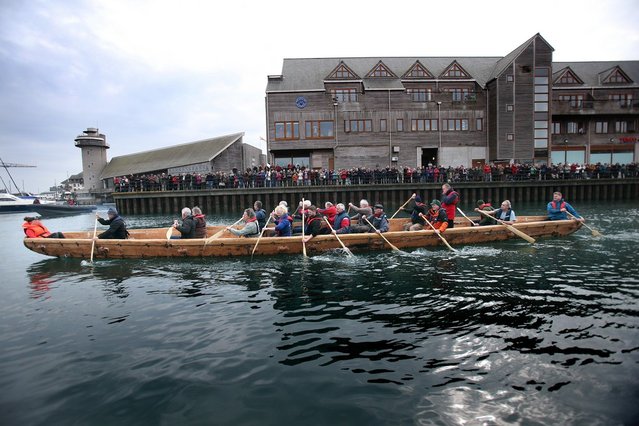
Crew in Britain's first ever full-size reconstructed sea-going Bronze Age boat, paddle out to sea near to the National Maritime Museum as it makes its maiden voyage on March 6, 2013 in Falmouth, England. With a crew of of 18, equipped with Bronze-Age-style wooden paddles, the 15 metre long experimental vessel – a replica of the sort of craft used for long-distance trade between Britain and the continent 4000 years ago – will be used to test prehistoric seafaring methods in a project in collaboration with the University of Exeter and the Falmouth-based National Maritime Museum Cornwall. (Photo by Matt Cardy)

Crew in Britain's first ever full-size reconstructed sea-going Bronze Age boat, paddle out to sea near to the National Maritime Museum as it makes its maiden voyage on March 6, 2013 in Falmouth, England. (Photo by Matt Cardy)
Details
07 Mar 2013 08:48:00
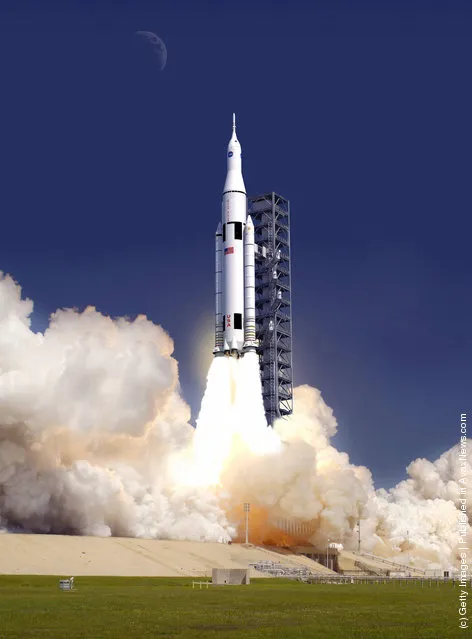
NASA's New Space Launch System

“The Space Launch System, or SLS, is a Shuttle-Derived heavy launch vehicle being designed by NASA, following the cancellation of the Constellation Program, to replace the Space Shuttle after its retirement. The NASA Authorization Act of 2010 envisions the transformation of the Ares I and Ares V vehicle designs into a single launch vehicle usable for both crew and cargo. It is to be upgraded over time with more powerful versions. The proposed SLS is visually similar to the legacy Saturn V booster and in particular the proposed, two-stage, Saturn INT-20”. – Wikipedia

Photo: In this illustration provided by NASA, the design for a new space rocket system, the Space Launch System, is seen. NASA's new rocket design will reportedly cost about $35 billion and be ready to for test launch in 2017. According to NASA, the rocket will be used to carry Orion Multi-Purpose Crew Vehicle as well as cargo and science experiments to earth's orbit, as a backup for the space station and possibly destinations beyond that. (Illustration by NASA via Getty Images)

Details
15 Sep 2011 10:50:00