Loading...
Done
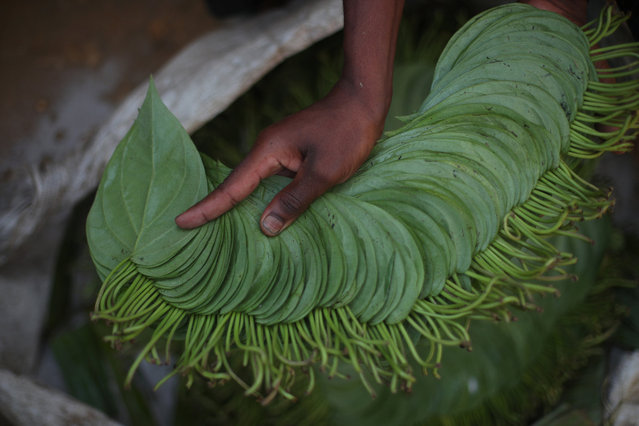
Faruk, 17, a Rohingya refugee trader holds betel leaves which are on sale at a stall in Palong Khali refugee camp near Cox's Bazar, Bangladesh, November 3, 2017. He left his village in Myanmar when the military opened fire towards the Rohingya. “I buy this betel leaf from Palong Khali market, in one bundle there are 160 pieces, I buy it for 80 taka and I sell it for 100 taka. Bangladeshi's and I sell for the same rate in the camp. Outside in the local market it is 80 taka per bundle. My problem is that I don't have money so I can't buy anything to eat, I can't buy fish to eat”, he said. (Photo by Hannah McKay/Reuters)

Faruk, 17, a Rohingya refugee trader holds betel leaves which are on sale at a stall in Palong Khali refugee camp near Cox's Bazar, Bangladesh, November 3, 2017. He left his village in Myanmar when the military opened fire towards the Rohingya. “I buy this betel leaf from Palong Khali market, in one bundle there are 160 pieces, I buy it for 80 taka and I sell it for 100 taka (1 Bangladeshi Taka = 0.012 US Dollar). Bangladeshi's and I sell for the same rate in the camp. Outside in the local market it is 80 taka per bundle. My problem is that I don't have money so I can't buy anything to eat, I can't buy fish to eat”, he said. (Photo by Hannah McKay/Reuters)
Details
27 Nov 2017 08:54:00
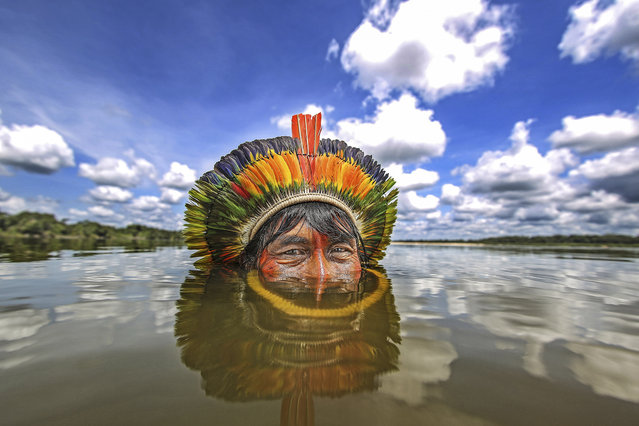
Bej indian in the Xingu river, state of Mato Grosso, Brazil on December 20, 2015 .(Photo by Ricardo Stuckert/Caters News Agency)

These images offer a rare glimpse of life within remote Brazilian tribes. Award winning photographer Ricardo, 47, said: “The pictures show the traditional way of life of these people who live in harmony with nature. The photos provide an overview of the contemporary situation of the indigenous people in Brazil”. Here: Bej indian in the Xingu river, state of Mato Grosso, Brazil on December 20, 2015 .(Photo by Ricardo Stuckert/Caters News Agency)
Details
12 Dec 2017 06:46:00
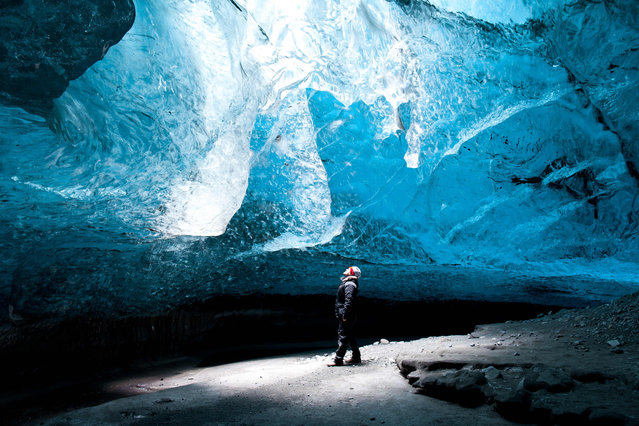
A wide view of Rob Lott  in the crystal ice cave in the Vatnajokull Glacier, Iceland. (Photo by Rob Lott/Barcroft Media)

Shimmering clearest blue and stretching as far as the eye can see, this is one of Iceland's famed crystal ice caves. The giant solid waves look frozen in time but they are slowly moving along as part of the Vatnajokull Glacier – which stretches across eight per cent of the island. The images were captured in February 2014 by British photographer Rob Lott, 49. Photo: A wide view of Rob Lott in the crystal ice cave in the Vatnajokull Glacier, Iceland. (Photo by Rob Lott/Barcroft Media)
Details
17 Mar 2014 08:26:00
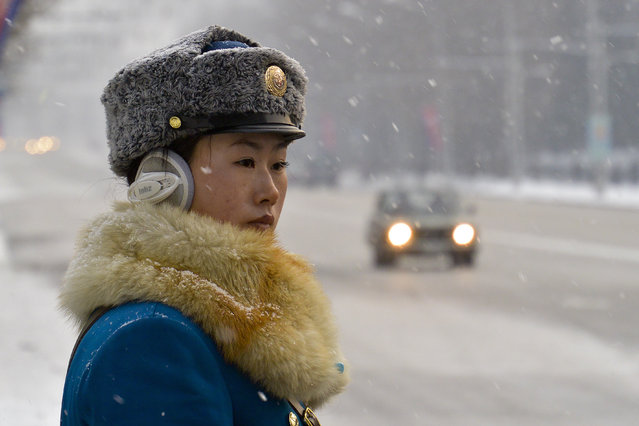
A female traffic police officer in the snow in February 2013, in Pyongyang, North Korea. (Photo by Andrew Macleod/Barcroft Media)

North Korea has closed its borders in fear of the spread of the Ebola virus. But at a time when the secretive state was still welcoming tourists, former aid worker Andrew Macleod made the journey to the repressive nation. Andrew's holiday snaps and camera footage provide a unique insight into the reclusive country, where he came across deserted motorways, metro stations plastered with propaganda and attractive border guards. Here: a female traffic police officer in the snow in February 2013, in Pyongyang, North Korea. (Photo by Andrew Macleod/Barcroft Media)
Details
06 Nov 2014 09:11:00
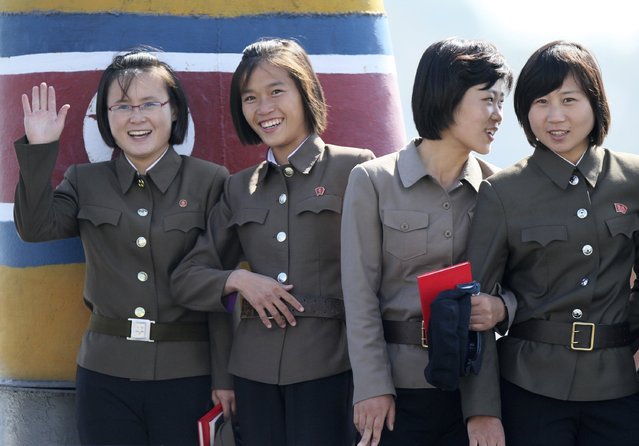
North Korean soldiers wave along the Yalu River, near the North Korean town of Sinuiju, opposite to the Chinese border city of Dandong October 7, 2014. (Photo by Jacky Chen/Reuters)

North Korean soldiers wave along the Yalu River, near the North Korean town of Sinuiju, opposite to the Chinese border city of Dandong October 7, 2014. (Photo by Jacky Chen/Reuters)
Details
10 Oct 2014 12:34:00
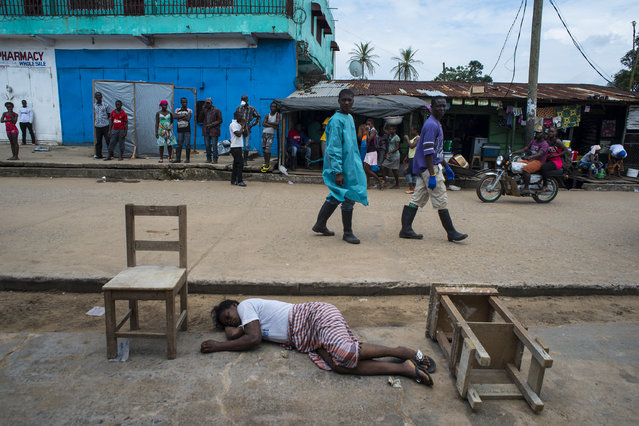
A woman lays dead outside the Redemption Hospital on Saturday September 20, 2014 in Monrovia, Liberia. Ebola patients come to the hospital, which has become a transfer and holding center to intake Ebola patients, but there is no space and some die while waiting outside. Redemption is located in one of the poorest neighborhoods of Monrovia that locals call "New Kru Town”. (Photo by Michel du Cille/The Washington Post)

A woman lays dead outside the Redemption Hospital on Saturday September 20, 2014 in Monrovia, Liberia. Ebola patients come to the hospital, which has become a transfer and holding center to intake Ebola patients, but there is no space and some die while waiting outside. Redemption is located in one of the poorest neighborhoods of Monrovia that locals call "New Kru Town”. Health workers are overwhelmed with a constant stream of new patients since the Ebola outbreak. (Photo by Michel du Cille/The Washington Post)
Details
16 Oct 2014 12:59:00
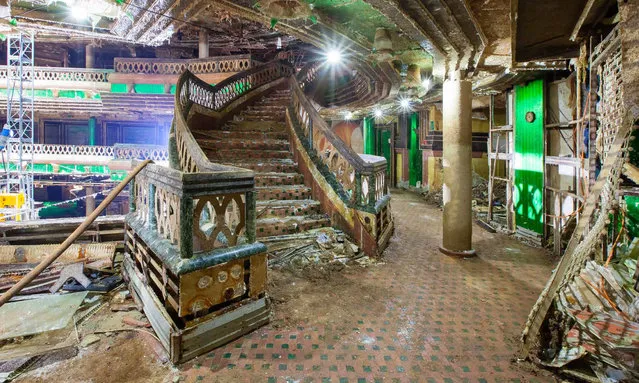
Extraordinary images of the cruise ship by Jonathan Danko Kielkowski from his book Concordia, published by White Press. The German photographer swam out to where the ship – which ran aground off Tuscany in 2012 with the loss of 32 lives – is moored. Francesco Schettino, the ship’s captain, was jailed for 16 years over the accident. (Photo by Jonathan Danko Kielkowski)

Extraordinary images of the cruise ship by Jonathan Danko Kielkowski from his book Concordia, published by White Press. The German photographer swam out to where the ship – which ran aground off Tuscany in 2012 with the loss of 32 lives – is moored. Francesco Schettino, the ship’s captain, was jailed for 16 years over the accident. (Photo by Jonathan Danko Kielkowski)
Details
23 Jan 2016 13:34:00
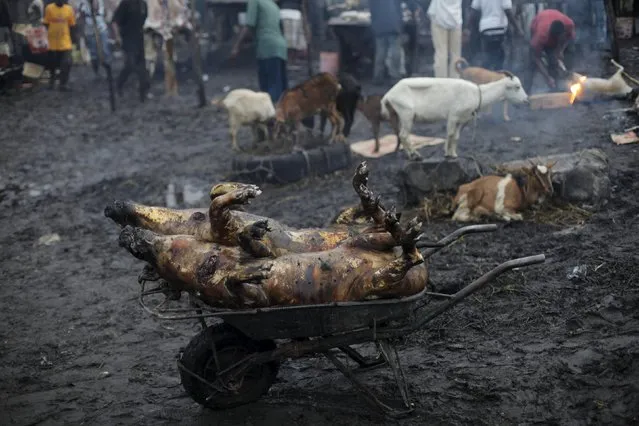
A wheelbarrow loaded with two butchered pigs is seen at La Saline slaughterhouse in Port-au-Prince, Haiti, March 19, 2015. Reuters photographer Andres Martinez Casares: “The grunts of a pig or the bleating of a goat are one thing. Then there's the sound of animals about to be killed. That's something else. If you haven't heard that before, it's quite something. It's very early in the morning when this happens, well before dawn. Day after day, it's the same toil over and over again”. (Photo by Andres Martinez Casares/Reuters)

A wheelbarrow loaded with two butchered pigs is seen at La Saline slaughterhouse in Port-au-Prince, Haiti, March 19, 2015. Reuters photographer Andres Martinez Casares: “The grunts of a pig or the bleating of a goat are one thing. Then there's the sound of animals about to be killed. That's something else. If you haven't heard that before, it's quite something... (Photo by Andres Martinez Casares/Reuters)
Details
30 Jan 2016 13:10:00