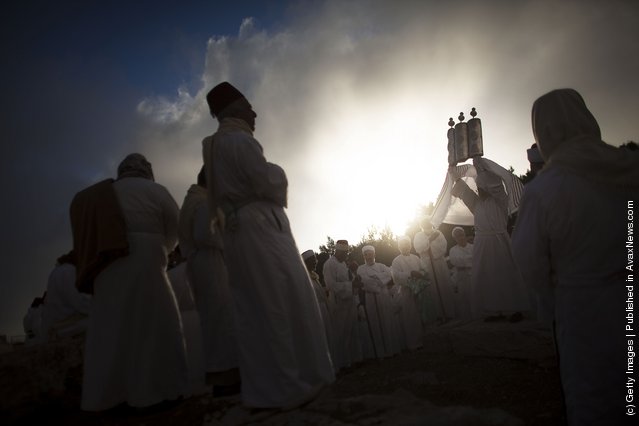
A priest of the ancient Samaritan community, wrapped in a prayer shawl, holds up a Tora scroll as worshippers pray during the holy day of Shavuot on Mount Gerizim on June 12, 2011 in Nablus, West Bank. Shavuot is a Jewish religious holiday and commemorates the anniversary of the day God is said to have given the Torah to the Israelites. (Photo by Uriel Sinai/Getty Images)
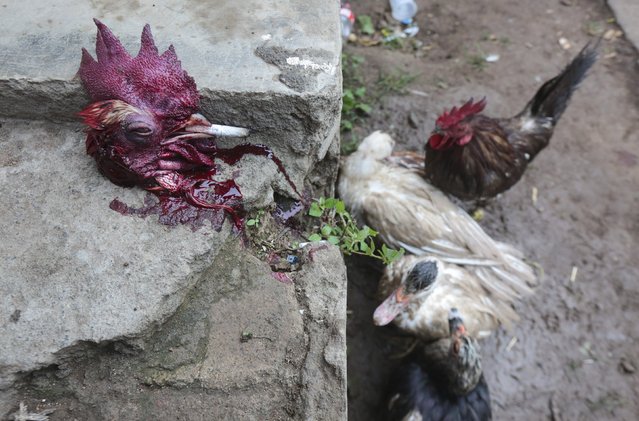
The head of a decapitated rooster is pictured after a rooster run, during celebrations in honour of San Juan Bautista in San Juan de Oriente town, Nicaragua, June 26, 2015. The rooster runs, where horse-riders try to pull the head off live roosters, symbolize the beheading of John the Baptist. (Photo by Oswaldo Rivas/Reuters)
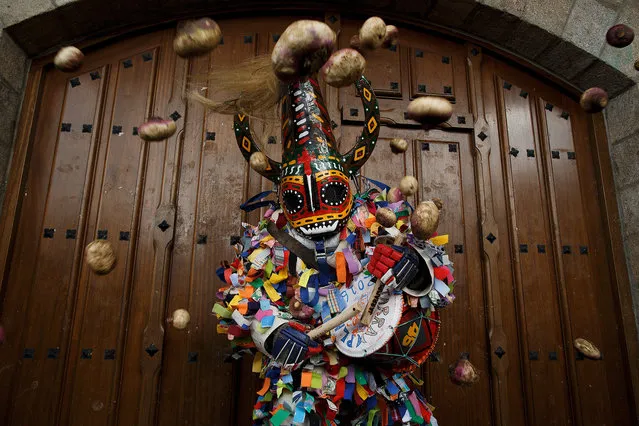
People throw turnips at the Jarramplas as he comes out from the church beating his drum during the Jarramplas Festival on January 20, 2016 in Piornal, Caceres province, Spain. The centuries old Jarramplas festival takes place annually every January 19-20 on Saint Sebastian Day and this year they expect to use more than 20 thousand kilogrames of turnips. Even though the exact origins of the festival are not known, various theories exist including the mythological punishment of Caco by Hercules, a relation to ceremonies celebrated by the American Indians that were seen by the first conquerors, to a cattle thief ridiculed and expelled by his village neighbours. It is generally believed to symbolize the expulsion of everything bad. (Photo by Pablo Blazquez Dominguez/Getty Images)
A woman tries to eat a water bug at a bar in downtown Tokyo, Japan, February 12, 2017. A Tokyo bar on Sunday offered courageous couples and curious gourmets a special menu of desserts and drinks made with insects ahead of Tuesday's holiday. (Photo by Toru Hanai/Reuters)
Fireworks light the sky over Copacabana beach during New Year's Eve celebrations in Rio de Janeiro, Brazil, Thursday, January 1, 2016. (Photo by Mauro Pimentel/AP Photo)
Pope Benedict XVI arrives at the Santa Sabina Basilica for the Ash Wednesday service on March 9, 2011 in Rome, Italy. Ash Wednesday opens the liturgical 40-day period of Lent, a period of prayer, fasting, penitence and alms giving leading up to Easter.