Loading...
Done
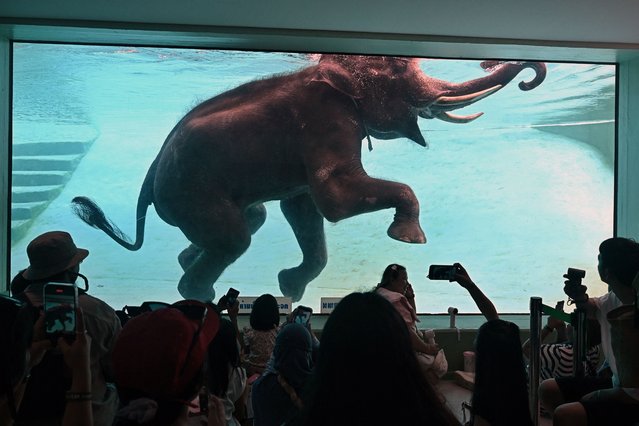
A captive elephant is made to swim for visitors at Khao Kheow Open Zoo in Chonburi province, Thailand on September 15, 2024. (Photo by Lillian Suwanrumpha/AFP Photo)

A captive elephant is made to swim for visitors at Khao Kheow Open Zoo in Chonburi province, Thailand on September 15, 2024. (Photo by Lillian Suwanrumpha/AFP Photo)
Details
22 Sep 2024 03:35:00
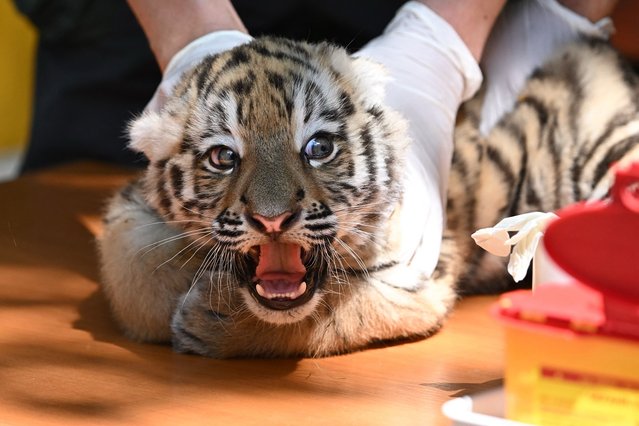
One of the Siberian tiger twins, born on April 13, 2025, is presented to the press at the Budapest zoo and botanic garden, on June 12, 2025 during their first veterinary examination. (Photo by Attila Kisbenedek/AFP Photo)

One of the Siberian tiger twins, born on April 13, 2025, is presented to the press at the Budapest zoo and botanic garden, on June 12, 2025 during their first veterinary examination. (Photo by Attila Kisbenedek/AFP Photo)
Details
22 Jun 2025 02:07:00
The National Geographic Photo Ark is a travelling exhibition of photographer Joel Sartore’s quest to create a photo archive of biodiversity around the world. So far, Sartore has captured studio portraits of more than 6,000 species – a number that he hopes to double. On 1 July, the ark will open at Melbourne zoo – the first time it has been exhibited in the southern hemisphere. More than 50 portraits will be on display, including many of Australian endangered animals being protected by programs at the zoo itself. These captions have been edited from text supplied by Melbourne zoo. Here: Barking owl. So-named because its call sounds like a barking dog, these birds are native to Australia, Indonesia and Papua New Guinea. In Victoria they are listed as an endangered species, and in 2003 there were estimated to be fewer than 50 breeding pairs. The main threat to the species in Victoria is loss of habitat, especially large trees with hollows in which they can nest and on which many of their prey depend. Apart from a bark, they may utter a chilling scream when they feel threatened. (Photo by Joel Sartore/National Geographic Photo Ark/The Guardian)

The National Geographic Photo Ark is a travelling exhibition of photographer Joel Sartore’s quest to create a photo archive of biodiversity around the world. So far, Sartore has captured studio portraits of more than 6,000 species – a number that he hopes to double. On 1 July, the ark will open at Melbourne zoo – the first time it has been exhibited in the southern hemisphere. More than 50 portraits will be on display, including many of Australian endangered animals being protected by programs at the zoo itself. These captions have been edited from text supplied by Melbourne zoo. Here: Barking owl. (Photo by Joel Sartore/National Geographic Photo Ark/The Guardian)
Details
01 Jul 2017 07:45:00
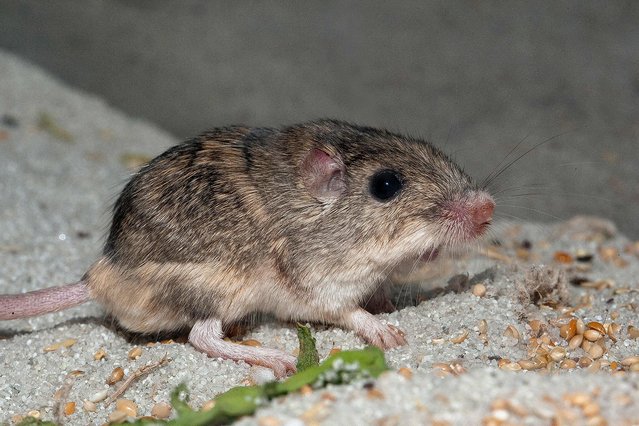
This undated handout image courtesy of the San Diego Zoo Wildlife Alliance shows “Pat”, a Pacific pocket mouse fondly named after actor Sir Patrick Stewart. A mouse named after “Star Trek” actor Patrick Stewart is officially the world's oldest in captivity, a US zoo has announced Pat the Pacific Pocket Mouse – the smallest species of mouse in North America – bagged the title when he hit nine years and 209 days old on February 8, 2023. (Photo by Ken Bohn/San Diego Zoo Wildlife Alliance via AFP Photo)

This undated handout image courtesy of the San Diego Zoo Wildlife Alliance shows “Pat”, a Pacific pocket mouse fondly named after actor Sir Patrick Stewart. A mouse named after “Star Trek” actor Patrick Stewart is officially the world's oldest in captivity, a US zoo has announced Pat the Pacific Pocket Mouse – the smallest species of mouse in North America – bagged the title when he hit nine years and 209 days old on February 8, 2023. (Photo by Ken Bohn/San Diego Zoo Wildlife Alliance via AFP Photo)
Details
11 Jun 2024 02:39:00
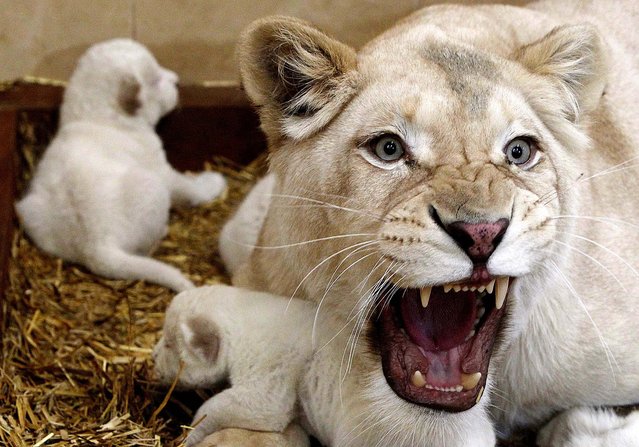
White lioness Azira lies in the cage with her three white cubs, on February 4, 2014. Zoo owner Andrzej Pabich says white lions often have defects that prevent giving birth, or the mother rejects her cubs, but Azira has been patiently feeding and caring for her little ones. (Photo by Czarek Sokolowski/Associated Press)

White lioness Azira lies in the cage with her three white cubs, on February 4, 2014. Zoo owner Andrzej Pabich says white lions often have defects that prevent giving birth, or the mother rejects her cubs, but Azira has been patiently feeding and caring for her little ones. (Photo by Czarek Sokolowski/Associated Press)
Details
08 Feb 2014 15:52:00
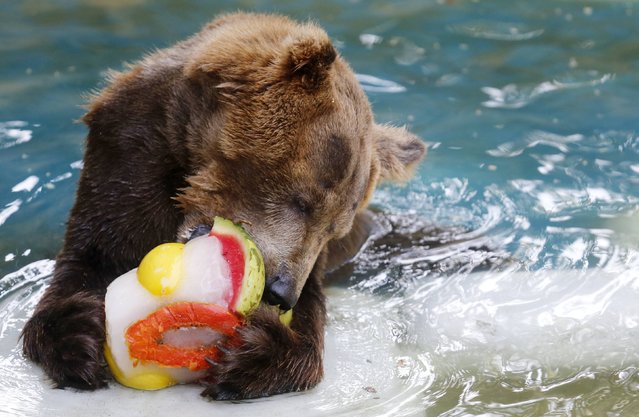
A grizzly bear eats a frozen fruits during a hot summer day at Rio de Janeiro's zoo January 13, 2015. According to a local climate institute, temperatures in Rio de Janeiro on Tuesday rose up to 34 degrees Celsius (93.2 degrees Fahrenheit). (Photo by Sergio Moraes/Reuters)

A grizzly bear eats a frozen fruits during a hot summer day at Rio de Janeiro's zoo January 13, 2015. According to a local climate institute, temperatures in Rio de Janeiro on Tuesday rose up to 34 degrees Celsius (93.2 degrees Fahrenheit). (Photo by Sergio Moraes/Reuters)
Details
14 Jan 2015 11:52:00
Two fourteen-week old lion cubs, a male named Ramzes and a female named Zara, are seen during a Christening ceremony at the Bojnice Zoo April 4, 2015. (Photo by Radovan Stoklasa/Reuters)

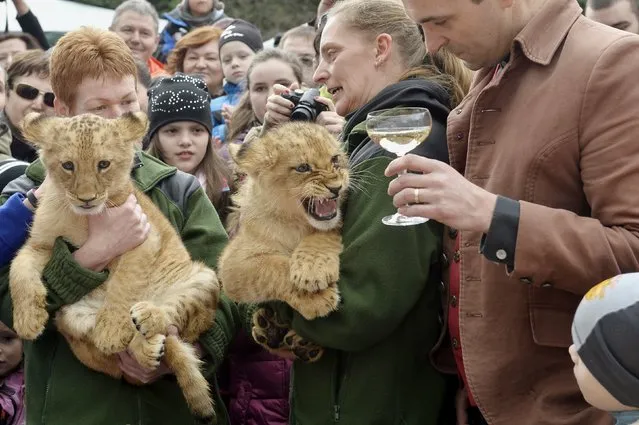
Two fourteen-week old lion cubs, a male named Ramzes and a female named Zara, are seen during a Christening ceremony at the Bojnice Zoo April 4, 2015. The two cubs are Barbary lions (Panthera leo leo), local media reported. (Photo by Radovan Stoklasa/Reuters)
Details
05 Apr 2015 11:24:00
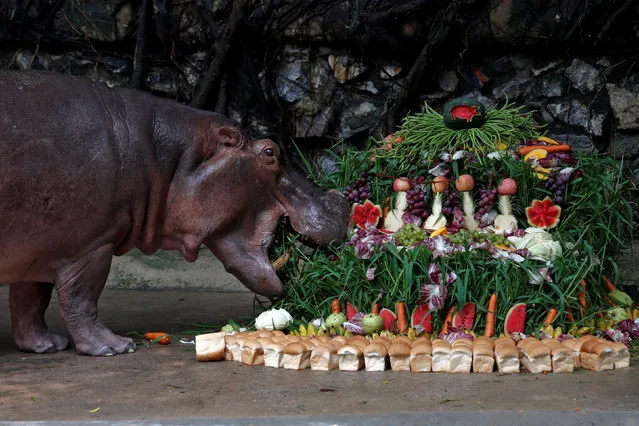
A female hippopotamus named “Mali”, which means Jasmine, eats fruits arranged to look like a cake during her 50th birthday celebration at Dusit Zoo in Bangkok, Thailand September 23, 2016. (Photo by Chaiwat Subprasom/Reuters)

A female hippopotamus named “Mali”, which means Jasmine, eats fruits arranged to look like a cake during her 50th birthday celebration at Dusit Zoo in Bangkok, Thailand September 23, 2016. (Photo by Chaiwat Subprasom/Reuters)
Details
25 Sep 2016 07:06:00