Loading...
Done
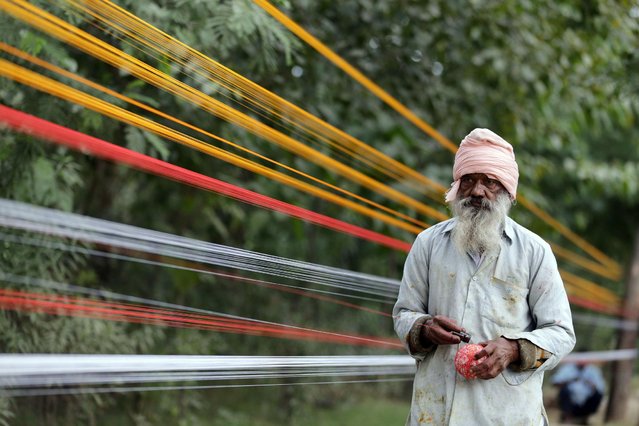
An Indian worker makes a roll of the kite thread being prepared on a roadside on the outskirts of Amritsar, India, 24 November 2020. The kite string or the “Dor”, in the local language, is made of crushed glass, glue, colors, and egg to make it strong enough to hold the kite. With the onset of the winter season, kite flying enthusiasts especially in northern Punjab, ranging from children to aged people, start flying kites as a leisure activity from their homes' rooftops and from open spaces, enjoying warmth of the winter sun at the same time. Kite flying season peaks in Amritsar on Lohri festival which marks the culmination of winter and is celebrated in the month of January every year. (Photo by Raminder Pal Singh/EPA/EFE)

An Indian worker makes a roll of the kite thread being prepared on a roadside on the outskirts of Amritsar, India, 24 November 2020. The kite string or the “Dor”, in the local language, is made of crushed glass, glue, colors, and egg to make it strong enough to hold the kite. (Photo by Raminder Pal Singh/EPA/EFE)
Details
07 Dec 2020 00:01:00
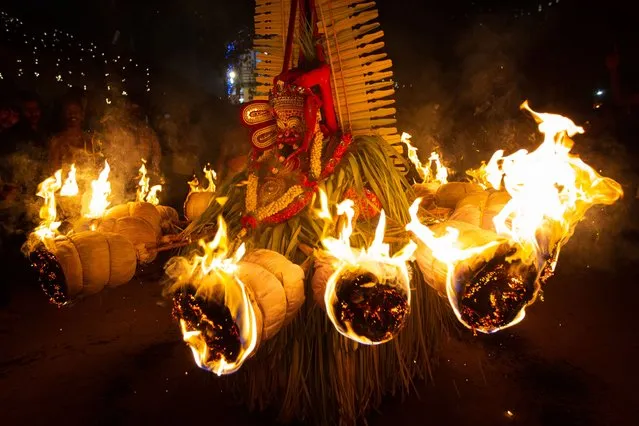
A man dressed in the likeness of the Hindu deity Agni Kandakarnan performs during the Theyyam ritualistic dance festival on March 14, 2023 in Somwarpet, India. Theyyam is a colourful socioreligious dance form that is the amalgamation of ritual, vocal and instrumental music, dance, painting, and literature and its genesis can be traced to the coastal regions of the southern Indian states of Kerala and Karnataka. (Photo by Abhishek Chinnappa/Getty Images)

A man dressed in the likeness of the Hindu deity Agni Kandakarnan performs during the Theyyam ritualistic dance festival on March 14, 2023 in Somwarpet, India. Theyyam is a colourful socioreligious dance form that is the amalgamation of ritual, vocal and instrumental music, dance, painting, and literature and its genesis can be traced to the coastal regions of the southern Indian states of Kerala and Karnataka. (Photo by Abhishek Chinnappa/Getty Images)
Details
25 Mar 2023 03:53:00
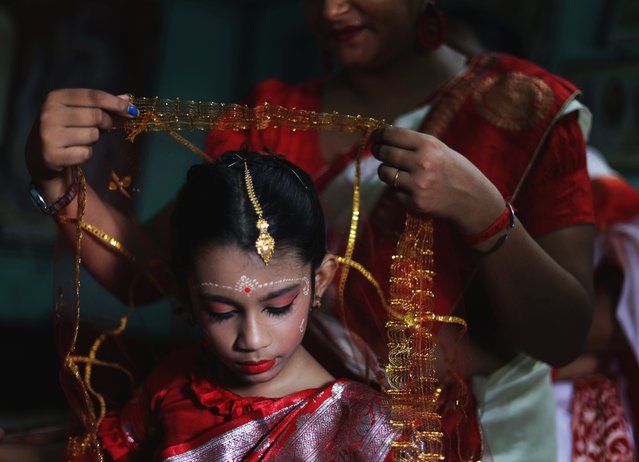
Indian girl, Amrita Bannerjee, gets dressed as the Goddess Durga, during Kumari Puja ritual as part of the Durga Puja festival at Shidaspur village, far north of Kolkata, India, 30 September 2025. During the Kumari Puja, devotees worship a girl aged between six and twelve, symbolizing the Kanya Kumari (virgin) form of the Goddess Durga Devi. Hindu devotees believe that Kanya is a living embodiment of the goddess Durga. (Photo by Piyal Adhikary/EPA)

Indian girl, Amrita Bannerjee, gets dressed as the Goddess Durga, during Kumari Puja ritual as part of the Durga Puja festival at Shidaspur village, far north of Kolkata, India, 30 September 2025. During the Kumari Puja, devotees worship a girl aged between six and twelve, symbolizing the Kanya Kumari (virgin) form of the Goddess Durga Devi. Hindu devotees believe that Kanya is a living embodiment of the goddess Durga. (Photo by Piyal Adhikary/EPA)
Details
31 Oct 2025 02:37:00
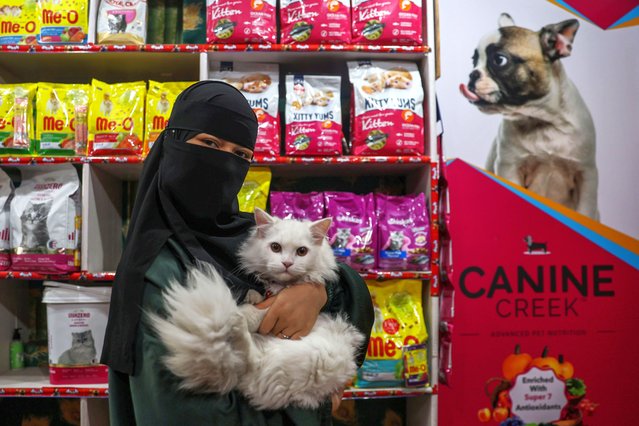
A girl holds her newly purchased pet cat while posing for a photograph at a pet shop in Srinagar, the summer capital of Indian Kashmir, 10 November 2025. Kashmir is seeing more pet owners, especially of Persian cats. Over 6,000 cat bite cases were reported last year, accounting for nearly half of the rabies control budget. Experts urge vaccination as demand for pedigree pets continues to rise. (Photo by Farooq Khan/EPA)

A girl holds her newly purchased pet cat while posing for a photograph at a pet shop in Srinagar, the summer capital of Indian Kashmir, 10 November 2025. Kashmir is seeing more pet owners, especially of Persian cats. Over 6,000 cat bite cases were reported last year, accounting for nearly half of the rabies control budget. Experts urge vaccination as demand for pedigree pets continues to rise. (Photo by Farooq Khan/EPA)
Details
16 Nov 2025 04:16:00
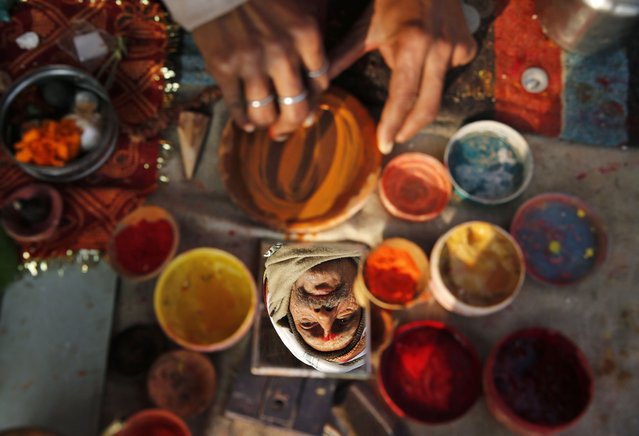
A Hindu holy man is reflected on a mirror as he prepares a bowl of vermillion powder for devotees near “Sangam”, the confluence of holy rivers of Ganges, Yamuna and the mythical Saraswati, during the annual traditional fair of Magh Mela in Allahabad, in the northern Indian state of Uttar Pradesh, India, Tuesday, January 6, 2015. (Photo by Rajesh Kumar Singh/AP Photo)

A Hindu holy man is reflected on a mirror as he prepares a bowl of vermillion powder for devotees near “Sangam”, the confluence of holy rivers of Ganges, Yamuna and the mythical Saraswati, during the annual traditional fair of Magh Mela in Allahabad, in the northern Indian state of Uttar Pradesh, India, Tuesday, January 6, 2015. Hundreds of thousands of devout Hindus are expected to take holy dips at the confluence during the astronomically auspicious period of over 45 days celebrated as Magh Mela. (Photo by Rajesh Kumar Singh/AP Photo)
Details
07 Jan 2015 13:41:00
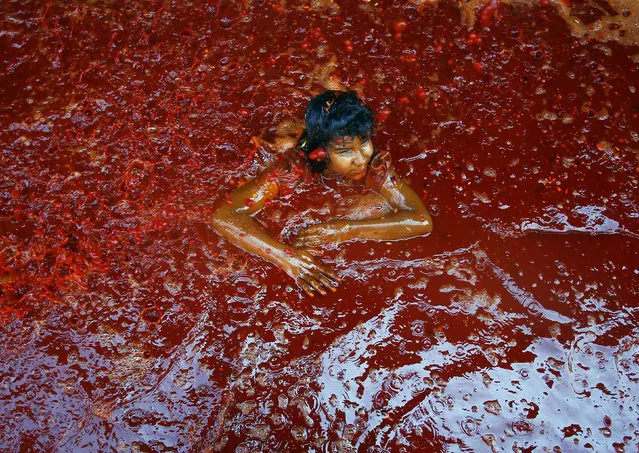
A child lies in a puddle of coloured water during “Huranga” at Dauji temple near the northern Indian city of Mathura, March 7, 2015. “Huranga” is a game played between men and women a day after Holi, the festival of colours, during which men drench women with liquid colours and women tear off the clothes of the men. (Photo by Anindito Mukherjee/Reuters)

A child lies in a puddle of coloured water during “Huranga” at Dauji temple near the northern Indian city of Mathura, March 7, 2015. “Huranga” is a game played between men and women a day after Holi, the festival of colours, during which men drench women with liquid colours and women tear off the clothes of the men. (Photo by Anindito Mukherjee/Reuters)
Details
14 Mar 2015 13:46:00
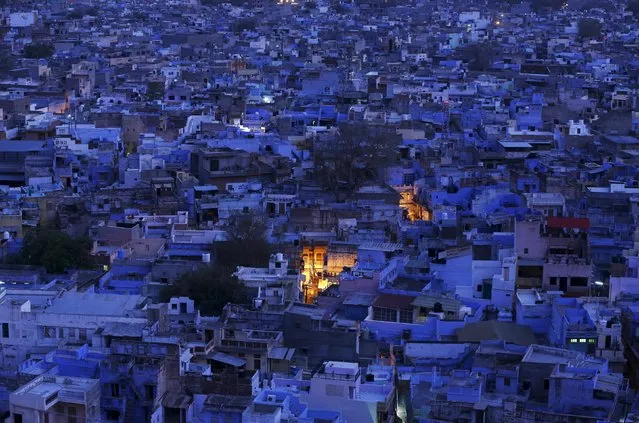
A general view of the residential area is pictured during dusk at Jodhpur in Rajasthan, April 5, 2015. Jodhpur, also known as the blue city in the desert Indian state of Rajasthan, which residents say originally, was used to show where the highest caste of priestly Hindus live, who wanted to set them apart from the rest of the population. Later the rest of the population followed suit. Another reason for the city to be blue is to keep the buildings cool during the summers, local residents said. (Photo by Adnan Abidi/Reuters)

A general view of the residential area is pictured during dusk at Jodhpur in Rajasthan, April 5, 2015. Jodhpur, also known as the blue city in the desert Indian state of Rajasthan, which residents say originally, was used to show where the highest caste of priestly Hindus live, who wanted to set them apart from the rest of the population. Later the rest of the population followed suit. Another reason for the city to be blue is to keep the buildings cool during the summers, local residents said. (Photo by Adnan Abidi/Reuters)
Details
12 Apr 2015 08:27:00
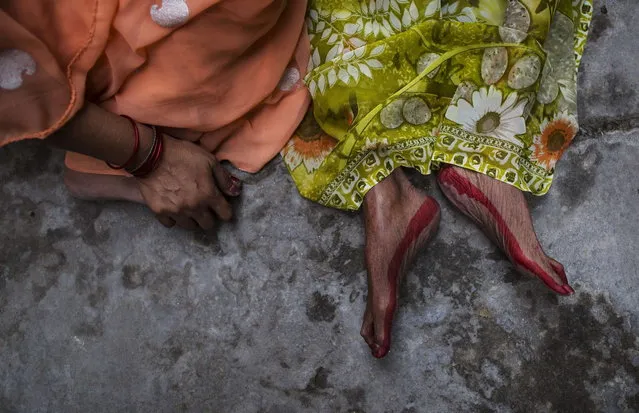
A relative (L) of Champa Devi, 88, sits next to her body, minutes after her death at Mukti Bhavan (Salvation House) at Varanasi, in the northern Indian state of Uttar Pradesh, June 21, 2014. (Photo by Danish Siddiqui/Reuters)

A relative (L) of Champa Devi, 88, sits next to her body, minutes after her death at Mukti Bhavan (Salvation House) at Varanasi, in the northern Indian state of Uttar Pradesh, June 21, 2014. The city of Varanasi, on the banks of the River Ganges, is widely considered Hinduism's holiest city and many Hindus believe that dying there and having their remains scattered in the Ganges allows their soul to escape a cycle of death and rebirth, attaining “moksha” or salvation. “Mukti Bhavan” or “Salvation House”, is a charity-run hostel that caters for people who wish to come to Varanasi to die. Guests can normally stay up to two weeks after which, if they haven't yet passed away, they are gently asked to leave. (Photo by Danish Siddiqui/Reuters)

Details
24 Jul 2014 12:32:00