Loading...
Done
Porters carry the carcasses of a shark (L) and a Marlin (R) to the local market in Hamarweyne near the port of Mogadishu on the Indian Ocean coast on November 18, 2014 in the Somalia capital as fishermen bring in their catch. (Photo by Mohamed Abdiwahab/AFP Photo)

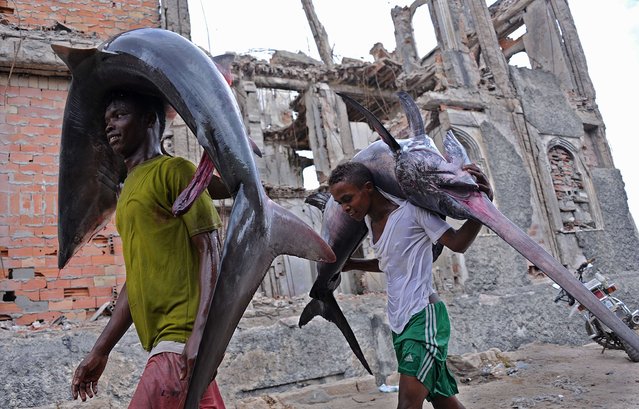
Porters carry the carcasses of a shark (L) and a Marlin (R) to the local market in Hamarweyne near the port of Mogadishu on the Indian Ocean coast on November 18, 2014 in the Somalia capital as fishermen bring in their catch. (Photo by Mohamed Abdiwahab/AFP Photo)
Details
22 Nov 2014 14:00:00
A camel yawns as a tourist checks images on her camera following a ride on a camel safari alongside the Pacific Ocean on Lighthouse Beach, north of Sydney, December 4, 2014. For 25 years camel rides on this beach have given visitors to Australia's holiday coast a rare experience available only in a handful of locations in the country. (Photo by Jason Reed/Reuters)

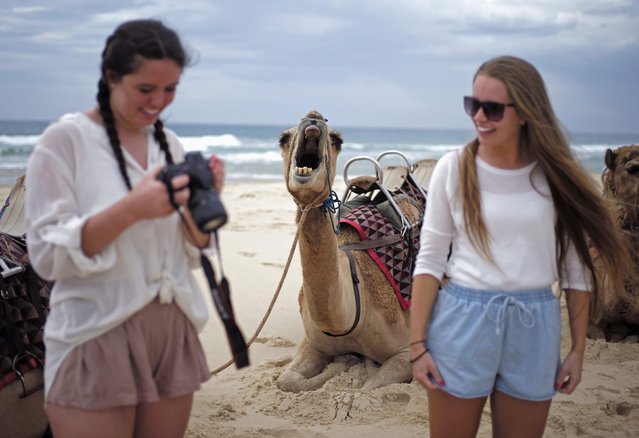
A camel yawns as a tourist checks images on her camera following a ride on a camel safari alongside the Pacific Ocean on Lighthouse Beach, north of Sydney, December 4, 2014. For 25 years camel rides on this beach have given visitors to Australia's holiday coast a rare experience available only in a handful of locations in the country. Australia's long history with the “ships of the desert” goes back to the 1800s when they were imported from Afghanistan and India for use as transportation across Australia's vast deserts before being released into the wild following their replacement by motorised transport. (Photo by Jason Reed/Reuters)
Details
06 Dec 2014 12:48:00
Emma the Maltese's fur blows in the wind as she rides in her owner's purse on 5th Avenue at Central Park in New York December 2, 2014. (Photo by Carlo Allegri/Reuters)

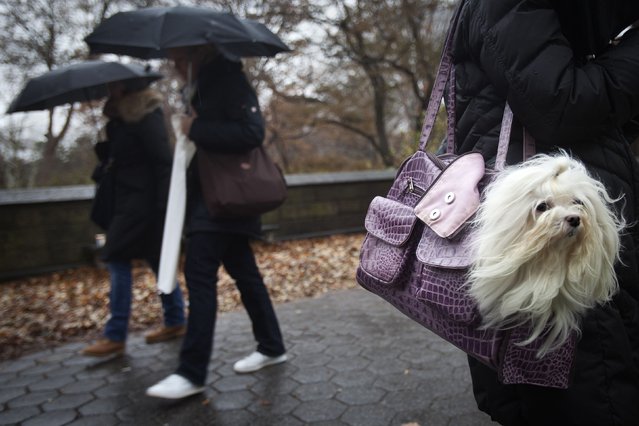
Emma the Maltese's fur blows in the wind as she rides in her owner's purse on 5th Avenue at Central Park in New York December 2, 2014. (Photo by Carlo Allegri/Reuters)
Details
06 Dec 2014 13:07:00
In this Tuesday, February 11, 2014, photo, a trained monkey, that makes a living for her Pakistani owner by performing to a crowd in public and private places, sits held by a leash, in Rawalpindi, Pakistan. For Pakistanis who raise and train the monkeys they are an important source of income in an impoverished country, and they form a strong bond with the animals. The monkeys are usually captured in the wild when they are babies and then trained. A trained monkey can fetch 20,000 to 30,000 rupees ($190 to $285). (Photo by Muhammed Muheisen/Associated Press)

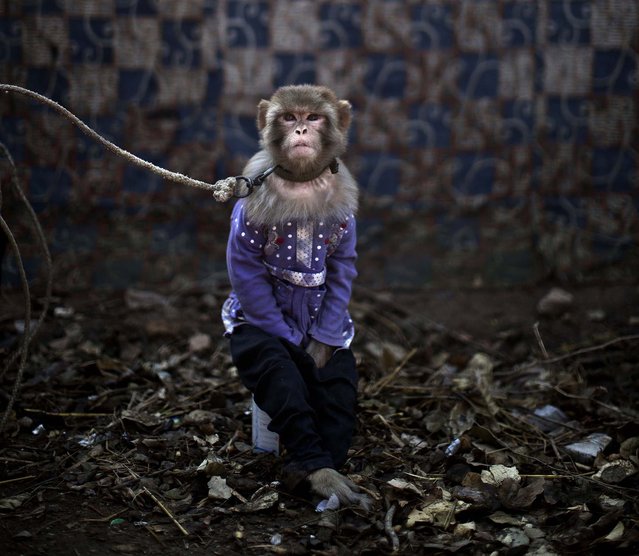
In this Tuesday, February 11, 2014, photo, a trained monkey, that makes a living for her Pakistani owner by performing to a crowd in public and private places, sits held by a leash, in Rawalpindi, Pakistan. For Pakistanis who raise and train the monkeys they are an important source of income in an impoverished country, and they form a strong bond with the animals. The monkeys are usually captured in the wild when they are babies and then trained. A trained monkey can fetch 20,000 to 30,000 rupees ($190 to $285). (Photo by Muhammed Muheisen/Associated Press)
Details
23 Feb 2014 09:50:00
A wolf-like robot “Super Monster Wolf” stands beside a rice field to drive away wild animals that cause damages to crops in Kisarazu, Chiba prefecture, on August 25, 2017. The agricultural coopetative association JA Kisarazu-shi introduced the 65cm-long and 50cm-high robot recently on a trial basis which can detect wild animals such as boars and deers with an infrared ray sensor when they approach and intimidates them, flashing the red LED eyes and blaring 48 types of sounds including a wolf growl and human voice. (Photo by Toru Yamanaka/AFP Photo)

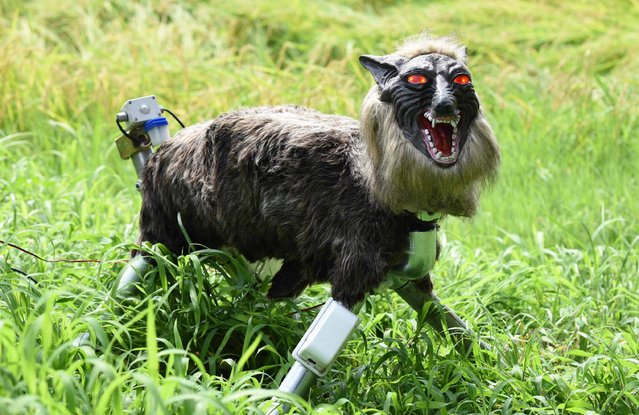
A wolf-like robot “Super Monster Wolf” stands beside a rice field to drive away wild animals that cause damages to crops in Kisarazu, Chiba prefecture, on August 25, 2017. The agricultural coopetative association JA Kisarazu-shi introduced the 65cm-long and 50cm-high robot recently on a trial basis which can detect wild animals such as boars and deers with an infrared ray sensor when they approach and intimidates them, flashing the red LED eyes and blaring 48 types of sounds including a wolf growl and human voice. (Photo by Toru Yamanaka/AFP Photo)
Details
27 Aug 2017 07:17:00
Girls lead a gaggle of geese, backdropped by a banner against the war in Ukraine, during a Saint Martin's Day procession next to Charles Bridge in Prague, Czech Republic, Friday, November 11, 2022. Saint Martin's day marks the end of the harvest season as well as the start of winter. (Photo by Vadim Ghirda/AP Photo)

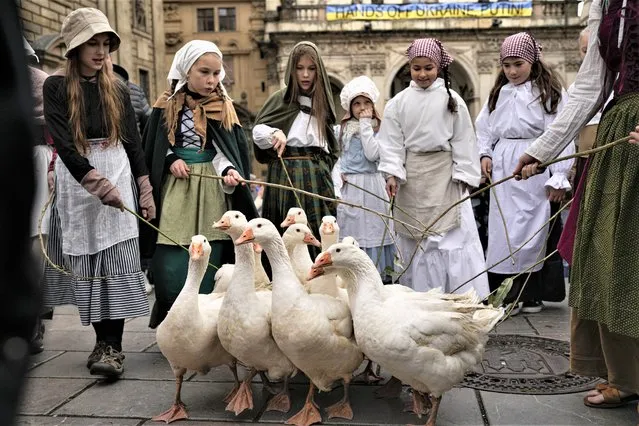
Girls lead a gaggle of geese, backdropped by a banner against the war in Ukraine, during a Saint Martin's Day procession next to Charles Bridge in Prague, Czech Republic, Friday, November 11, 2022. Saint Martin's day marks the end of the harvest season as well as the start of winter. (Photo by Vadim Ghirda/AP Photo)
Details
14 Nov 2022 05:21:00
Guanacos sit during a signing ceremony in Patagonia Park, Chile, January 29, 2018. Chilean President Michelle Bachelet signed decrees Monday creating vast new national parks using lands donated by U.S. conservation organization Tompkins Conservation in what is believed to be the largest private donation of land ever from a private entity to a country. (Photo by Esteban Felix/AP Photo)

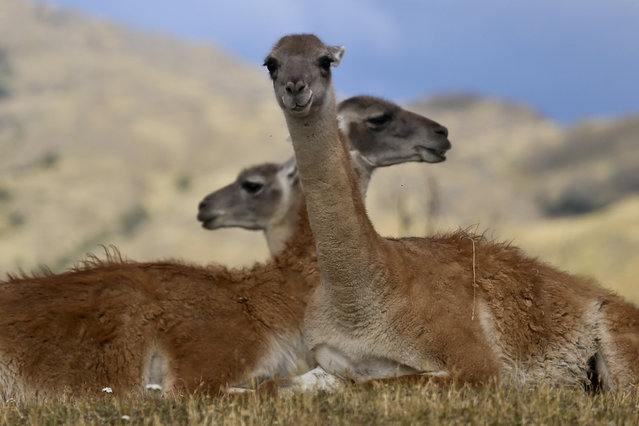
Guanacos sit during a signing ceremony in Patagonia Park, Chile, January 29, 2018. Chilean President Michelle Bachelet signed decrees Monday creating vast new national parks using lands donated by U.S. conservation organization Tompkins Conservation in what is believed to be the largest private donation of land ever from a private entity to a country. (Photo by Esteban Felix/AP Photo)
Details
27 Dec 2018 00:01:00
Faruk, 17, a Rohingya refugee trader holds betel leaves which are on sale at a stall in Palong Khali refugee camp near Cox's Bazar, Bangladesh, November 3, 2017. He left his village in Myanmar when the military opened fire towards the Rohingya. “I buy this betel leaf from Palong Khali market, in one bundle there are 160 pieces, I buy it for 80 taka and I sell it for 100 taka. Bangladeshi's and I sell for the same rate in the camp. Outside in the local market it is 80 taka per bundle. My problem is that I don't have money so I can't buy anything to eat, I can't buy fish to eat”, he said. (Photo by Hannah McKay/Reuters)

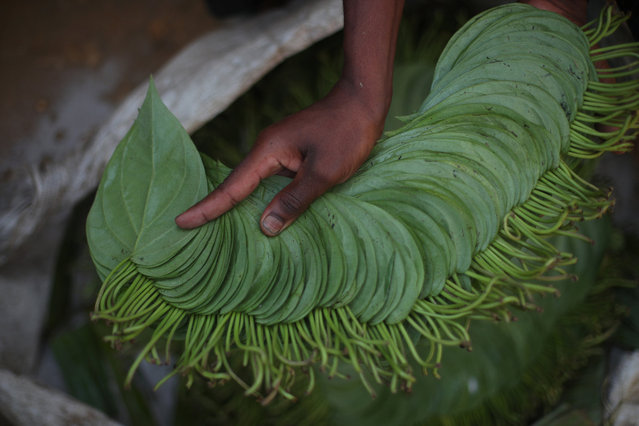
Faruk, 17, a Rohingya refugee trader holds betel leaves which are on sale at a stall in Palong Khali refugee camp near Cox's Bazar, Bangladesh, November 3, 2017. He left his village in Myanmar when the military opened fire towards the Rohingya. “I buy this betel leaf from Palong Khali market, in one bundle there are 160 pieces, I buy it for 80 taka and I sell it for 100 taka (1 Bangladeshi Taka = 0.012 US Dollar). Bangladeshi's and I sell for the same rate in the camp. Outside in the local market it is 80 taka per bundle. My problem is that I don't have money so I can't buy anything to eat, I can't buy fish to eat”, he said. (Photo by Hannah McKay/Reuters)
Details
27 Nov 2017 08:54:00