People look at a skeleton couple kissing installation dubbed “Till Death Do Us Part” during a Valentine's Day event in Bucharest, Romania, Tuesday, February 13, 2024. (Photo by Vadim Ghirda/AP Photo)
An aerial drone photo shows a view of the Wujiangzhai scenic spot in Zunyi, southwest China's Guizhou Province, March 14, 2024. The Wujiangzhai scenic spot, with its natural landscape and local folk customs, offers a blend of sightseeing, leisure activities and exhibitions, making it a popular destination for tourists. (Photo by Xinhua News Agency/Rex Features/Shutterstock)
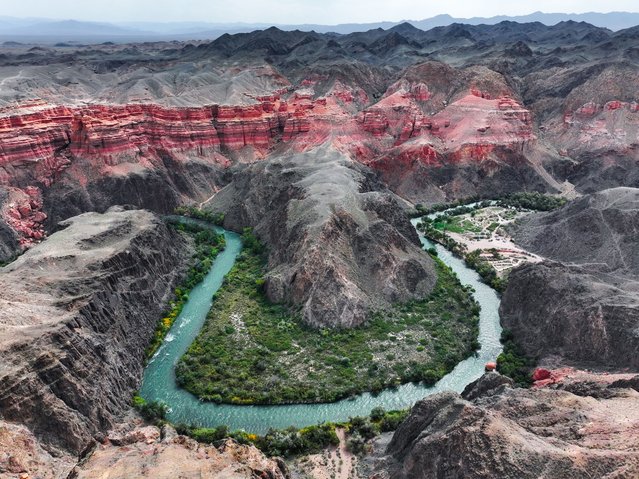
An aerial view of Charyn Canyon located about 200 kilometers east of Almaty city in Kazakhstan on September 22, 2024. The canyon, visited by more than 50,000 people each year, was placed under protection in 1964 and became part of the Charyn National Park, established on February 23, 2004. (Photo by Muhammed Enes Yildirim/Anadolu via Getty Images)
Young recruits of the 72nd Chorni Zaporozhtsi Separate Mechanized Brigade of the Ukrainian Armed Forces attend an exercise, amid Russia's attack on Ukraine, in Kyiv region, Ukraine on April 5, 2025. Ukraine's Defence Ministry launched a recruitment drive for young people, 18- to 24-year-olds, to serve in the military for a year for the equivalent of about $24,000 and hefty bonuses. (Photo by Gleb Garanich/Reuters)
Kim Goodman, from Chicago, Illinois, US, holds the record for the farthest eyeball protrusion, at 12mm. (Photo by Paul Michael Hughes/Guinness World Records/PA Wire Press Association)
A Sphynx cat stares sitting on its owner's lap during an international feline beauty competition in Bucharest, Romania, Saturday, April 14, 2018. More than 250 cats take part in the two-day competition in the Romanian capital. (Photo by Vadim Ghirda/AP Photo)
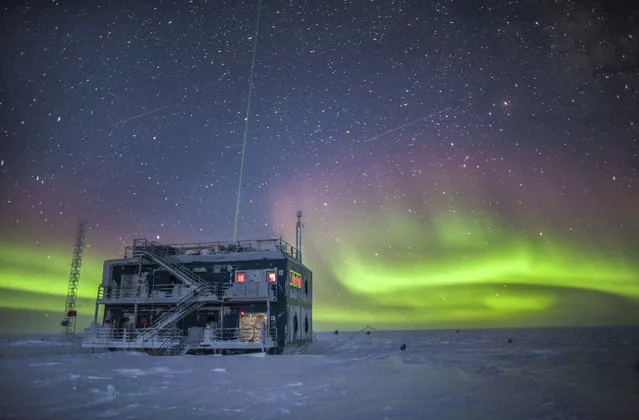
This undated photo provided by NOAA in May 2018 shows aurora australis near the South Pole Atmospheric Research Observatory in Antarctica. When a hole in the ozone formed over Antarctica, countries around the world in 1987 agreed to phase out several types of ozone-depleting chemicals called chlorofluorocarbons (CFCs). Production was banned, emissions fell and the hole shriveled. But according to a study released on Wednesday, May 16, 2018, scientists say since 2013, there’s more of a banned CFC going into the atmosphere. (Photo by Patrick Cullis/NOAA via AP Photo)
Secondary school graduates play in a fountain as they celebrate the last day of school, traditionally called the “last bell” in central Kiev, Ukraine on May 31, 2019. (Photo by Valentyn Ogirenko/Reuters)