Loading...
Done
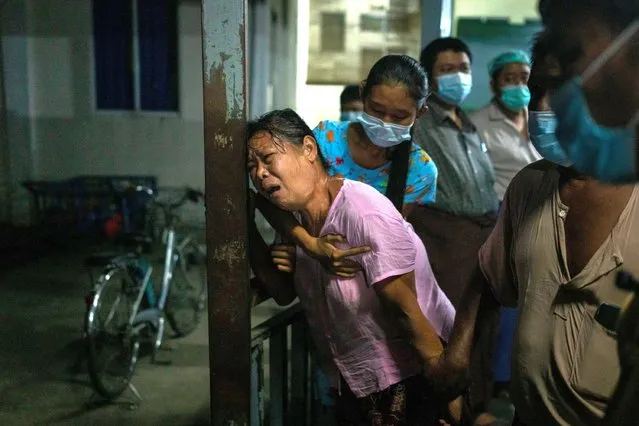
The mother of a protester mourns at a hospital after her son was killed was killed during clashes on March 03, 2021 in Yangon, Myanmar. Medics and health workers have found themselves on the front lines and under intense pressure, as they try to help anti-coup protesters as resistance continues to erupt across the country, to be met with deadly force by the military junta. The military government has intensified a crackdown on protesters in recent days, using tear gas and live ammunition, charging at and arresting protesters and journalists. At least 25 people have been killed so far, according to monitoring organizations, leaving ill-equipped medics to help scores of the injured. (Photo by Stringer/Getty Images)

The mother of a protester mourns at a hospital after her son was killed was killed during clashes on March 03, 2021 in Yangon, Myanmar. Medics and health workers have found themselves on the front lines and under intense pressure, as they try to help anti-coup protesters as resistance continues to erupt across the country, to be met with deadly force by the military junta. (Photo by Stringer/Getty Images)
Details
04 Mar 2021 08:45:00
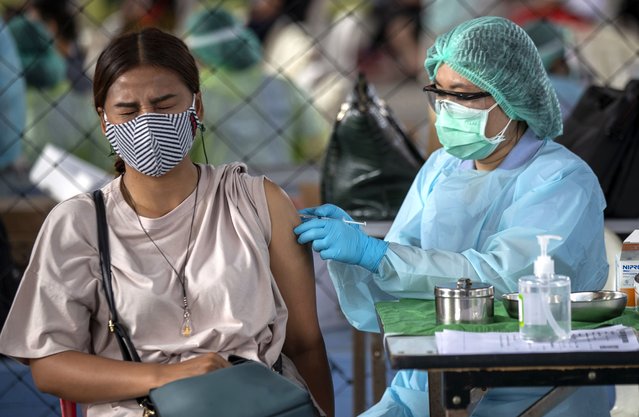
A health worker administers a dose of the Sinovac COVID-19 vaccine to a worker in a local entertainment venue area where a new cluster of COVID-19 infections were found in Bangkok, Thailand, Wednesday, April 7, 2021. Officials in Thailand’s capital have ordered a two-week closure of all entertainment venues in three districts to try to limit the spread of the coronavirus from nightspots there. (Photo by Sakchai Lalit/AP Photo)

A health worker administers a dose of the Sinovac COVID-19 vaccine to a worker in a local entertainment venue area where a new cluster of COVID-19 infections were found in Bangkok, Thailand, Wednesday, April 7, 2021. Officials in Thailand’s capital have ordered a two-week closure of all entertainment venues in three districts to try to limit the spread of the coronavirus from nightspots there. (Photo by Sakchai Lalit/AP Photo)
Details
08 Apr 2021 11:21:00
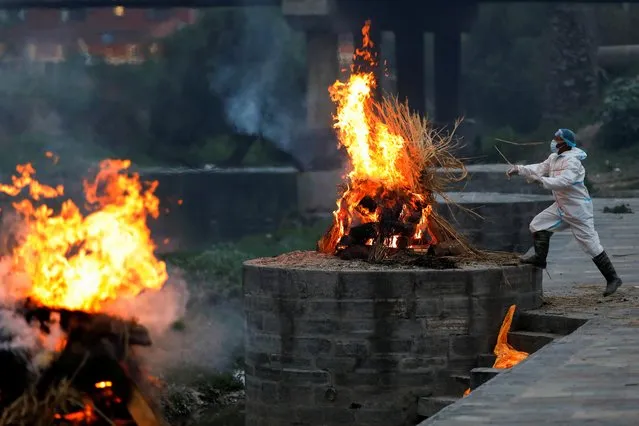
A man wearing personal protective equipment (PPE) cremates a body of a coronavirus disease (COVID-19) victim at the crematory as the country recorded the highest daily increase in deaths since the pandemic began, in Kathmandu, Nepal on May 3, 2021. (Photo by Navesh Chitrakar/Reuters)

A man wearing personal protective equipment (PPE) cremates a body of a coronavirus disease (COVID-19) victim at the crematory as the country recorded the highest daily increase in deaths since the pandemic began, in Kathmandu, Nepal on May 3, 2021. (Photo by Navesh Chitrakar/Reuters)
Details
15 May 2021 08:31:00
A mermaids swims during MerMagic Con at the Freedom Aquatic Center in Manassas, Virginia on August 7, 2021. (Photo by Joseph Prezioso/AFP Photo)

A mermaids swims during MerMagic Con at the Freedom Aquatic Center in Manassas, Virginia on August 7, 2021. MerMagic Con is advertised as the largest Mermaid convention in the world. Some parts of the convention are based on modeling and looks like the Miss Mermaid USA Pageant. The Society of Fat Mermaids looks to bring together plus size people and promote the idea that anyone can become a mermaid. Becoming a mermaid is not cheap, most merfolk spend thousands of dollars on their tail and outfit. Most tails are custom made out of silicone and others are foam and fabric. (Photo by Joseph Prezioso/AFP Photo)
Details
18 Aug 2021 08:25:00
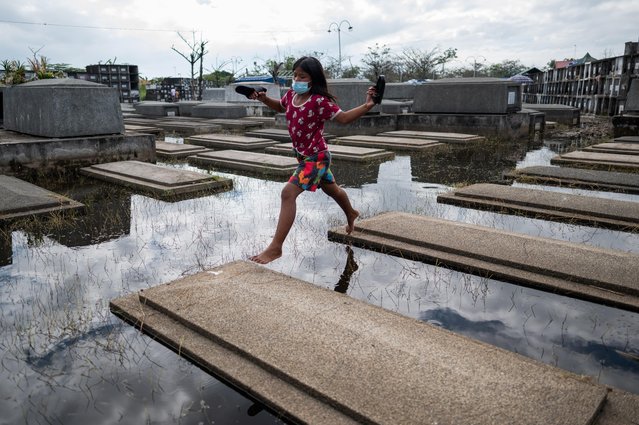
A girl jumps from a tomb, a day before the nationwide cemetery closure during All Saints' Day amid the coronavirus disease (COVID-19), at a flooded cemetery in Masantol, Pampanga, Philippines, October 28, 2021. (Photo by Lisa Marie David/Reuters)

A girl jumps from a tomb, a day before the nationwide cemetery closure during All Saints' Day amid the coronavirus disease (COVID-19), at a flooded cemetery in Masantol, Pampanga, Philippines, October 28, 2021. (Photo by Lisa Marie David/Reuters)
Details
13 Nov 2021 08:05:00
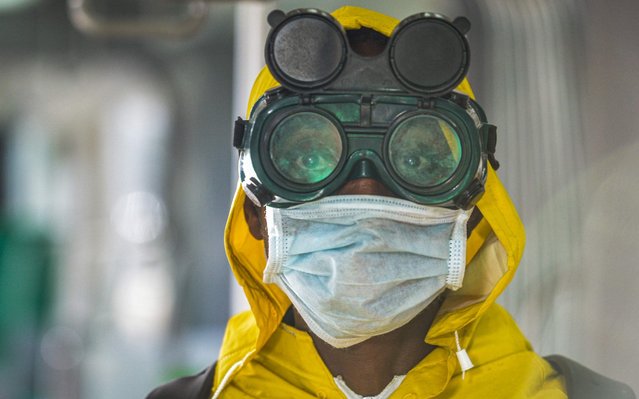
A cleaning staff waers protective gear to disinfect a metro carriage as a prevemtive measure against the spreading of the COVID-19 coronavirus in Addis Ababa, Ethiopia, on March 20, 2020. African countries have been among the last to be hit by the global COVID-19 coronavirus epidemic but as cases rise, many nations are now taking strict measures to block the deadly illness. (Photo by Michael Tewelde/AFP Photo)

A cleaning staff waers protective gear to disinfect a metro carriage as a prevemtive measure against the spreading of the COVID-19 coronavirus in Addis Ababa, Ethiopia, on March 20, 2020. African countries have been among the last to be hit by the global COVID-19 coronavirus epidemic but as cases rise, many nations are now taking strict measures to block the deadly illness. (Photo by Michael Tewelde/AFP Photo)
Details
23 Mar 2020 00:07:00
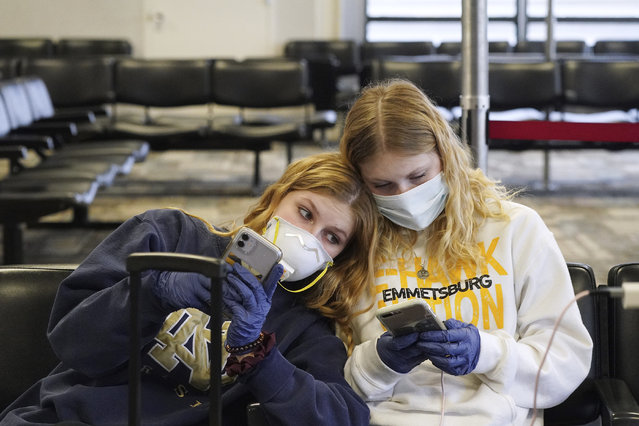
Rachel Miner, 15, left, of Emmetsburg, Iowa, sits with Carlotta Haas, 15, a foreign exchange student from Duesseldorf, Germany, who had been living with Miner and her family but was called home, as they waited for her flight Wednesday, March 25, 2020, in at Minneapolis-St. Paul International Airport in Minneapolis. (Photo by Anthony Souffle/Star Tribune via AP Photo)

Rachel Miner, 15, left, of Emmetsburg, Iowa, sits with Carlotta Haas, 15, a foreign exchange student from Duesseldorf, Germany, who had been living with Miner and her family but was called home, as they waited for her flight Wednesday, March 25, 2020, in at Minneapolis-St. Paul International Airport in Minneapolis. (Photo by Anthony Souffle/Star Tribune via AP Photo)
Details
09 Apr 2020 00:05:00
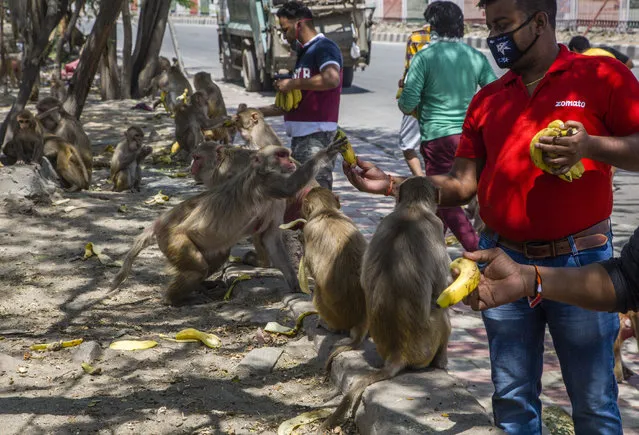
Men give bananas to monkeys gathered on the side of the road as India remains under an unprecedented lockdown over the highly contagious coronavirus (COVID-19) on April 08, 2020 in New Delhi, India. Wild animals, including monkeys, are roaming human settlements in India as people are staying indoors due to the 21-day lockdown. With India's 1.3 billion population and tens of millions of cars off the roads, wildlife is moving towards areas inhabited by humans. Wild animals in many countries have been seen roaming streets. A study says some 60 percent of the new diseases found around the globe every year are zoonotic, meaning they originate in animals and are passed on to humans. COVID-19 is a zoonotic disease that is suspected to have come from the wet markets of Wuhan, China. (Photo by Yawar Nazir/Getty Images)

Men give bananas to monkeys gathered on the side of the road as India remains under an unprecedented lockdown over the highly contagious coronavirus (COVID-19) on April 08, 2020 in New Delhi, India. Wild animals, including monkeys, are roaming human settlements in India as people are staying indoors due to the 21-day lockdown. (Photo by Yawar Nazir/Getty Images)
Details
12 Apr 2020 00:05:00