Loading...
Done
A young Palestinian crawls under a barbed wire during a military-style exercise at a summer camp organized by Islamic Jihad movement, in Khan Younis in the southern Gaza Strip, August 13, 2015. (Photo by Ibraheem Abu Mustafa/Reuters)

A young Palestinian crawls under a barbed wire during a military-style exercise at a summer camp organized by Islamic Jihad movement, in Khan Younis in the southern Gaza Strip, August 13, 2015. (Photo by Ibraheem Abu Mustafa/Reuters)
Details
14 Aug 2015 14:07:00
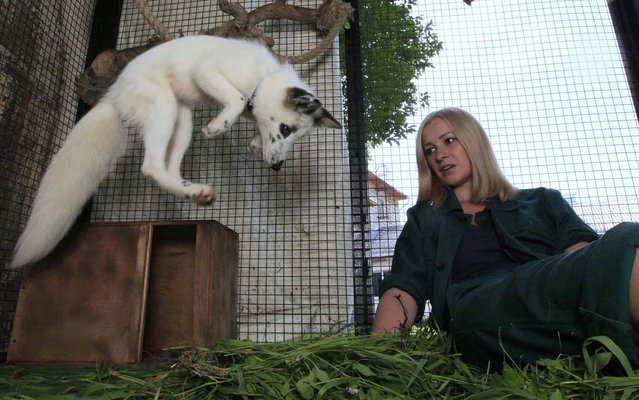
A four-month-old snow fox cub named “Vesna” leaps next to a Zoo employee at the Royev Ruchey Zoo in Krasnoyarsk, Russia, on August 6, 2013. (Photo by Ilya Naymushin/Reuters)

A four-month-old snow fox cub named “Vesna” (“Spring”) leaps next to a Zoo employee at the Royev Ruchey Zoo in Krasnoyarsk, Russia, on August 6, 2013. (Photo by Ilya Naymushin/Reuters)
Details
10 Aug 2013 14:43:00
A bishop walks past a new street-art collage by Italian artist Maupal showing Pope Francis playing tic-tac-toe and drawing peace signs as a Swiss guard keep watches the street near the Vatican on October 19, 2016 in Rome. (Photo by Tiziana Fabi/AFP Photo)

A bishop walks past a new street-art collage by Italian artist Maupal showing Pope Francis playing tic-tac-toe and drawing peace signs as a Swiss guard keep watches the street near the Vatican on October 19, 2016 in Rome. (Photo by Tiziana Fabi/AFP Photo)
Details
21 Oct 2016 12:04:00
Luling, Louisiana US. New evidence contradicts previous claims of the relative safety of glyphosate, the world’s most widely used herbicide, which is manufactured here. It is often used in conjunction with seeds that have been genetically modified to tolerate its application, meaning that anyone consuming these crops is eating a genetically modified plant, and whatever residue of the pesticide that remains. (Photo by J. Henry Fair/Industrial Scars/Papadakis Publisher)

Luling, Louisiana, US. New evidence contradicts previous claims of the relative safety of glyphosate, the world’s most widely used herbicide, which is manufactured here. It is often used in conjunction with seeds that have been genetically modified to tolerate its application, meaning that anyone consuming these crops is eating a genetically modified plant, and whatever residue of the pesticide that remains. (Photo by J. Henry Fair/Industrial Scars/Papadakis Publisher)
Details
25 Oct 2016 10:40:00
A boy and a serviceman pose for a picture during Marines Day celebration in the Black Sea port of Sevastopol, Crimea, November 27, 2016. (Photo by Pavel Rebrov/Reuters)

A boy and a serviceman pose for a picture during Marines Day celebration in the Black Sea port of Sevastopol, Crimea, November 27, 2016. (Photo by Pavel Rebrov/Reuters)
Details
28 Nov 2016 12:24:00
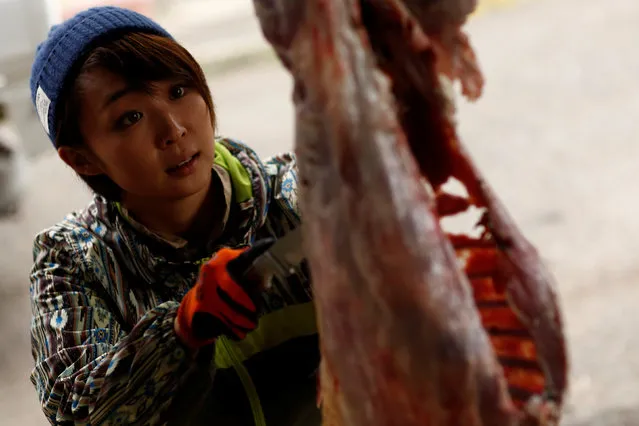
Hunter Chiaki Kodama guts a deer in a shed in Oi, Fukui Prefecture, Japan, November 17, 2016. (Photo by Thomas Peter/Reuters)

Hunter Chiaki Kodama guts a deer in a shed in Oi, Fukui Prefecture, Japan, November 17, 2016. A small but growing number of Japanese women enter the male-dominated world of hunting, where it was once taboo for men to even speak to a woman before going on a hunt. (Photo by Thomas Peter/Reuters)
Details
24 Dec 2016 09:55:00
Maja, a 40-year-old elephant, extends her trunk into a bakery as a customer buys a newspaper while Maja took a stroll through the neighborhood with her minders from a nearby circus on July 1, 2016 in Berlin, Germany. (Photo by Sean Gallup/Getty Images)

Maja, a 40-year-old elephant, extends her trunk into a bakery as a customer buys a newspaper while Maja took a stroll through the neighborhood with her minders from a nearby circus on July 1, 2016 in Berlin, Germany. (Photo by Sean Gallup/Getty Images)
Details
29 Dec 2016 07:42:00
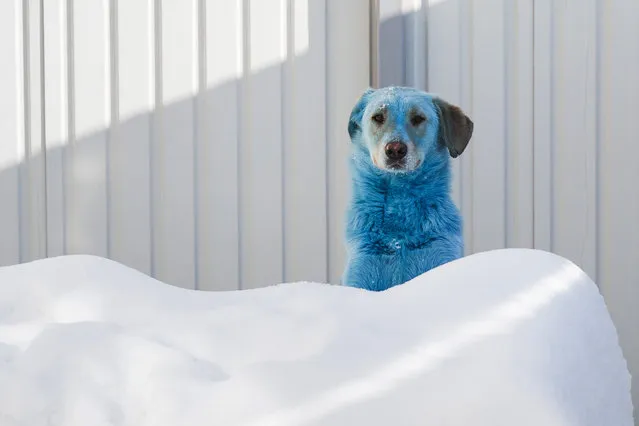
A dog at the Zoozashchita-NN veterinary clinic in Nizhny Novgorod, Russia on February 19, 2021. On February 13, 13 stray dogs with bright blue fur were found and caught at the Dzerzhinskoye Steklo (Dzerzhinsk Glass) factory producing acrylic glass and prussic acid in the city of Dzerzhinsk. The dogs' fur tested positive for the Prussian blue pigment; now the dogs are under supervision at the Zoozashchita-NN vet clinic in Nizhny Novgorod. (Photo by Mikhail Solunin/TASS)

A dog at the Zoozashchita-NN veterinary clinic in Nizhny Novgorod, Russia on February 19, 2021. On February 13, 13 stray dogs with bright blue fur were found and caught at the Dzerzhinskoye Steklo (Dzerzhinsk Glass) factory producing acrylic glass and prussic acid in the city of Dzerzhinsk. The dogs' fur tested positive for the Prussian blue pigment; now the dogs are under supervision at the Zoozashchita-NN vet clinic in Nizhny Novgorod. (Photo by Mikhail Solunin/TASS)
Details
11 Jan 2022 07:20:00