Loading...
Done
German artist Ha Schult stands with his trash people below the pyramids May 15, 2002 in Giza, Egypt

“HA Schult, born Hans-Jürgen Schult on June 24, 1939 in Parchim, Mecklenburg is a German installation, happening and conceptual artist known primarily for his object and performance art and more specifically his work with garbage”. – Wikipedia

Photo: German artist Ha Schult stands with his “trash people” below the pyramids May 15, 2002 in Giza, Egypt. Inspired by the statues of the terracotta army of Chinese Emperor Quin Shi Huangdi (247–206 B.C.), the thousand piece sulpture has stood in Red Square in Moscow, La Defense in Paris and the Great Wall in China. Schult, born in 1939 wants to bring the “trash war” to the world's attention beause trash is the greatest battle facing mankind. (Photo by Norbert Schiller/Getty Images)
Details
31 Jul 2011 13:37:00


“Yucca is a genus of perennial shrubs and trees in the agave family, Agavaceae. Its 40-50 species are notable for their rosettes of evergreen, tough, sword-shaped leaves and large terminal panicles of white or whitish flowers. They are native to the hot and dry (arid) parts of North America, Central America, South America, and the Caribbean. Early reports of the species were confused with the cassava (Manihot esculenta). Consequently, Linnaeus mistakenly derived the generic name from the Carib word for the latter, yuca. It is also colloquially known in the midwest United States as “Ghosts in the graveyard”, as it is commonly found growing in rural graveyards and when in bloom the flowers appear as an apparition floating.” – Wikipedia

Photo: A yucca standing among flowers bursts forth a very large stalk of flowers as a heavy wildflower bloom on June 21, 2005 in the Angeles National Forest northwest of La Canada, California. (Photo by David McNew/Getty Images)
Details
29 Mar 2011 07:31:00
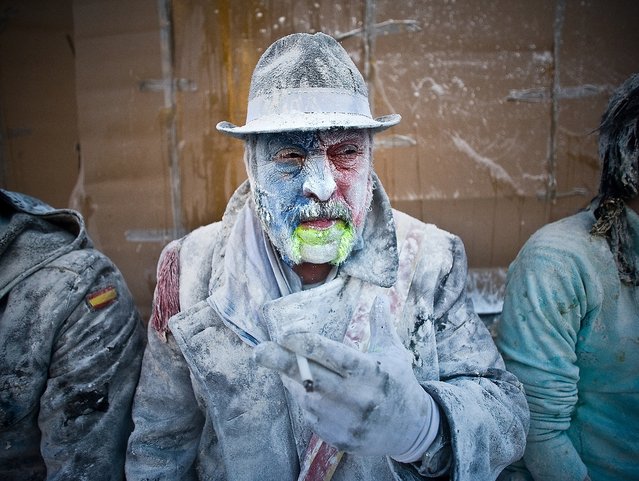
A Reveller smokes during the battle of “Enfarinats”, a flour fight in celebration of the Els Enfarinats festival. (Photo by David Ramos)

It’s a classic tale of dictatorship gone wrong and the fight for freedom. Like in any good battle, there’s fire, albeit from firecrackers, but the ammunition in this one is – flour. It takes place in a Hemingway-esque Spanish village. The battle of “Enfarinats” in celebration of the Els Enfarinats festival, rages on on December 28, 2012 in Ibi, Spain. Citizens of Ibi annually celebrate the festival with a fight using flour, eggs and firecrackers. The battle takes place between two groups, a group of married men called “Els Enfarinats” who take the control of the village for one day pronouncing a number of ridiculous laws and fining the citizens that infringe them and a group called “La Oposicio” who try to restore order. At the end of the day the money collected from the fines is donated to charitable causes in the village. The festival has been celebrated since 1981 after the town of Ibi recovered the tradition but the origins remain unknown.

Photo: A Reveller smokes during the battle of “Enfarinats”, a flour fight in celebration of the Els Enfarinats festival. (Photo by David Ramos)
Details
30 Dec 2012 10:28:00
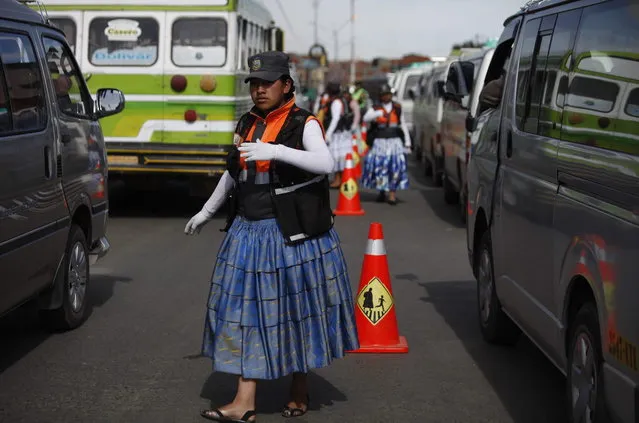
In this December 3, 2013 photo, an Aymara woman cops directs traffic on the streets of El Alto, Bolivia. The women wear the bright petticoats and shawls of indigenous women in the Andes, called cholitas in Bolivian slang, the main difference being that instead of bowler hats they wear khaki green police-style caps. Some don fluorescent traffic vests. (Photo by Juan Karita/AP Photo)

“This city in Bolivia's highlands has hired Aymara women dressed in traditional multilayered Andean skirts and brightly embroidered vests to work as traffic cops and bring order to its road chaos. About 20 of the “traffic cholitas” have been trained to direct cars and buses in El Alto, a teeming, impoverished sister city of La Paz in Bolivia's Andes mountains”. – El Alto via Associated Press. Photo: In this December 3, 2013 photo, an Aymara woman cops directs traffic on the streets of El Alto, Bolivia. The women wear the bright petticoats and shawls of indigenous women in the Andes, called cholitas in Bolivian slang, the main difference being that instead of bowler hats they wear khaki green police-style caps. Some don fluorescent traffic vests. (Photo by Juan Karita/AP Photo)
Details
25 Dec 2013 10:48:00
Natalia Lage Rainha de Drums of the Escola de Samba Inocente de Belford Roxo during a presentation in the parade of the Special Group of Carnival in Rio de Janeiro at Avenida Marques de Sapucai, Sambadrome in Rio de Janeiro on April 21, 2021. The Carnival parades that take place in February were postponed to this month of April due to the high number of cases caused during the pandemic caused by COVID-19 (Coronavirus). (Photo by Thiago Ribeiro/AGIF via AFP Photo)

Natalia Lage Rainha de Drums of the Escola de Samba Inocente de Belford Roxo during a presentation in the parade of the Special Group of Carnival in Rio de Janeiro at Avenida Marques de Sapucai, Sambadrome in Rio de Janeiro on April 21, 2021. The Carnival parades that take place in February were postponed to this month of April due to the high number of cases caused during the pandemic caused by COVID-19 (Coronavirus). (Photo by Thiago Ribeiro/AGIF via AFP Photo)
Details
04 Jul 2023 02:14:00
Revellers are sprayed by a water cannon during a street party called “Bloco Das Barbas” in Rio de Janeiro, Brazil on February 18, 2023. Hundreds of street parties traditionally take place every year in the city before and during Rio de Janeiro's carnival. (Photo by Carl de Souza/AFP Photo)

Revellers are sprayed by a water cannon during a street party called “Bloco Das Barbas” in Rio de Janeiro, Brazil on February 18, 2023. Hundreds of street parties traditionally take place every year in the city before and during Rio de Janeiro's carnival. (Photo by Carl de Souza/AFP Photo)
Details
11 May 2024 05:33:00
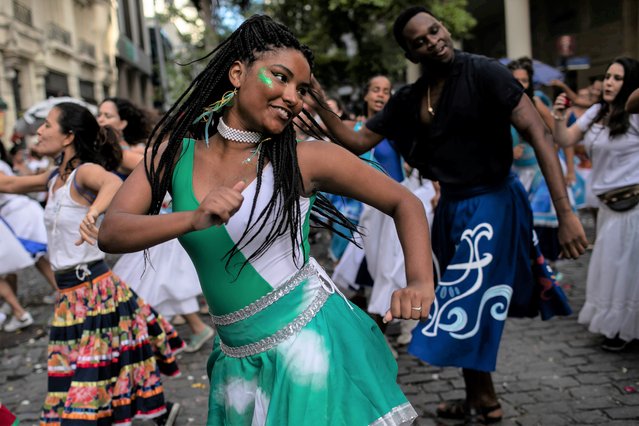
A woman dances during a rehearsal by the group “Tambores de Olokun” in Rio de Janeiro, Brazil, Sunday, April 17, 2022. The Brazilian municipalities of Rio de Janeiro and Sao Paulo postponed the traditional parades of the carnival samba schools to April 22 - 23, as a result of the COVID-19 pandemic. (Photo by Bruna Prado/AP Photo)

A woman dances during a rehearsal by the group “Tambores de Olokun” in Rio de Janeiro, Brazil, Sunday, April 17, 2022. The Brazilian municipalities of Rio de Janeiro and Sao Paulo postponed the traditional parades of the carnival samba schools to April 22 - 23, as a result of the COVID-19 pandemic. (Photo by Bruna Prado/AP Photo)
Details
19 Apr 2022 05:56:00
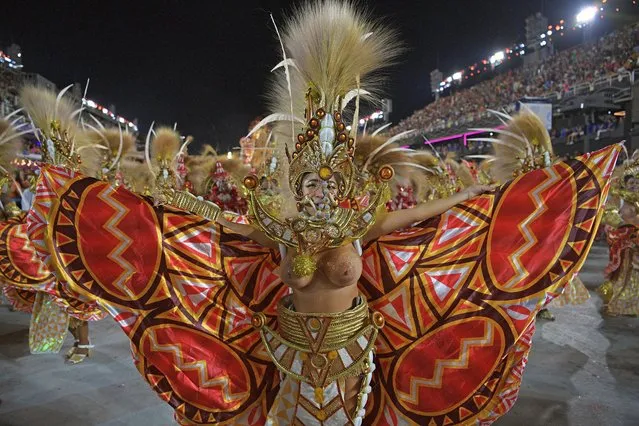
A member of Viradouro samba school performs during the first night of Rio's Carnival parade at the Sambadrome Marques de Sapucai in Rio de Janeiro, Brazil on April 22, 2022. (Photo by Carl de Souza/AFP Photo)

A member of Viradouro samba school performs during the first night of Rio's Carnival parade at the Sambadrome Marques de Sapucai in Rio de Janeiro, Brazil on April 22, 2022. (Photo by Carl de Souza/AFP Photo)
Details
29 May 2022 04:12:00