
13 Mar 2015 09:25:00,post received
0 comments

Details

Mercedes driver Nico Rosberg, right, of Germany steers his car in front of Mercedes driver Mercedes driver Lewis Hamilton of Britain, center and Ferrari driver Sebastian Vettel of Germany during the Austrian Formula One Grand Prix race at the Red Bull Ring in Spielberg, southern Austria, Sunday, June 21, 2015. (AP Photo/Kerstin Joensson)
28 Jun 2015 16:26:00,post received
0 comments
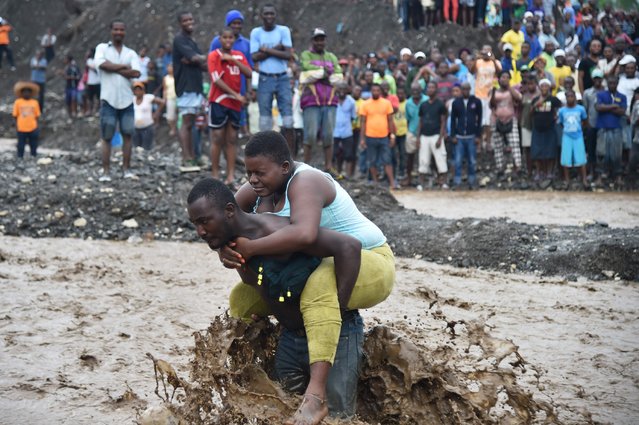
A man carries a woman across a river at Petit Goave where a bridge collapsed during the rains of the Hurricane Matthew, southwest of Port-au-Prince, October 5, 2016. (Photo by Hector Retamal/AFP Photo)
07 Oct 2016 09:52:00,post received
0 comments

Cast member Charlize Theron attends the “Atomic Blonde” World Premiere at Stage Theater on July 17, 2017 in Berlin, Germany. (Photo by Alamy Stock Photo)
23 Jul 2017 07:47:00,post received
0 comments

Norma Galicia aka “Pirulina” takes part in a demonstration during the commemoration of the International Day for the Elimination of Violence Against Women, in Guatemala City on November 25, 2013. So far this year, 696 women have died due to violent events in Guatemala. (Photo by Johan Ordonez/AFP Photo)
30 Nov 2013 13:39:00,post received
0 comments

Ayaka Oshita, a 27-year-old diver, practices in preparation for the upcoming seasonal feeding performance as a Santa diver at Sunshine Aquarium at Ikebukuro in Tokyo, Japan, 07 December 2021. Oshita has 15-month experience for feeding fish at the aquarium after she joined the aquarium in 2019. The Santa diver performance will be held for three days around the Christmas time. The aquarium will not inform the performance time to avoid the visitors' crowd due to the COVID-19 pandemic. (Photo by Kimimasa Mayama/EPA/EFE)
22 Dec 2021 07:27:00,post received
0 comments
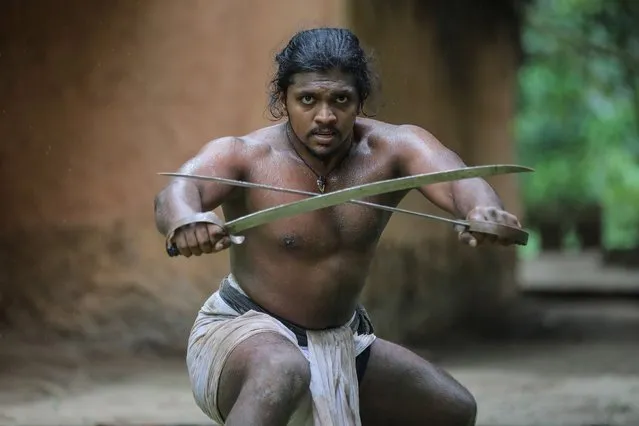
A student of the Sri Lankan ancient martial art “Angampora” performs during a practice session at the angam maduwa or fighting field, in Korathota, a suburb of Colombo, Sri Lanka, 07 September 2022. Sri Lanka's ancient martial art, Angampora, is thought to be thousands of years old. Anga translates to “body parts” and Angampora is a fighting art that uses body parts. Martial arts practitioners in Angampora were mostly in the king's service, and they were tasked with protecting the king and his kingdom. Angampora was practiced in secret for most centuries because the British, who colonized Sri Lanka, banned it in 1818 after seeing it as a threat. (Photo by Chamila Karunarathne/EPA/EFE)
14 Oct 2022 04:47:00,post received
0 comments

Welsh actress and television personality Amber Davies poses on a motorbike in the last decade of September 2023 – as she prepares to go full throttle for next year’s Dancing on Ice title. (Photo by Mark Hayman – Fabulous)
21 Oct 2023 03:59:00,post received
0 comments