“I am Kylie, a young digital artist based in Singapore. I am inspired by things like shyness and dreams and escapism”. – Kylie Woon. Photo: Temporary blindness. (Photo by Kylie Woon)
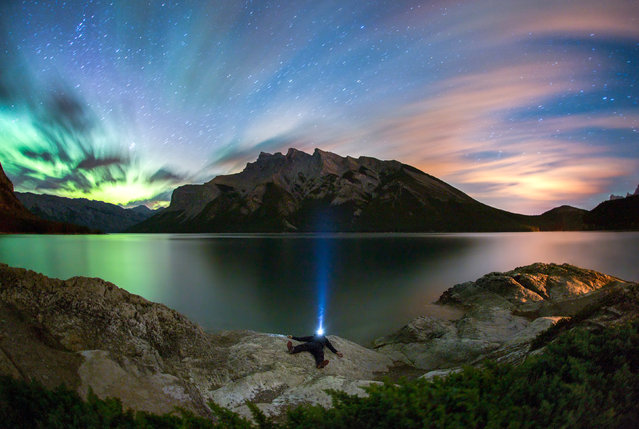
A landscape photographer turned the camera on himself to take a set of incredible selfie while visiting some of the world's most beautiful destinations. Paul Zizka, 39, from Alberta, Canada, has been a photographer for nine years, and thought that featuring in his own pictures would emphasize the nature surrounding him and create a more unique shot. Here: Lake Minnewanka, Banff National Park, Alberta, Canada. (Photo by Paul Zizka/Caters News Agency)
A workman sweeping the highest sidewalk in the world, the 81st story of the Empire State Building, the world's tallest building, to the top of which the greatest dirigible “Los Angeles” will attempt to moor, New York, New York, early 1930s. This photo was made 1,248 feet above street level. (Photo by Adam Glickman/Underwood Archives/Getty Images)
National Geographic invites photographers from around the world to enter the 2013 National Geographic Photography Contest. The grand-prize winner will receive $10,000 (USD) and a trip to National Geographic headquarters in Washington, D.C., to participate in the annual National Geographic Photography Seminar in January 2014. Photo: “We just want to move to search to the Leopard at that morning but we found a group of giraffes come toward a small lake and start drinking it was a nice moment when the Giraffe finish from drinking and leave a letters “S” with motion in the air”. (Photo and caption by Majed Ali/National Geographic Photography Contest)
Paramasivan points to the statue of sun god Surya at a temple outside the Kodaikanal Solar Observatory, India, February 5, 2017. In the early morning darkness, Devendran P. walks up a hill to a solar observatory in India's southern hill town of Kodaikanal, trudging the same path his father and grandfather walked in a century-old family tradition of studying the sun. (Photo by Danish Siddiqui/Reuters)
On August 31, 2012, a long filament of solar material that had been hovering in the sun's atmosphere, the corona, erupted out into space at 4:36 p.m. EDT. The coronal mass ejection, or CME, traveled at over 900 miles per second. The CME did not travel directly toward Earth, but did connect with Earth's magnetic environment, or magnetosphere, causing aurora to appear on the night of Monday, September 3. (Photo by NASA/GSFC/SDO via The Atlantic)
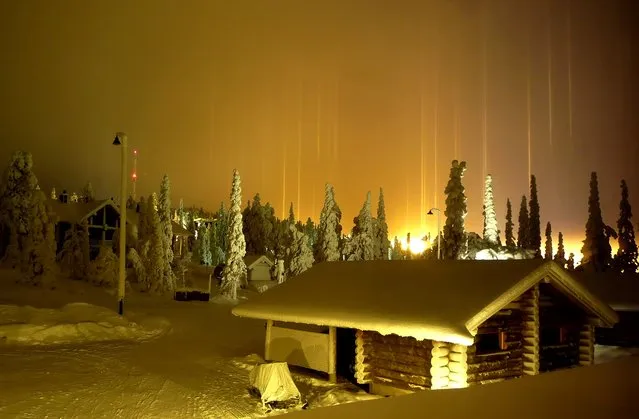
A light pillar is a visual phenomenon created by the reflection of light from ice crystals with near horizontal parallel planar surfaces. The light can come from the Sun (usually at or low to the horizon) in which case the phenomenon is called a sun pillar or solar pillar. It can also come from the Moon or from terrestrial sources such as streetlights.
China's Yanni Wu looks on as she stands with officials following a false start during the women's 100m hurdles final at Olympic Sports Centre Stadium in Hangzhou, China on October 1, 2023. (Photo by Dylan Martinez/Reuters)