Loading...
Done
A baby turtle's perilous first moments are captured as it takes to the sea for the first time on Heron Island in Queensland, Australia in July 2022. Predators such as sharks, birds, and pollution mean that approximately only one out of every 1000 turtles that hatch make it to adulthood, with some not even reaching open ocean. Amateur photographer (Photo by Hannah Mitchell/Solent News & Photo Agency)

A baby turtle's perilous first moments are captured as it takes to the sea for the first time on Heron Island in Queensland, Australia in July 2022. Predators such as sharks, birds, and pollution mean that approximately only one out of every 1000 turtles that hatch make it to adulthood, with some not even reaching open ocean. Amateur photographer (Photo by Hannah Mitchell/Solent News & Photo Agency)
Details
06 Oct 2023 04:29:00
Iraqi Kurds carry fire torches as they celebrate Nowruz Day, a festival marking the first day of spring, Kurdish and Persian New Year in Akre, Iraq on March 20, 2024. Newroz or Nowruz means “new day” in Persian, and is celebrated to mark the arrival of spring and the first day of the Iranian calendar. It is widely celebrated in Persian and neighboring regions and is recognized on UNESCO's Intangible Cultural Heritage of Human List. (Photo by Ismael Adnan/SOPA Images/Rex Features/Shutterstock)

Iraqi Kurds carry fire torches as they celebrate Nowruz Day, a festival marking the first day of spring, Kurdish and Persian New Year in Akre, Iraq on March 20, 2024. Newroz or Nowruz means “new day” in Persian, and is celebrated to mark the arrival of spring and the first day of the Iranian calendar. It is widely celebrated in Persian and neighboring regions and is recognized on UNESCO's Intangible Cultural Heritage of Human List. (Photo by Ismael Adnan/SOPA Images/Rex Features/Shutterstock)
Details
29 Mar 2024 05:30:00
A devotee gestures after being flogged by a reveler dressed as a devil during a mass celebration of the “Talciguines” of Texistepeque, El Salvador on Easter Monday, April 3, 2023. In the Nahuatl, Talciguin means “deviled men”, a traditional procession performed during Easter monday to represent the fight against the devil of the Christian prophet Jesus Christ. (Photo by Camilo Freedman/SOPA Images/Rex Features/Shutterstock)

A devotee gestures after being flogged by a reveler dressed as a devil during a mass celebration of the “Talciguines” of Texistepeque, El Salvador on Easter Monday, April 3, 2023. In the Nahuatl, Talciguin means “deviled men”, a traditional procession performed during Easter monday to represent the fight against the devil of the Christian prophet Jesus Christ. (Photo by Camilo Freedman/SOPA Images/Rex Features/Shutterstock)
Details
06 Apr 2023 03:48:00
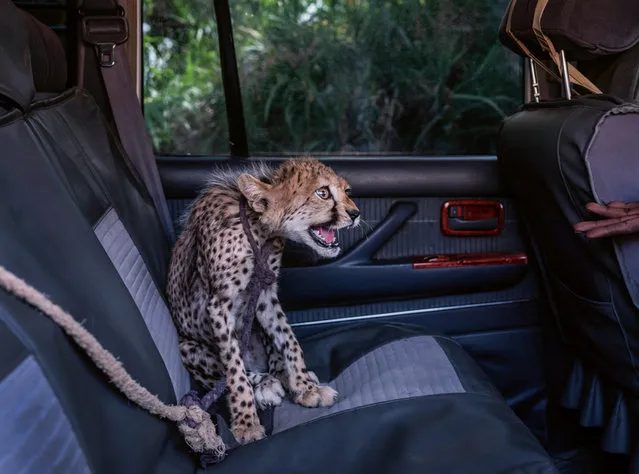
A five-month-old cheetah seated in the back of a Land Cruiser growls at an outstretched hand after being taken from traffickers in Ethiopia and driven to Harirad, Somaliland, in 2020. This photo is part of the work of more than 100 artists in Why We Photograph Animals, a new collection of wildlife photography that aims to help understand why people have photographed animals at different points in history and what it means in the present. (Photo by Nichole Sobecki/Thames & Hudson)

A five-month-old cheetah seated in the back of a Land Cruiser growls at an outstretched hand after being taken from traffickers in Ethiopia and driven to Harirad, Somaliland, in 2020. This photo is part of the work of more than 100 artists in Why We Photograph Animals, a new collection of wildlife photography that aims to help understand why people have photographed animals at different points in history and what it means in the present. (Photo by Nichole Sobecki/Thames & Hudson)
Details
28 Apr 2024 03:15:00
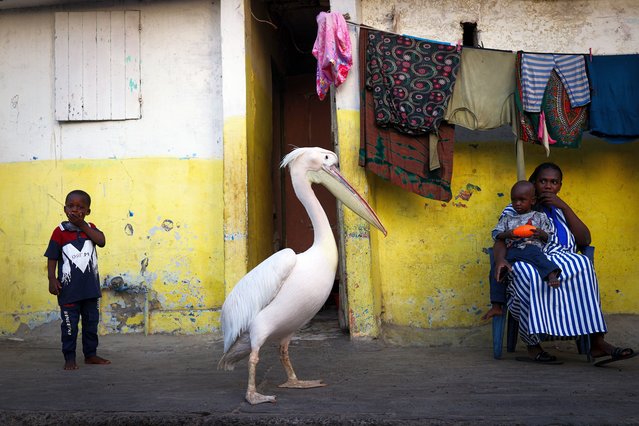
The pelican, named “Ndagabar”, which means pelican in the local Wolof language, begins visiting the neighborhood in the early hours of the day in Saint-Louis, Senegal on November 02, 2024. The pelican, which 62-year-old retired fisherman Madiop Gueye, has been keeping in front of his house for five years, has become the center of both the neighborhood and the region, attracting the attention of both local and foreign tourists. (Photo by Cem Ozdel/Anadolu via Getty Images)

The pelican, named “Ndagabar”, which means pelican in the local Wolof language, begins visiting the neighborhood in the early hours of the day in Saint-Louis, Senegal on November 02, 2024. The pelican, which 62-year-old retired fisherman Madiop Gueye, has been keeping in front of his house for five years, has become the center of both the neighborhood and the region, attracting the attention of both local and foreign tourists. (Photo by Cem Ozdel/Anadolu via Getty Images)
Details
10 Nov 2024 03:59:00
A tourist carries her luggage in a flooded St. Mark's Square, in Venice, Wednesday, November 13, 2019. The high-water mark hit 187 centimeters (74 inches) late Tuesday, Nov. 12, 2019, meaning more than 85% of the city was flooded. The highest level ever recorded was 194 centimeters (76 inches) during infamous flooding in 1966. (Photo by Luca Bruno/AP Photo)

A tourist carries her luggage in a flooded St. Mark's Square, in Venice, Wednesday, November 13, 2019. The high-water mark hit 187 centimeters (74 inches) late Tuesday, Nov. 12, 2019, meaning more than 85% of the city was flooded. The highest level ever recorded was 194 centimeters (76 inches) during infamous flooding in 1966. (Photo by Luca Bruno/AP Photo)
Details
05 Feb 2020 00:01:00
A 13-month-old chimp named Fumo carries a “Christmas present” of food treats in wrapping paper under his arm during a Christmas-themed feeding time at Sydney's Taronga Park Zoo, December 9, 2014. Fumo, meaning “chief” or “spear” in Swahili, is one of the latest additions to the zoo's successful primate breeding program. (Photo by Jason Reed/Reuters)

A 13-month-old chimp named Fumo carries a “Christmas present” of food treats in wrapping paper under his arm during a Christmas-themed feeding time at Sydney's Taronga Park Zoo, December 9, 2014. Fumo, meaning “chief” or “spear” in Swahili, is one of the latest additions to the zoo's successful primate breeding program. (Photo by Jason Reed/Reuters)
Details
09 Dec 2014 09:32:00
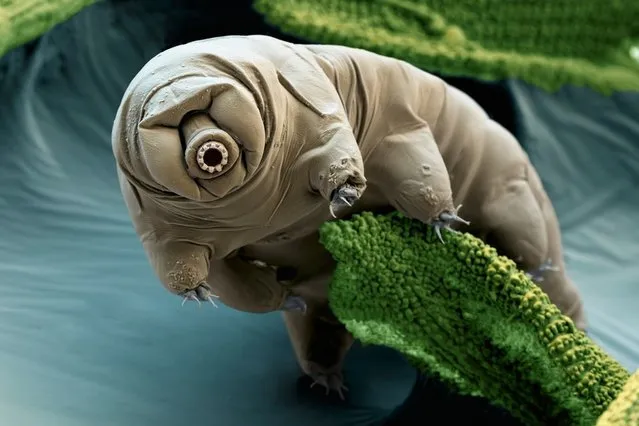
Tardigrades (commonly known as waterbears or moss piglets). (Photo by SPL/East News)

“Tardigrades (commonly known as waterbears or moss piglets) are small, water-dwelling, segmented animals with eight legs. Tardigrades were first discovered in 1773 by Johann August Ephraim Goeze, who called them kleiner Wasserbär, meaning “little water bear” in German. The name Tardigrada means “slow walker” and was given by Lazzaro Spallanzani in 1777. The name water bear comes from the way they walk, reminiscent of a bear's gait. The biggest adults may reach a body length of 1.5 millimetres (0.059 in), the smallest below 0.1 mm. Freshly hatched tardigrades may be smaller than 0.05 mm”. – Wikipedia. Photo: Tardigrades. (Photo by SPL/East News)
Details
26 Sep 2012 09:55:00