Leon Sejranovic, Stacey Hymer and Bailey Lewis pose in Melbourne on May 21, 2024, as they are announced as the Australian taekwondo team for the Paris Olympics. (Photo by Quinn Rooney/Getty Images)
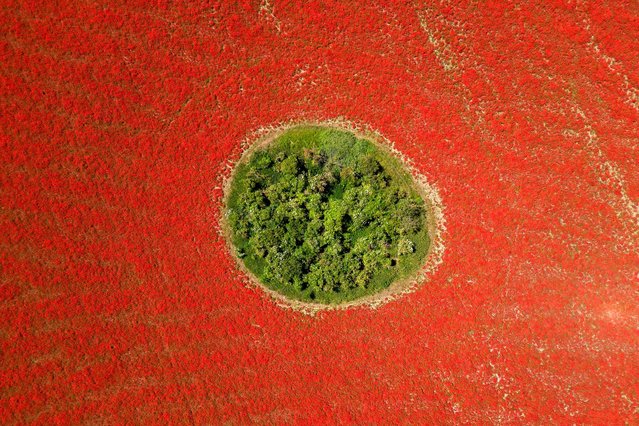
A field of poppies in flower in Great Massingham, Norfolk, UK on Tuesday, June 25, 2024. The field has been rewilded by the landowner, with the soil being ploughed and harrowed before being left for nature to run its course with the result being a huge sea of red poppies. (Photo by Joe Giddens/PA Images via Getty Images)
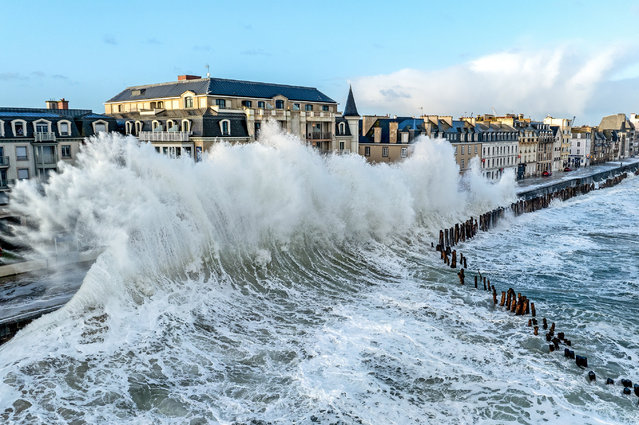
Waves to the height of 10m reaching 20-30m at the point of impact smashed against the coastline of the idyllic coastal city of Saint Malo, France on April 10, 2024. The extreme tidal waves were the result of Storm Pierrick. (Photo by Mathieu Rivrin/Solent News & Photo Agency)
A person smokes marijuana as marijuana enthusiasts mark the informal annual cannabis holiday, 4/20 (four-twenty), corresponding to the numerical figure widely recognized within the cannabis subculture as a symbol for all things related to marijuana, in Hyde Park in London, Britain on April 20, 2023. (Photo by Maja Smiejkowska/Reuters)
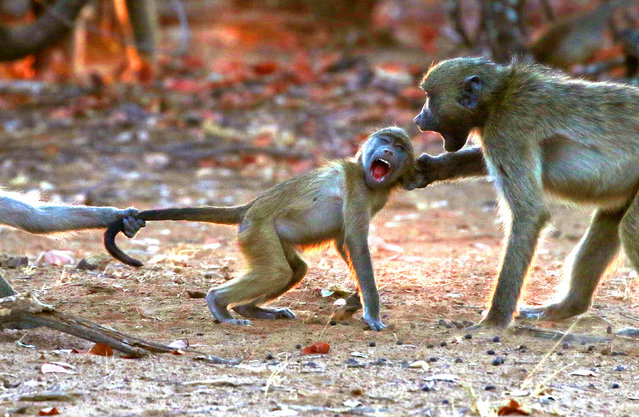
A young baboon receives an earful from an adult as another primate yanks its tail at Kruger National Park, South Africa in the first decade of July 2024. (Photo by John Mullineux/Solent News)
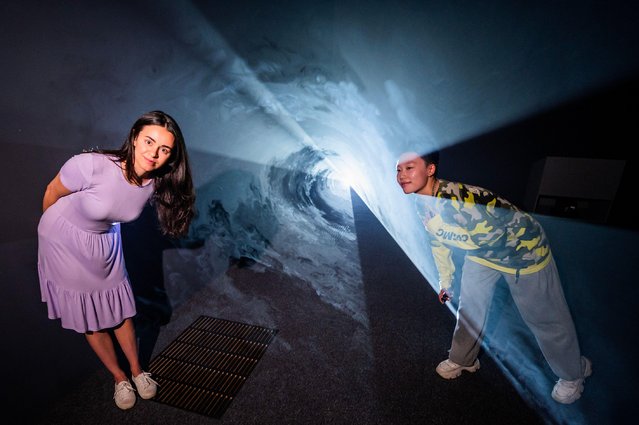
Solid Light, an exhibition of the immersive works of Anthony McCall, opens at Tate Modern in London on June 25, 2024. Installations use beams of light projected through a thin mist to create large three-dimensional forms. (Photo by Guy Bell/Alamy Live News)
British Alex Yee looks exhausted after the men's individual triathlon race at the Paris 2024 Olympic Games, on Wednesday 31 July 2024 in Paris, France. (Photo by Tom Jenkins/The Guardian)
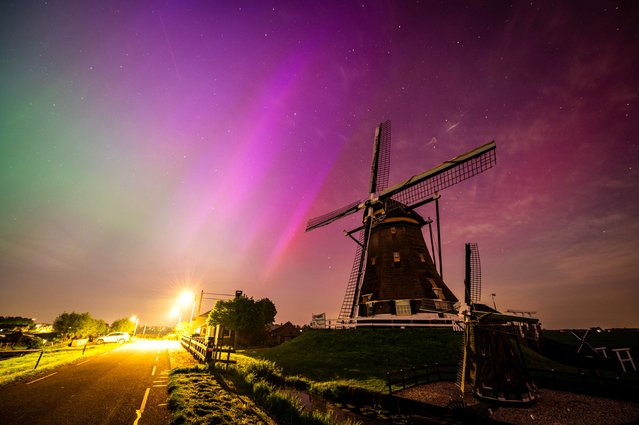
The Northern lights (aurora borealis) lights up the night sky above the Molenviergang in Aarlanderveen, the Netherlands, early on 11 May 2024. The National Oceanic and Atmospheric Administration (NOAA) of America has warned that the strongest geomagnetic storm for 20 years is set to hit Earth, making the Aurora Borealis, or Northern Lights, visible at much lower geomagnetic latitudes than usual. (Photo by Josh Walet/EPA/EFE/Rex Features/Shutterstock)