Loading...
Done
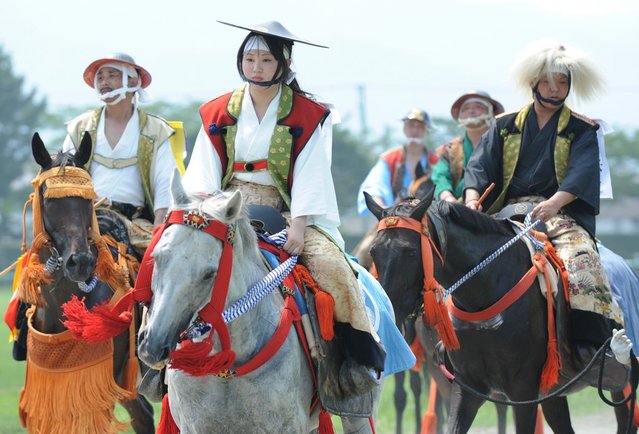
A young woman (C) clad in samurai costume leads other local poeple as she rides her horse during a parade at the annual Soma Nomaoi festival in Minamisoma, Fukushima Prefecture, on July 28, 2012.  The traditional full-scale festival kicked off for the first time after the accident of the Fukushima Dai-ichi Nuclear Power Plant following the massive earthquake and the tsunami on March 11, 2011. (Photo by Toru Yamanaka/AFP Photo)

Soma-Nomaoi is a festival that recreates a battle scene from more than 1,000 years ago. It is annually held for 4 days from July 22 to 25 in Haramachi City, Fukushima Prefecture, in the eastern part of Japan. In this historical event, 600 mounted samurai in traditional Japanese armor, with long swords at their side and ancestral flagstaffs streaming from their backs, ride across open fields. Soma-Nomaoi has been designated an Important Intangible Folk Cultural Property.

Photo: A young woman (C) clad in samurai costume leads other local poeple as she rides her horse during a parade at the annual Soma Nomaoi festival in Minamisoma, Fukushima Prefecture, on July 28, 2012. The traditional full-scale festival kicked off for the first time after the accident of the Fukushima Dai-ichi Nuclear Power Plant following the massive earthquake and the tsunami on March 11, 2011. (Photo by Toru Yamanaka/AFP Photo)
Details
02 Aug 2012 12:59:00
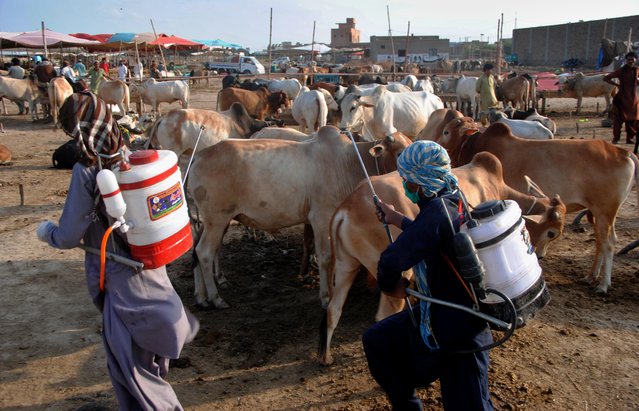
Health workers wearing face masks spray disinfectant liquid on sacrificial animals amid concerns over the spread of the SARS-CoV-2 coronavirus that causes the pandemic COVID-19 disease ahead of the Muslim festival of Eid al-Adha at an animal market in Hyderabad, southern Pakistan, 21 July 2020. Eid al-Adha, also known as the Festival of the Sacrifice, is the second and holiest of the two main Islamic holidays celebrated each year (the other one being Eid al-Fitr). Every year, on the 10th day of the Islamic lunar month of Dhu al-Hijjah, Muslims around the world ritually slaughter a sacrificial animal and split the meat into three parts: one is reserved for the family, another for friends and relatives, and the third is given to the poor and needy. The Saudi Supreme Court has declared that the first day of Eid al-Adha this year falls on 31 July. (Photo by Nadeem Khawar/EPA/EFE)

Health workers wearing face masks spray disinfectant liquid on sacrificial animals amid concerns over the spread of the SARS-CoV-2 coronavirus that causes the pandemic COVID-19 disease ahead of the Muslim festival of Eid al-Adha at an animal market in Hyderabad, southern Pakistan, 21 July 2020. (Photo by Nadeem Khawar/EPA/EFE)
Details
23 Jul 2020 00:07:00
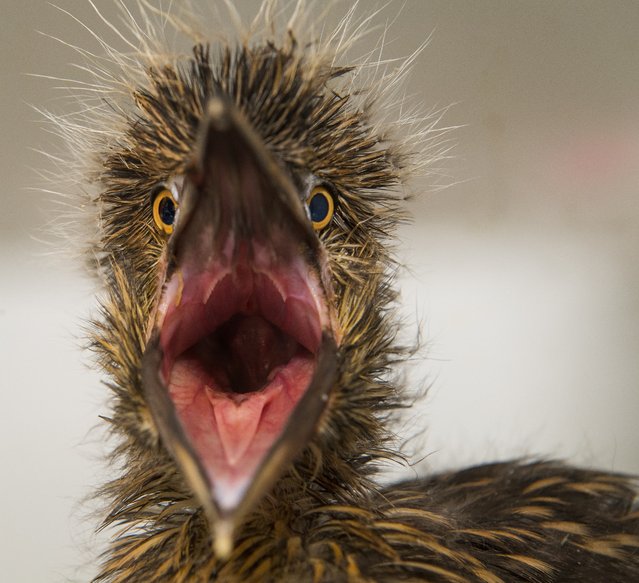
A baby Black-crowned Night Heron squawks in its incubator while being cared for at City Wildlife rescue and rehabilitation center in Washington, DC on May 31, 2017. The heron is one of several that have been brought to CW by the staff at The National Zoo over the past few years. The heron is a native bird and has made an established rookery inside the zoo grounds over a hundred years ago.  Every year at this time, some of the chicks get pushed or fall out of the nest and require human care.  Because the birds are native and not part of the Smithsonian collection, they partnered with CW to rehabilitate the herons for re-release back to the flock inside Zoo. They're reintroduced back to their flock so that they can migrate together in the Fall. The Black-crowned heron usually migrates from the DC area down to southeast North Carolina, some going as far as Jacksonville, FL in winter. The Black-crowned heron is the species of greatest conservation need in the District of Columbia because their numbers are in such rapid decline due to habitat loss. (Photo Linda Davidson/The Washington Post)

A baby Black-crowned Night Heron squawks in its incubator while being cared for at City Wildlife rescue and rehabilitation center in Washington, DC on May 31, 2017. The heron is one of several that have been brought to CW by the staff at The National Zoo over the past few years. (Photo Linda Davidson/The Washington Post)
Details
04 Jun 2017 08:04:00
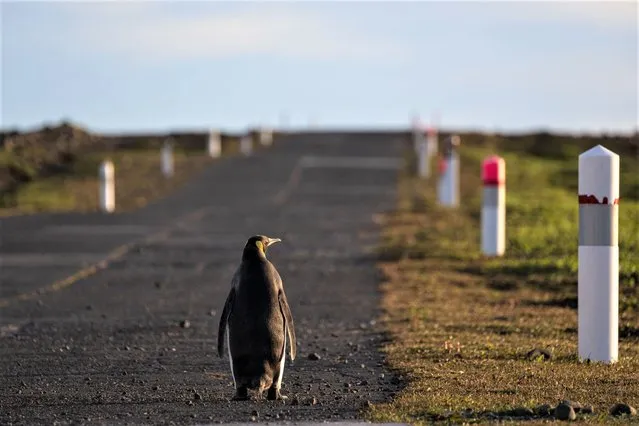
A penguin (Manchots Royaux) walks on the basement area, early morning on December 25, 2022, at the Kerguelen Islands, also known as the Desolation Islands, are a group of islands in the sub-Antarctic. (Photo by Patrick Hertzog/AFP Photo)

A penguin (Manchots Royaux) walks on the basement area, early morning on December 25, 2022, at the Kerguelen Islands, also known as the Desolation Islands, are a group of islands in the sub-Antarctic. (Photo by Patrick Hertzog/AFP Photo)
Details
22 Jan 2023 05:55:00
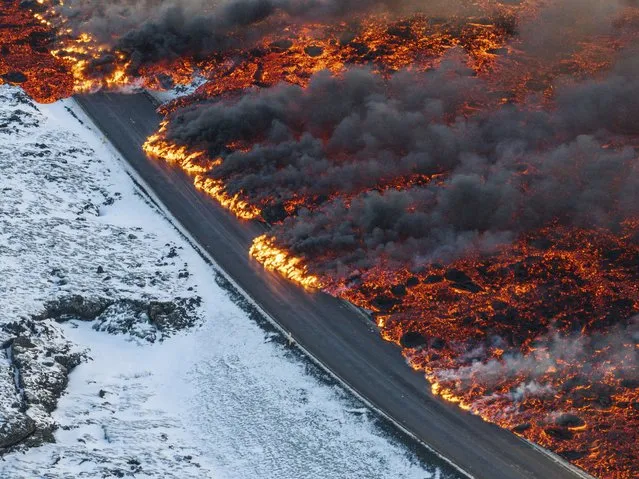
A view of lava crossing the main road to Grindavík and flowing on the road leading to the Blue Lagoon, in Grindavík, Iceland, Thursday, February 8, 2024. A volcano in southwestern Iceland has erupted for the third time since December and sent jets of lava into the sky. The eruption on Thursday morning triggered the evacuation the Blue Lagoon spa which is one of the island nation’s biggest tourist attractions. (Photo by Marco Di Marco/AP Photo)

A view of lava crossing the main road to Grindavík and flowing on the road leading to the Blue Lagoon, in Grindavík, Iceland, Thursday, February 8, 2024. A volcano in southwestern Iceland has erupted for the third time since December and sent jets of lava into the sky. The eruption on Thursday morning triggered the evacuation the Blue Lagoon spa which is one of the island nation’s biggest tourist attractions. (Photo by Marco Di Marco/AP Photo)
Details
17 Feb 2024 06:41:00
A vender arranges goods for sale at a market on the outskirts of Buenos Aires, Argentina, Wednesday, January 10, 2024. (Photo by Natacha Pisarenko/AP Photo)

A vender arranges goods for sale at a market on the outskirts of Buenos Aires, Argentina, Wednesday, January 10, 2024. (Photo by Natacha Pisarenko/AP Photo)
Details
25 Jan 2024 09:55:00
French actress Sophie Marceau and Irish actor Pierce Brosnan in film “The World is Not Enough” by Michael Apted, 1999. (Photo by Keith Hamshere/Sygma via Getty Images)

French actress Sophie Marceau and Irish actor Pierce Brosnan in film “The World is Not Enough” by Michael Apted, 1999. (Photo by Keith Hamshere/Sygma via Getty Images)
Details
26 Mar 2025 03:32:00


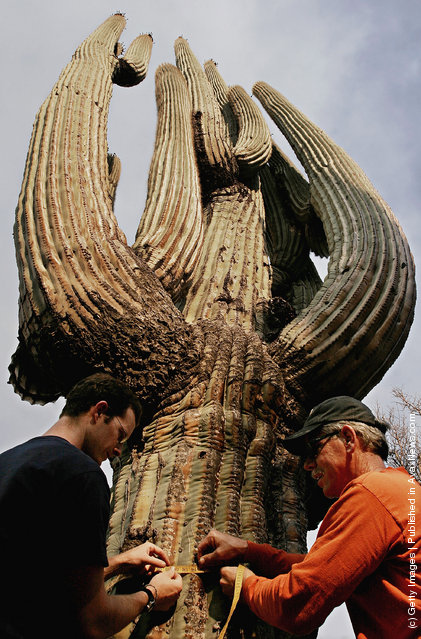
“The saguaro (scientific name Carnegiea gigantea) is a large, tree-sized cactus species in the monotypic genus Carnegiea. It is native to the Sonoran Desert in the U.S. state of Arizona, the Mexican state of Sonora, a small part of Baja California in the San Felipe Desert and an extremely small area of California, U.S. The saguaro blossom is the State Wildflower of Arizona”. – Wikipedia

Photo: Daniel Appel (L), a firefighter with Engine 84 from the Lassen National Forest in California and Mike Hallen, (R), Arizona representative of the National Register of Big Trees, measure the circumference of this Saguaro cactus called the "Grand One," in the Tonto National Forest on July 1, 2005 35 miles north of Phoenix, near Carefree, Arizona. The cactus, estimated to be more than 200 years old, measures a circumference of 7 feet, 10 inches (2.4 meters) and stands 46 feet high (14 meters). The cactus was burned in the Cave Creek Complex fire and may not survive. It was once the largest Saguaro in the world, two others have been found recently that have tied it's measurements. The fire has burned more than 214,000 acres of the Sonoran desert. (Photo by Jeff Topping/Getty Images)
Details
26 Jul 2011 12:27:00