Loading...
Done
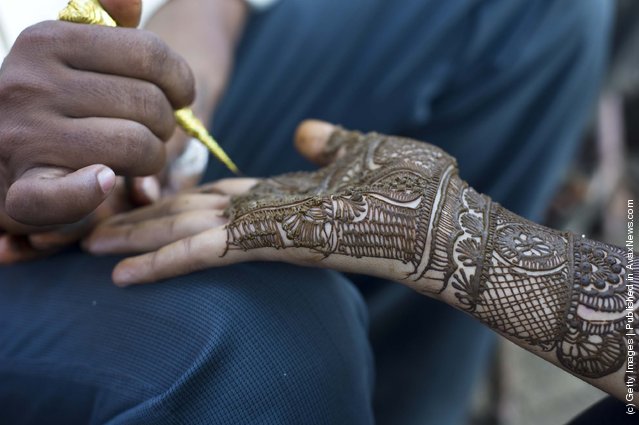
Application of henna or “Mehndi”  to a girls hand in a market in Jaipur, India

“Mehndi or menhdi is the application of henna as a temporary form of skin decoration in India, as well as by expatriate communities from the country. The word mehndi is derived from the Sanskrit word mendhikā. The use of mehndi and turmeric is described in the earliest Vedic ritual books. Haldi (Staining oneself with turmeric paste) as well as mehndi are important Vedic customs as a symbolic representation of the Outer and the Inner Sun. Vedic customs are meant to awaken the “inner light” and so the gold of the inner Sun has an important symbolic function”. – Wikipedia

Photo: Application of henna or “Mehndi” to a girls hand in a market on October 18, 2010 in Jaipur, India. (Photo by Simon de Trey-White/Getty Images)
Details
23 Nov 2011 13:33:00
Abdulahi Yaroow, 13, smokes a cigarette while chewing khat at the same time in Mogadishu August 10, 2014. (Photo by Thomas Mukoya/Reuters)

Abdulahi Yaroow, 13, smokes a cigarette while chewing khat at the same time in Mogadishu August 10, 2014. Grown on plantations in the highlands of Kenya and Ethiopia, tonnes of khat, or qat, dubbed “the flower of paradise” by its users, are flown daily into Mogadishu airport, to be distributed from there in convoys of lorries to markets across Somalia. Britain, whose large ethnic Somali community sustained a lucrative demand for the leaves, banned khat from July as an illegal drug. This prohibition jolted the khat market, creating a supply glut in Somalia and pushing down prices, to the delight of the many connoisseurs of its amphetamine-like high. (Photo by Thomas Mukoya/Reuters)
Details
28 Aug 2014 10:35:00
Mangli Munda poses on her wedding day with a stray dog in Jharkhand, India on August 30, 2014. An 18-year-old Indian girl has married a stray dog as a part of a tribal ritual designed to ward off an evil spell. (Photo by Barcroft Media/ABACAPress)

Mangli Munda poses on her wedding day with a stray dog in Jharkhand, India on August 30, 2014. An 18-year-old Indian girl has married a stray dog as a part of a tribal ritual designed to ward off an evil spell. Village elders hastily organised the wedding between Mangli Munda and the canine as the teenager is believed to be bringing bad luck to her community in a remote village in Jharkhand state. Mangli's father Sri Amnmunda agreed and even found a stray dog named Sheru as a match for his daughter. And while Mangli was a hesitant bride, she believes that the ceremony will help ensure that her future human husband will have a long life. (Photo by Barcroft Media/ABACAPress)
Details
04 Sep 2014 08:31:00
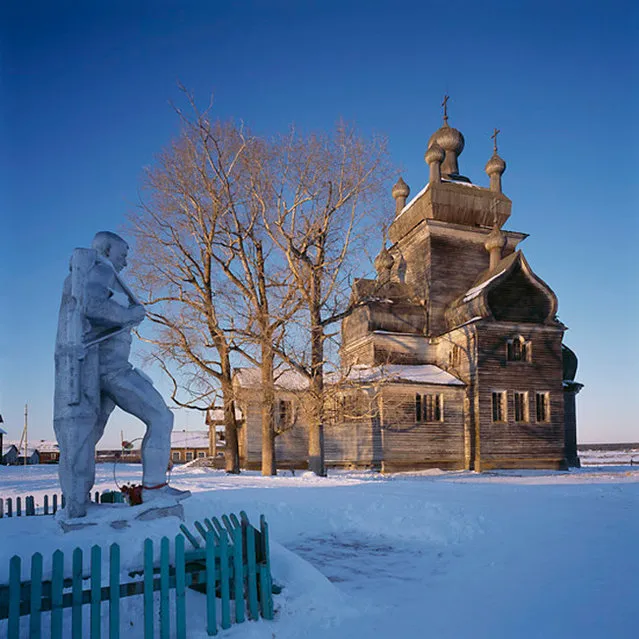
Wooden Churches - Travelling In The Russian North By Richard Davies Part 2

While communism, collectivism, worms, dry rot and casual looting failed to destroy the majestic wooden churches of Russia, it may be ordinary neglect that finally does them in. Dwindled now to several hundred remaining examples, these glories of vernacular architecture lie scattered amid the vastness of the world’s largest country. Just over a decade ago, Richard Davies, a British architectural photographer, struck out on a mission to record the fragile and poetic structures. Austerely beautiful and haunting, “Wooden Churches: Traveling in the Russian North” (White Sea Publishing; $132) is the result. Covering thousands of miles, Mr. Davies described how he and the writer Matilda Moreton tracked down the survivors from among the thousands of onion-domed structures built after Prince Vladimir converted to Christianity in 988.

See also: Wooden Churches Part1
Details
28 Nov 2013 12:13:00
Filipino typhoon victims walk through heavy mud in the typhoon hit town of Taft, Samar island, Philippines, 08 December 2014. Typhoon Hagupit weakened into a tropical storm as it moved towards the Philippine capital after killing at least 27 people and displacing more than one million people in the eastern and central provinces. (Photo by Francis R. Malasig/EPA)

Filipino typhoon victims walk through heavy mud in the typhoon hit town of Taft, Samar island, Philippines, 08 December 2014. Typhoon Hagupit weakened into a tropical storm as it moved towards the Philippine capital after killing at least 27 people and displacing more than one million people in the eastern and central provinces. Hagupit slammed into the country's eastern coast on 06 December evening, bringing heavy rains and gale-force winds that flattened homes, ripped off roofs, and knocked out power and communications. (Photo by Francis R. Malasig/EPA)
Details
10 Dec 2014 11:37:00
Stephen Gough the naked rambler makes his way south through Peebles in the Scottish Borders, following his release from Saughton Prison yesterday after serving his latest sentence on October 6, 2012 in Peebles, Scotland. The rambler has 18 convictions and has been in prison on and off since 2006 with offences ranging from not wearing clothes in front of the sheriff, breach of the peace and contempt of court. (Photo by Jeff J. Mitchell)

“Stephen Gough (born c. 1959), also known as Steve Gough and the Naked Rambler, is an activist, and a British former Royal Marine. In 2003-2004, he walked the length of Great Britain naked. He did it again in 2005-2006, but was arrested in England and in Scotland. He subsequently spent six years in prison, having been repeatedly rearrested for public nudity within a short period, each time he was released. He has spent most of his sentences in Saughton and Perth prisons, in Scotland”. – Wikipedia

Photo: Stephen Gough the naked rambler makes his way south through Peebles in the Scottish Borders, following his release from Saughton Prison yesterday after serving his latest sentence on October 6, 2012 in Peebles, Scotland. (Photo by Jeff J. Mitchell)
Details
07 Oct 2012 08:18:00


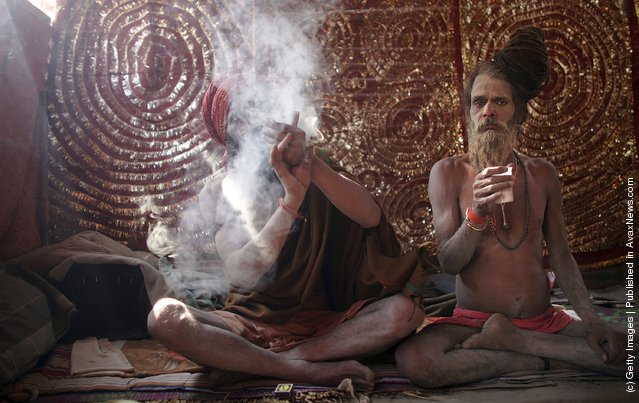
“Kumbh Mela is a mass Hindu pilgrimage in which Hindus gather at the Ganges river. The normal Kumbh Mela is celebrated every 3 years, the Ardh (half) Kumbh Mela is celebrated every six years at Haridwar and Prayag, the Purna (complete) Kumbh takes place every twelve years, at four places (Prayag (Allahabad), Haridwar, Ujjain, and Nashik). The Maha (great) Kumbh Mela which comes after 12 “Purna Kumbh Melas”, or 144 years, is held at Allahabad.

The last Ardh Kumbh Mela was held over a period of 45 days beginning in January 2007, more than 70 million Hindu pilgrims took part in the Ardh Kumbh Mela at Prayag, and on January 15, the most auspicious day of the festival of Makar Sankranti, more than 5 million participated. The previous Maha Kumbh Mela, held in 2001, was attended by around 60 million people, making it at the time the largest gathering anywhere in the world in recorded history”. – Wikipedia

Photo: Sadhus (holy men) smoke at their camp near the ritual site at Sangam, the confluence of the Ganges, Yamuna and mythical Saraswati rivers during the Ardh Kumbh Mela festival (Half Pitcher festival) January 18, 2007 in Allahabad, India. Millions of Hindu pilgrims have flocked to the largest religious gathering in the world which lasts for 45 days in northern India. The festival commemorates the mythical conflict between gods and demons over a pitcher filled with the “nectar of immortality”. Devotees believe that taking a holy dip in the Ganges at this time washes away their sins and paves the path to salvation. (Photo by Mario Tama/Getty Images)
Details
30 Jun 2011 10:27:00
Ocean voyage

Do you think that history is a science? Well, not exactly. First, and foremost, history is the state's “legend of wars”, it’s official regalia. Of course, public historians are not interested in scientific truth – quite the opposite. In this respect, any attempt to present a state’s history as altruistic and benevolent as possible is welcomed and encouraged – as opposed to any revisionism attempts that may be more accurate. In this matter, Chinese have surpassed us all – they revised in highly creative manner (but rather shamelessly) the technology already invented by Europeans, a process that resulted in oldest state on the planet. Here is an interesting paradox: ask any sinologist about the Middle Kingdom during second century B.C., and he will describe it to you in such a vivid manner as if he has been living there all his life – but as soon as you will ask him to describe Chinese history in the 19-20th centuries… let's say, his eagerness will be greatly diminished. However, we will discuss China in a different article, and in the meantime we will try to understand how exactly historic “legend of wars” is formed and functions – based on a specific and well-known example. A great example is Ferdinand Magellan's first voyage around the world.
Details
14 Nov 2011 09:11:00