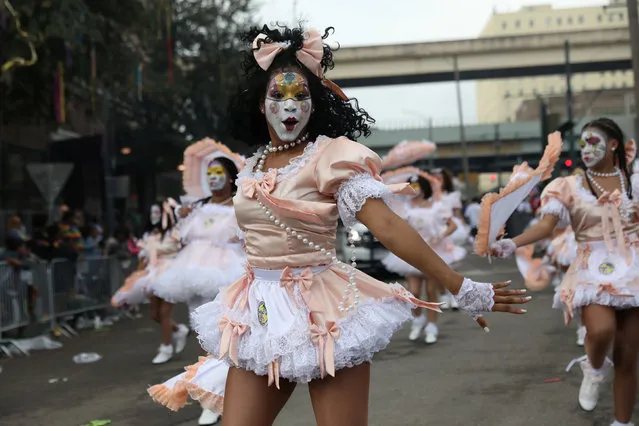
A model presents a creation during The Blonds Autumn/Winter 2017 collection during New York Fashion Week in the Manhattan borough of New York, U.S., February 14, 2017. (Photo by Brendan McDermid/Reuters)
Cattle are the most important way of livelihood for the Karamojong: they provide milk, meat, blood and money when sold, Karamoja, Uganda, February 2017. (Photo by Sumy Sadurni/Barcroft Images)
A production department of a textile factory is seen abandoned in Kaduna, Nigeria November 3, 2016. President Muhammadu Buhari hopes to revive the once flourishing textile and leather industries in northern Nigeria to end the country's dependence on oil exports and diversify Africa's biggest economy. (Photo by Afolabi Sotunde/Reuters)
A Hindu holy man, or sadhu, smokes marijuana in a chillum at the premises of Pashupatinath Temple, ahead of the Shivaratri festival in Kathmandu, Nepal February 15, 2017. (Photo by Navesh Chitrakar/Reuters)
This photograph released by Indian Space Research Organization shows its polar satellite launch vehicle lifting off from a launch pad at the Satish Dhawan Space Centre in Sriharikota, India, Wednesday, February 15, 2017. India's space agency said it successfully launched more than 100 foreign nano satellites into orbit Wednesday aboard a single rocket.(Photo by Indian Space Research Organization via AP Photo)
Underwater photographer of the year – winner. Dancing Octopus by Gabriel Barathieu (France). Location: Island of Mayotte, off the coast of south-east Africa. “Balletic and malevolent”, one judge said of this octopus, hunting in a lagoon. Barathieu waited until spring tides when there was just 30cm of water on the flats and plenty of light in the shallows. (Photo by Gabriel Barathieu/UPY2017)
A woman receives a bouquet made of vegetables and flowers, priced at 238RMB, from a delivery staff of a florist outside an office building on Valentine's Day in Beijing, China, February 14, 2017. (Photo by Jason Lee/Reuters)
Nikolay Skidan, a hunter, carries the skin of a wolf in the village of Khrapkovo, Belarus February 1, 2017. Wolf fur grows thickest in winter, so Belarussian hunter Vladimir Krivenchik only sets his traps once snow is on the ground. He and his wife live on the edge of the Chernobyl exclusion zone – 2,600 square km of land on the Belarus-Ukraine border that was contaminated by a nuclear disaster in 1986. (Photo by Vasily Fedosenko/Reuters)