Loading...
Done
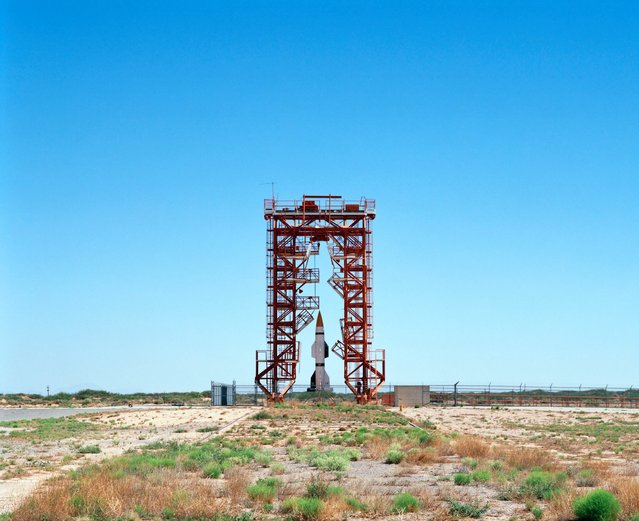
Launch Pad and Gantry with Hermes A-1 Rocket – V2 Launch Complex 33, White Sands missile range, New Mexico in 2006. (Photo by Roland Miller)

Roland Miller is on a mission to document the deserted sites of America’s space race. He has photographed launch pads, bunkhouses and research facilities across the country, some of which no longer exist or are closed to the public on secure military bases. His book, “Abandoned in Place”, is published by the University of New Mexico Press in March. Here: Launch Pad and Gantry with Hermes A-1 Rocket – V2 Launch Complex 33, White Sands missile range, New Mexico in 2006. (Photo by Roland Miller)
Details
25 Feb 2016 11:38:00
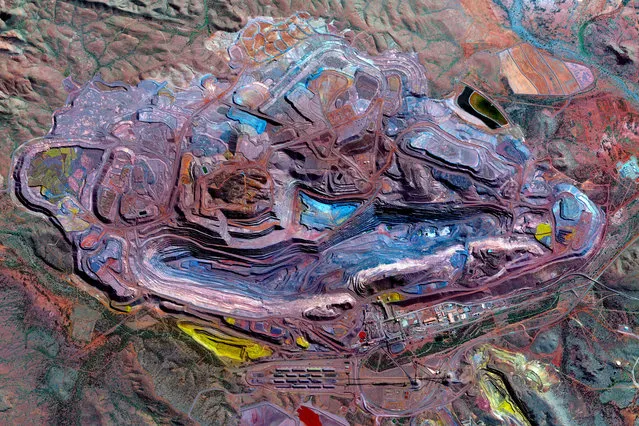
Mount Whaleback iron ore mine 23°21’32.3”S, 119°40’40.1”E. The Mount Whaleback Iron Ore Mine in the Pilbara region of Western Australia. Roughly 98% of the world’s mined iron ore is used to make steel and is thus a significant component in the construction of buildings, automobiles, and appliances such as refrigerators. (Photo by Daily Overview/DigitalGlobe, a Maxar Company)

Mount Whaleback iron ore mine 23°21’32.3”S, 119°40’40.1”E. The Mount Whaleback Iron Ore Mine in the Pilbara region of Western Australia. Roughly 98% of the world’s mined iron ore is used to make steel and is thus a significant component in the construction of buildings, automobiles, and appliances such as refrigerators. (Photo by Daily Overview/DigitalGlobe, a Maxar Company)
Details
16 Nov 2018 00:03:00
Russian cosmonaut Alexander Skvortsov, Expedition 40 flight engineer, attired in a Russian Orlan spacesuit, participates in a session of extravehicular activity (EVA) in support of science and maintenance on the International Space Station on August 18, 2014. During the five-hour, 11-minute spacewalk, Skvortsov and cosmonaut Oleg Artemyev (out of frame) deployed a small science satellite, retrieved and installed experiment packages and inspected components on the exterior of the orbital laboratory. (Photo by NASA)

Russian cosmonaut Alexander Skvortsov, Expedition 40 flight engineer, attired in a Russian Orlan spacesuit, participates in a session of extravehicular activity (EVA) in support of science and maintenance on the International Space Station on August 18, 2014. During the five-hour, 11-minute spacewalk, Skvortsov and cosmonaut Oleg Artemyev (out of frame) deployed a small science satellite, retrieved and installed experiment packages and inspected components on the exterior of the orbital laboratory. (Photo by NASA)
Details
13 Apr 2022 06:53:00
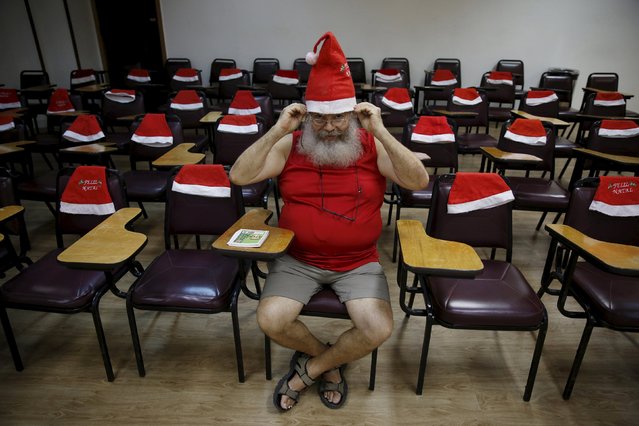
A student of the "Escola de Papai Noel do Brasil" (Brazil's school of Santa Claus) wears his hat before lessons in Rio de Janeiro, Brazil, October 27, 2015. (Photo by Pilar Olivares/Reuters)

A student of the "Escola de Papai Noel do Brasil" (Brazil's school of Santa Claus) wears his hat before lessons in Rio de Janeiro, Brazil, October 27, 2015. The school, which was founded since 1993, prepare men to represent Santa Claus during the Christmas season. Lessons include singing, physical activity, how to dress and how to care for their beard. (Photo by Pilar Olivares/Reuters)
Details
31 Oct 2015 08:03:00
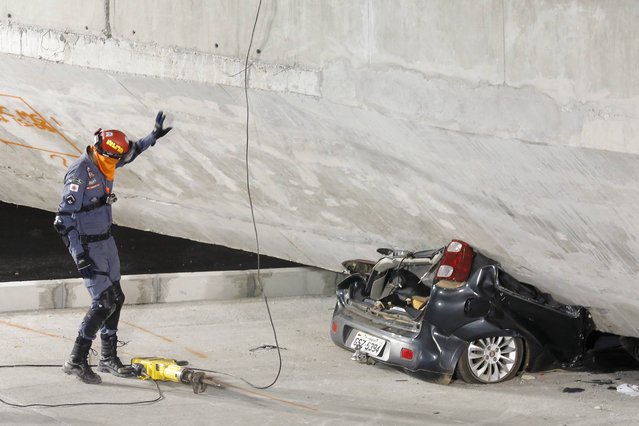
A policeman looks at a car crushed underneath a collapsed bridge in Belo Horizonte, Brazil, Thursday, July 3, 2014. The overpass under construction collapsed Thursday in the Brazilian World Cup host city. The incident took place on a main avenue, the expansion of which was part of the World Cup infrastructure plan but, like most urban mobility projects related to the Cup, was not finished on time for the event. (Photo by Victor R. Caivano/AP Photo)

A policeman looks at a car crushed underneath a collapsed bridge in Belo Horizonte, Brazil, Thursday, July 3, 2014. The overpass under construction collapsed Thursday in the Brazilian World Cup host city. The incident took place on a main avenue, the expansion of which was part of the World Cup infrastructure plan but, like most urban mobility projects related to the Cup, was not finished on time for the event. (Photo by Victor R. Caivano/AP Photo)
Details
05 Jul 2014 06:46:00
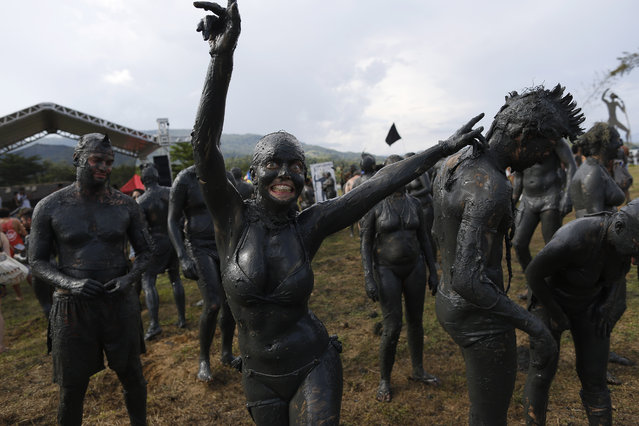
A woman, covered in mud, dances during the traditional “Bloco da Lama” or “Mud Block” carnival party, in Paraty, Brazil, Saturday, February 14, 2015. Revelers in the seaside colonial town threw themselves into deposits of black, mineral-rich slime, emerging covered head-to-toe in the sludge. Bikinis and trunks disappeared beneath the mud, which highlights both gym-pumped pectorals and beer-fed guts. (Photo by Leo Correa/AP Photo)

A woman, covered in mud, dances during the traditional “Bloco da Lama” or “Mud Block” carnival party, in Paraty, Brazil, Saturday, February 14, 2015. Revelers in the seaside colonial town threw themselves into deposits of black, mineral-rich slime, emerging covered head-to-toe in the sludge. Bikinis and trunks disappeared beneath the mud, which highlights both gym-pumped pectorals and beer-fed guts. (Photo by Leo Correa/AP Photo)
Details
16 Feb 2015 13:00:00
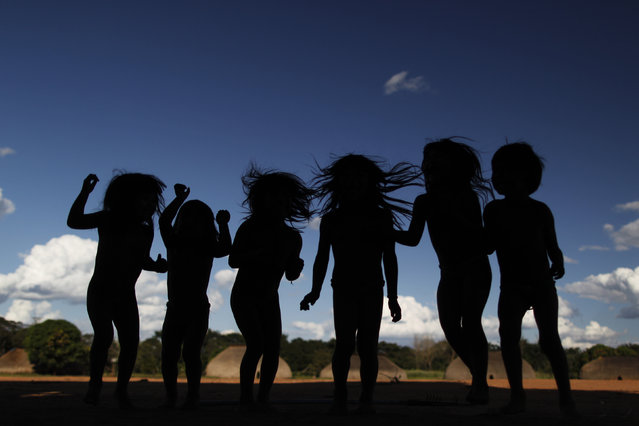
Yawalapiti children play during the preparations for the celebration of “quarup”, a ritual held to honor in death a person of great importance to them, in the Xingu National Park, Mato Grosso State, May 7, 2012. (Photo by Ueslei Marcelino/Reuters)

Yawalapiti children play during the preparations for the celebration of “quarup”, a ritual held to honor in death a person of great importance to them, in the Xingu National Park, Mato Grosso State, May 7, 2012. (Photo by Ueslei Marcelino/Reuters)
Details
16 Oct 2014 13:07:00
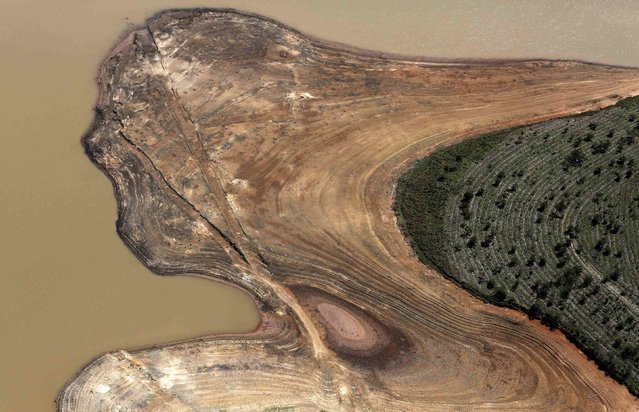
An aerial view of the Atibainha dam, part of the Cantareira reservoir, during a drought in Nazare Paulista, Sao Paulo state November 18, 2014. (Photo by Nacho Doce/Reuters)

An aerial view of the Atibainha dam, part of the Cantareira reservoir, during a drought in Nazare Paulista, Sao Paulo state November 18, 2014. Brazil's worst drought in 80 years has left the Cantareira system, that provides greater Sao Paulo with most of its water, with the lowest water level on record, with daily rationing becoming common in the region's smaller cities, according to the state authorities and the two main reservoirs serving metropolitan Sao Paulo, South America's largest city, could dry out by February if relief does not arrive in the upcoming rainy season. (Photo by Nacho Doce/Reuters)
Details
20 Nov 2014 12:19:00