Loading...
Done
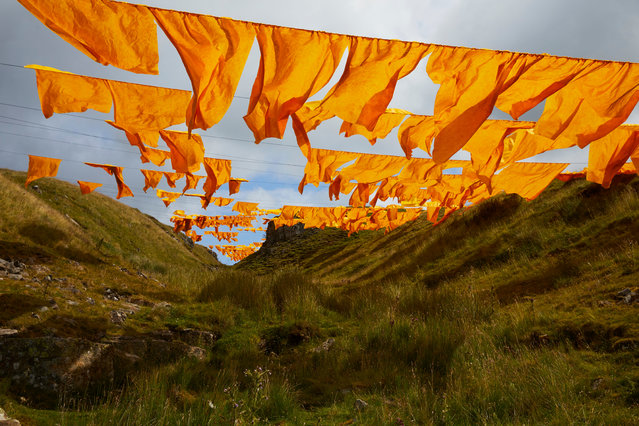
Monumental landscape artwork “Hush” by installation artist Steve Messam hangs in the moors of Teesdale on July 18, 2019 in Barnard Castle, England. The outdoor installation is inspired by the geology, mining history and landscape of the area. It hangs over Bales Hush, a deep gauge in the terrain created when miners flushed the area with water to reveal the geological riches below. Hundreds of metres of recyclable saffron yellow fabric blow in the wind. (Photo by Christopher Thomond/The Guardian)

Monumental landscape artwork “Hush” by installation artist Steve Messam hangs in the moors of Teesdale on July 18, 2019 in Barnard Castle, England. The outdoor installation is inspired by the geology, mining history and landscape of the area. It hangs over Bales Hush, a deep gauge in the terrain created when miners flushed the area with water to reveal the geological riches below. Hundreds of metres of recyclable saffron yellow fabric blow in the wind. (Photo by Christopher Thomond/The Guardian)
Details
20 Jul 2019 00:03:00
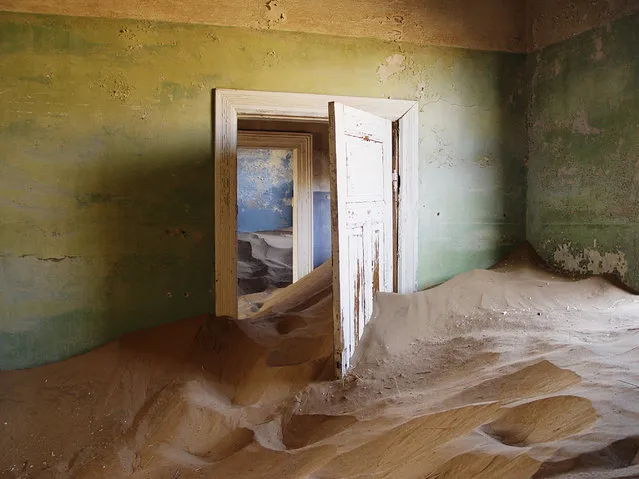
Kolmanskop Abandoned Ghost Town

In 1908 the black worker Zacharias Lewala found a diamond while working in this area and showed it to his supervisor, the German railroad inspector August Stauch. After realizing that this area is rich of diamonds, lots of German miners settled in this area and soon after the German government declared a large area as a "Sperrgebiet", starting to exploit the diamond field.
Details
02 Apr 2013 10:12:00
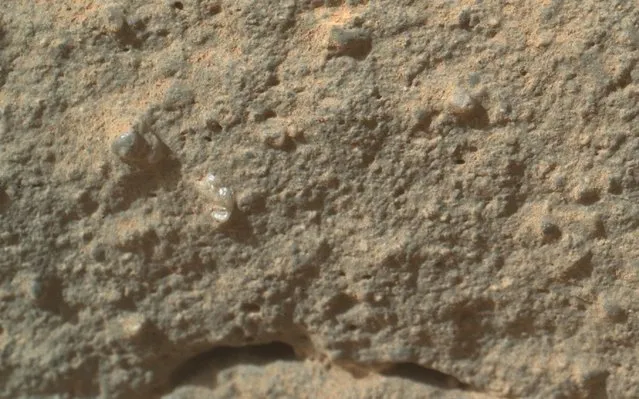
Scientists say that a “Martian flower”, seen here in an image from the Curiosity rover's Mars Hand Lens Imager, is a 2-millimeter-wide grain or pebble that's embedded in the surrounding rock. Another, darker-colored mineral grain can be seen above and to the left. (Photo by NASA)

“The scientists behind NASA's $2.5 billion Curiosity rover mission on Mars on Tuesday explained the nature of a tiny, gleaming "flower" embedded in Red Planet rock, and revealed where they'll be using the SUV-sized robot's drill for the first time”. – Alan Boyle via NBCNews.com

Photo: Scientists say that a “Martian flower”, seen here in an image from the Curiosity rover's Mars Hand Lens Imager, is a 2-millimeter-wide grain or pebble that's embedded in the surrounding rock. Another, darker-colored mineral grain can be seen above and to the left. (Photo by NASA)
Details
16 Jan 2013 11:12:00
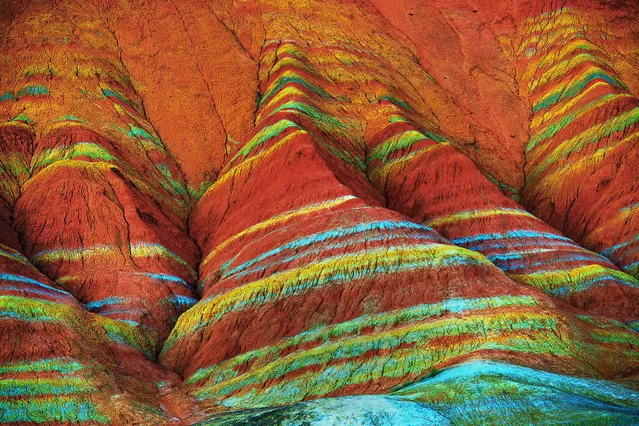
View of colourful rock formations at the Zhangye Danxia Landform Geological Park in Gansu Province, China. The Zhangye Danxia Landform Geological Park is 40km from Zhangye city. The park spans more than 400 square kilometers in Gansu. The unusual terrain is the result of red sandstone and mineral deposits carved over the years by natural forces. A number of boardwalks have been built to encourage visitors to explore the rock formations. (Photo by ImagineChina/The Grosby Group)

View of colourful rock formations at the Zhangye Danxia Landform Geological Park in Gansu Province, China. The Zhangye Danxia Landform Geological Park is 40km from Zhangye city. The park spans more than 400 square kilometers in Gansu. The unusual terrain is the result of red sandstone and mineral deposits carved over the years by natural forces. (Photo by ImagineChina/The Grosby Group)
Details
02 Dec 2013 09:12:00
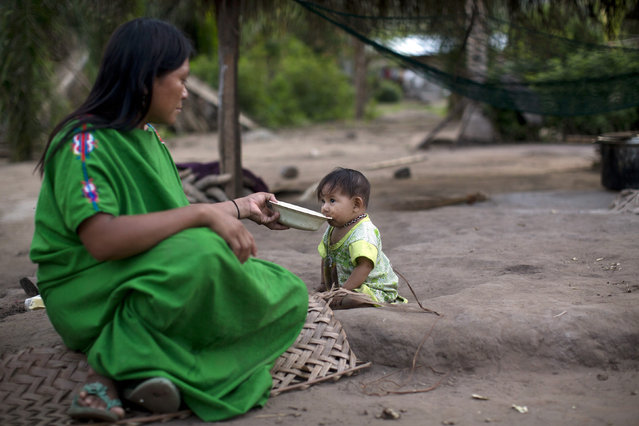
In this November 19, 2015 photo, Ester Melendez feeds banana porridge to her nine-month-old daughter Dina, in Pichiquia, an Ashaninka indigenous community in Peru's Junin region. Incursions and assaults by loggers, miners, colonists and leftist guerrillas have reduced the lands of the Ashaninka people in the Peruvian Amazon, leaving many of the 97,000 members of the group malnourished, despite efforts by the government and independent organizations to help. (Photo by Rodrigo Abd/AP Photo)

In this November 19, 2015 photo, Ester Melendez feeds banana porridge to her nine-month-old daughter Dina, in Pichiquia, an Ashaninka indigenous community in Peru's Junin region. Incursions and assaults by loggers, miners, colonists and leftist guerrillas have reduced the lands of the Ashaninka people in the Peruvian Amazon, leaving many of the 97,000 members of the group malnourished, despite efforts by the government and independent organizations to help. (Photo by Rodrigo Abd/AP Photo)
Details
10 Dec 2015 08:00:00
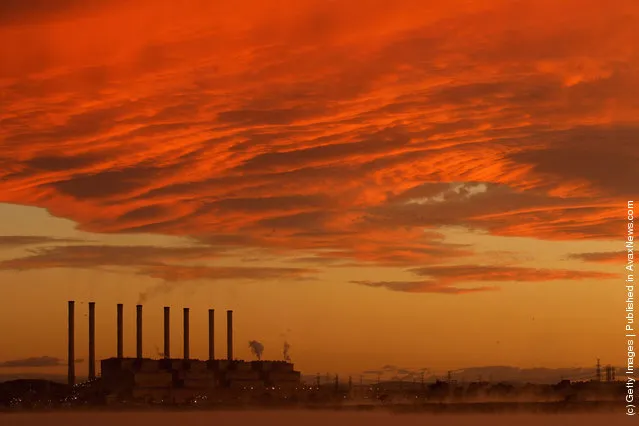
A view of the Hazelwood Power Station across the cooling pondage at sunrise in Melbourne, Australia

A view of the Hazelwood Power Station across the cooling pondage at sunrise on March 21, 2012 in Melbourne, Australia. The brown coal fueled power station, located in Latrobe Valley is the oldest in Victoria and provides the state nearly 25% of its energy. In 2005 Hazelwood was labeled Australia's least carbon efficient power station by WWF Australia and continues to be a target of issue of environmentalist groups. (Photo by Hamish Blair/Getty Images)
Details
21 Mar 2012 08:34:00
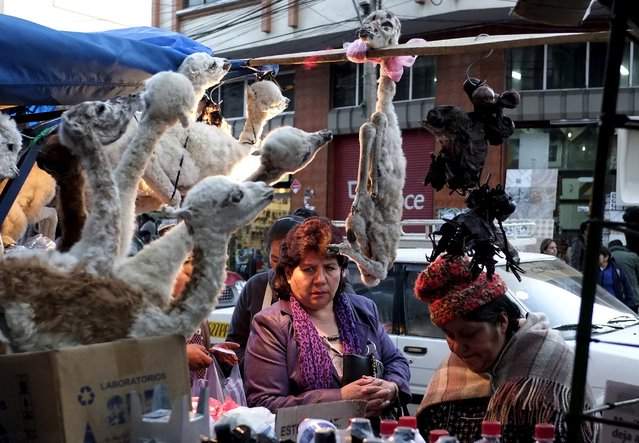
A woman (C) shops for an offering at the witch doctor's street in La Paz, July 31, 2015. (Photo by David Mercado/Reuters)

A woman (C) shops for an offering at the witch doctor's street in La Paz, July 31, 2015. According to Andean culture, the all the month of August is a time to give offerings to “Pachamama” to give thanks for their farms and health. The Aymaras use coca leaves, candies, animal fat, llama fetuses, some dried fruits, powdered minerals and alcohol during these rituals. (Photo by David Mercado/Reuters)
Details
02 Aug 2015 12:27:00
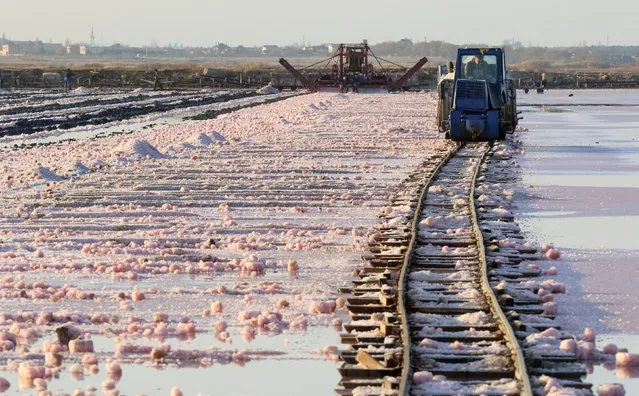
A train drives along a field at a salt production site at the Sasyk-Sivash lake near the city of Yevpatoria, Crimea, November 14, 2017. (Photo by Pavel Rebrov/Reuters)

A train drives along a field at a salt production site at the Sasyk-Sivash lake near the city of Yevpatoria, Crimea, November 14, 2017. A saltwater lagoon known as Lake Sasyk-Sivash on Ukraine's Crimea peninsula is the source of a rare resource: pink salt. The mineral is tinted by tiny algae that produce the pigment beta-carotene. Each autumn, seasonal workers collect thousands of tons of pink salt for processing and export. (Photo by Pavel Rebrov/Reuters)
Details
16 Nov 2017 08:18:00