Loading...
Done
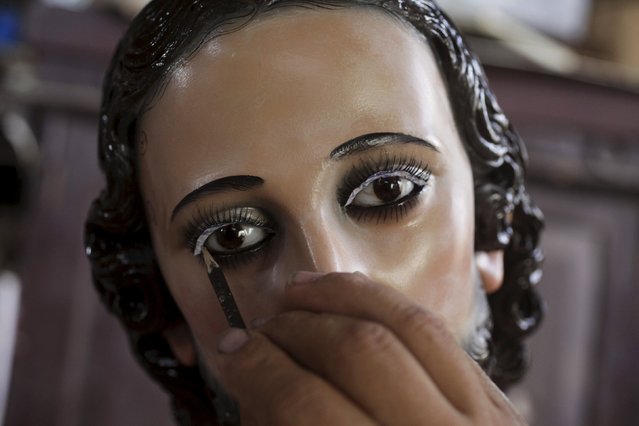
Jose Sabas Gomez pastes eyelashes to a statue of El Jesus Nazareno in his workshop in Apastepeque, El Salvador March 9, 2016. (Photo by Jose Cabezas/Reuters)

Jose Sabas Gomez pastes eyelashes to a statue of El Jesus Nazareno in his workshop in Apastepeque, El Salvador March 9, 2016. Sabas is one of a small number of artists still working on traditional religious art in El Salvador. According to him, there used to be more workshops engaged in the work of restoring statues of saints, but only four remain today as the labor-intensive craft is no longer a popular choice of profession. (Photo by Jose Cabezas/Reuters)
Details
16 Mar 2016 14:14:00
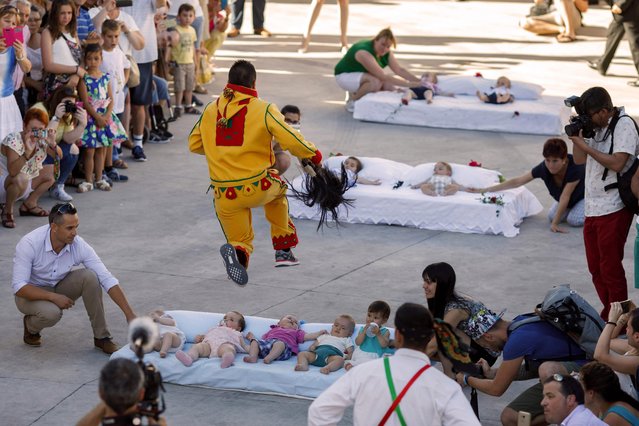
A man dressed up as the devil jumps over babies lying on a mattress in the street during “El Colacho”, the “baby jumping festival” in the village of Castrillo de Murcia, near Burgos on June 18, 2017. Baby jumping (El Colacho) is a traditional Spanish practice dating back to 1620 that takes place annually to celebrate the Catholic feast of Corpus Christi. During the act – known as El Salto del Colacho (the devil's jump) or simply El Colacho – men dressed as the Devil jump over babies born in the last twelve months of the year who lie on mattresses in the street. (Photo by Cesar Manso/AFP Photo)

A man dressed up as the devil jumps over babies lying on a mattress in the street during “El Colacho”, the “baby jumping festival” in the village of Castrillo de Murcia, near Burgos on June 18, 2017. Baby jumping (El Colacho) is a traditional Spanish practice dating back to 1620 that takes place annually to celebrate the Catholic feast of Corpus Christi. During the act – known as El Salto del Colacho (the devil's jump) or simply El Colacho – men dressed as the Devil jump over babies born in the last twelve months of the year who lie on mattresses in the street. (Photo by Cesar Manso/AFP Photo)
Details
20 Jun 2017 07:29:00
In this February 19, 2017 photo, a couple dances during the “If you don't give me....then you lend me” Carnival street party on Ipanema beach, in Rio de Janeiro, Brazil. The typical view of Carnival in Brazil is anything goes, with no headdress too big, no outfit too small, no song too ribald, but this year some organizers of the world's best known party are drawing the line at lyrics that are sexist, homophobic or racist. (Photo by Silvia Izquierdo/AP Photo)

In this February 19, 2017 photo, a couple dances during the “If you don't give me....then you lend me” Carnival street party on Ipanema beach, in Rio de Janeiro, Brazil. The typical view of Carnival in Brazil is anything goes, with no headdress too big, no outfit too small, no song too ribald, but this year some organizers of the world's best known party are drawing the line at lyrics that are sexist, homophobic or racist. (Photo by Silvia Izquierdo/AP Photo)
Details
24 Feb 2017 00:06:00
Participants enjoy the “Color Me Run” festival in Hanoi, Vietnam, 28 May 2016. The festival which was inspired by the Holi Festival from India, attracted thousands of teenagers this year. (Photo by Luong Thai Linh/EPA)

Participants enjoy the “Color Me Run” festival in Hanoi, Vietnam, 28 May 2016. The festival which was inspired by the Holi Festival from India, attracted thousands of teenagers this year. (Photo by Luong Thai Linh/EPA)
Details
29 May 2016 10:39:00
A dog in a purple dress, taken in El Dorado, Arkansas, December 2016. (Photo by Tammy Swarek/Barcroft Images)

A dog in a purple dress, taken in El Dorado, Arkansas, December 2016. The dapper dogs in clothes are back with a second series, and they’re feeling festive. (Photo by Tammy Swarek/Barcroft Images)
Details
23 Dec 2016 07:59:00
Arcelia Aguilar, a resident of “Hogar Jardin De Los Abuelitos”, receives a hug from her niece Maria Aguilar through “El muro de los Abrazos” (The Wall of Hugs) which is a wall made from plastic sheets to protect against the coronavirus, in San Salvador, El Salvador on September 1, 2020. (Photo by Jose Cabezas/Reuters)

Arcelia Aguilar, a resident of “Hogar Jardin De Los Abuelitos”, receives a hug from her niece Maria Aguilar through “El muro de los Abrazos” (The Wall of Hugs) which is a wall made from plastic sheets to protect against the coronavirus, in San Salvador, El Salvador on September 1, 2020. (Photo by Jose Cabezas/Reuters)
Details
03 Sep 2020 00:07:00
Mahmoud El Komy, a 26-year-old Egyptian mechatronics engineer, stands beside Cira 3, a remote-controlled robot that runs tests on suspected coronavirus disease (COVID-19) patients, to limit the human exposure to the virus, amid a second wave of infections in Tanta, Egypt, November 18, 2020. (Photo by Mohamed Abd El Ghany/Reuters)

Mahmoud El Komy, a 26-year-old Egyptian mechatronics engineer, stands beside Cira 3, a remote-controlled robot that runs tests on suspected coronavirus disease (COVID-19) patients, to limit the human exposure to the virus, amid a second wave of infections in Tanta, Egypt, November 18, 2020. (Photo by Mohamed Abd El Ghany/Reuters)
Details
20 Dec 2020 00:01:00
Aymara indigenous women “Martha La Altena” (El Alto's Martha) (R) and “Susana La Bonita” (Pretty Susana) take part in a freestyle wrestling flight in El Alto, on June 29, 2018. “Cholita Fighters” aim to include their show in a tourist route. (Photo by Aizar Raldes/AFP Photo)

Aymara indigenous women “Martha La Altena” (El Alto's Martha) (R) and “Susana La Bonita” (Pretty Susana) take part in a freestyle wrestling flight in El Alto, on June 29, 2018. “Cholita Fighters” aim to include their show in a tourist route. (Photo by Aizar Raldes/AFP Photo)
Details
06 Nov 2022 04:22:00