Loading...
Done
An employee at Christie's auction house examines a complete sub-fossilised elephant bird egg on March 27, 2013 in London, England. The elephant bird egg is expected to fetch 30,000 GBP when it features in Christie's “Travel, Science and Natural History” sale, which is to be held on April 24, 2013 in London.  (Photo by Oli Scarff)

An employee at Christie's auction house examines a complete sub-fossilised elephant bird egg on March 27, 2013 in London, England. The elephant bird egg is expected to fetch 30,000 GBP when it features in Christie's “Travel, Science and Natural History” sale, which is to be held on April 24, 2013 in London. (Photo by Oli Scarff)
Details
28 Mar 2013 12:16:00
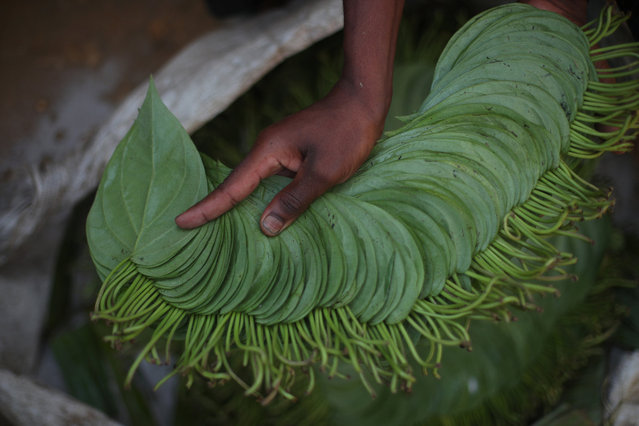
Faruk, 17, a Rohingya refugee trader holds betel leaves which are on sale at a stall in Palong Khali refugee camp near Cox's Bazar, Bangladesh, November 3, 2017. He left his village in Myanmar when the military opened fire towards the Rohingya. “I buy this betel leaf from Palong Khali market, in one bundle there are 160 pieces, I buy it for 80 taka and I sell it for 100 taka. Bangladeshi's and I sell for the same rate in the camp. Outside in the local market it is 80 taka per bundle. My problem is that I don't have money so I can't buy anything to eat, I can't buy fish to eat”, he said. (Photo by Hannah McKay/Reuters)

Faruk, 17, a Rohingya refugee trader holds betel leaves which are on sale at a stall in Palong Khali refugee camp near Cox's Bazar, Bangladesh, November 3, 2017. He left his village in Myanmar when the military opened fire towards the Rohingya. “I buy this betel leaf from Palong Khali market, in one bundle there are 160 pieces, I buy it for 80 taka and I sell it for 100 taka (1 Bangladeshi Taka = 0.012 US Dollar). Bangladeshi's and I sell for the same rate in the camp. Outside in the local market it is 80 taka per bundle. My problem is that I don't have money so I can't buy anything to eat, I can't buy fish to eat”, he said. (Photo by Hannah McKay/Reuters)
Details
27 Nov 2017 08:54:00
Tourists are watching the sunrise from a viewing platform on the Three Gorges Dam in Yichang, China, on June 23, 2024. (Photo by Costfoto/NurPhoto/Rex Features/Shutterstock)

Tourists are watching the sunrise from a viewing platform on the Three Gorges Dam in Yichang, China, on June 23, 2024. (Photo by Costfoto/NurPhoto/Rex Features/Shutterstock)
Details
25 Jun 2024 03:06:00
Top of the world: a former Gurkha (special forces soldier), Nirmal Purja, takes a selfie at the start of his attempt to scale the world’s 14 highest peaks in seven months to break a 31-year-old record. Nirmal Purja, known as Nims, aims to smash the current record – which stands at seven years, 11 months and 14 days – set by Polish climber Jerzy Kukuczka. On the way, he also plans to defeat at least seven speed world records on mountains over 8,000m high. (Photo by PA Wire Press Association)

A former Gurkha (special forces soldier), Nirmal Purja, takes a selfie at the start of his attempt to scale the world’s 14 highest peaks in seven months to break a 31-year-old record. Nirmal Purja, known as Nims, aims to smash the current record – which stands at seven years, 11 months and 14 days – set by Polish climber Jerzy Kukuczka. On the way, he also plans to defeat at least seven speed world records on mountains over 8,000m high. (Photo by Nirmal Purja/PA Wire Press Association)
Details
11 Mar 2019 00:07:00
Eighty one-year-old Sakon Haba (L) wearing loin cloth walks past a police station after he bathed in ice-cold water at the Teppozu Inari shrine in Tokyo January 11, 2015. According to organizers, about 100 participants took part in the Shinto ceremony to purify their souls and wish for good health in the new year. (Photo by Toru Hanai/Reuters)

Eighty one-year-old Sakon Haba (L) wearing loin cloth walks past a police station after he bathed in ice-cold water at the Teppozu Inari shrine in Tokyo January 11, 2015. According to organizers, about 100 participants took part in the Shinto ceremony to purify their souls and wish for good health in the new year. (Photo by Toru Hanai/Reuters)
Details
17 Jan 2015 12:02:00
Kawakanih Yawalapiti, 9, Upper Xingu region of Mato Grosso, Brazil, 2018: Kawakanih lives with her tribe, the Yawalapiti, in Xingu national park, a preserve in the Amazon basin of Brazil. The Yawalapiti collect seeds to preserve species unique to their ecosystem, which lies between the rain forest and savannah. Kawakanih’s diet is simple, consisting mainly of fish, cassava, porridge, fruit and nuts. “It takes five minutes to catch dinner”, says Kawakanih. “When you’re hungry, you just go to the river with your net”. (Photo by Gregg Segal/The Guardian)

Photographer Gregg Segal travelled the world to document children and the food they eat in a week. Partly inspired by the increasing problems of childhood obesity, he tracked traditional regional diets as yet unaffected by globalisation, and ironically, found that the healthiest diets were often eaten by the least well off. (Photo by Gregg Segal/The Guardian)
Details
03 Jul 2019 00:03:00
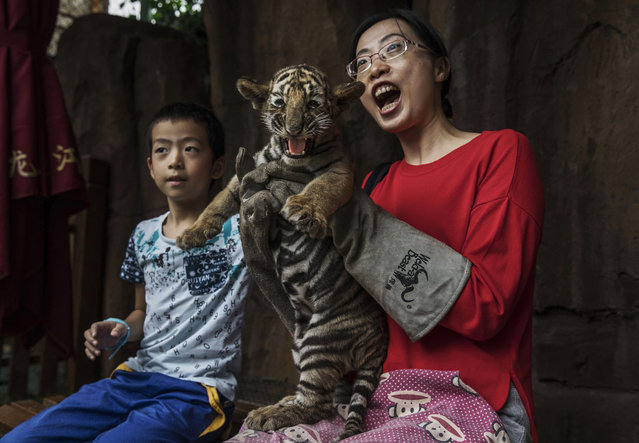
A Chinese tourist wears protective gloves as she holds a baby Siberian tiger as they pose for pictures at the Heilongjiang Siberian Tiger Park on August 16, 2017 in Harbin, northern China. (Photo by Kevin Frayer/Getty Images)

A Chinese tourist wears protective gloves as she holds a baby Siberian tiger as they pose for pictures at the Heilongjiang Siberian Tiger Park on August 16, 2017 in Harbin, northern China. The center is one of two Siberian tiger parks in the Chinese province of Heilongjiang, about 500 kilometers (300 miles) from the border with Russia. It is considered the world's largest for breeding the Siberian, or Amur, tiger which is listed as endangered by the World Wildlife Federation. (Photo by Kevin Frayer/Getty Images)
Details
23 Aug 2017 08:29:00
2012 MOSCOW THERMONUCLEAR APOCALYPSE

2012 MOSCOW THERMONUCLEAR APOCALYPSE
Details
05 Jun 2012 13:38:00