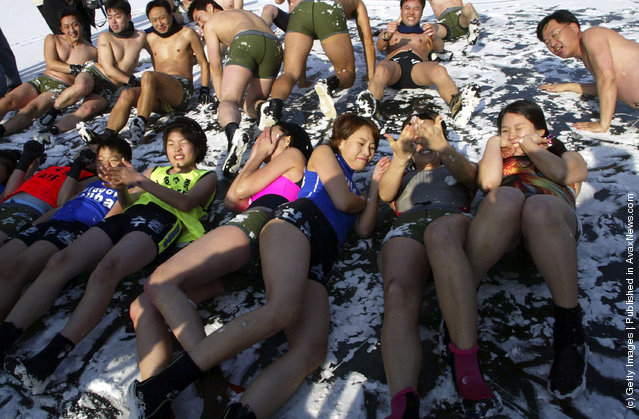
South Korean divers prepare to plunge through a hole in the ice of the frozen Imjin River on January 16, 2005 in Yeonchun, South Korea. (Photo by Chung Sung-Jun/Getty Images)
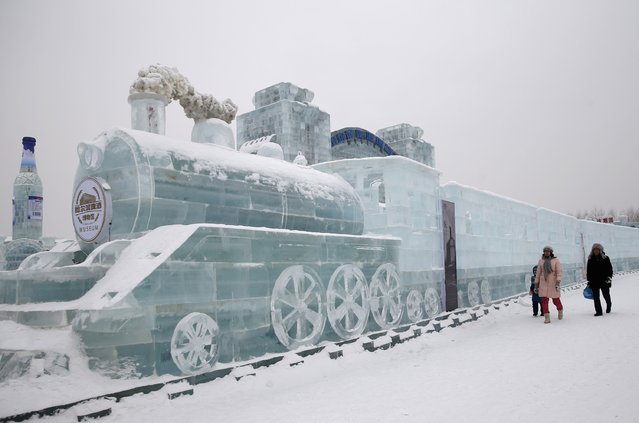
Visitors walk past a train-shaped ice sculpture ahead of the 31st Harbin International Ice and Snow Festival in the northern city of Harbin, Heilongjiang province, January 4, 2015. The winter festival will be officially opened on January 5, 2015. (Photo by Kim Kyung-Hoon/Reuters)
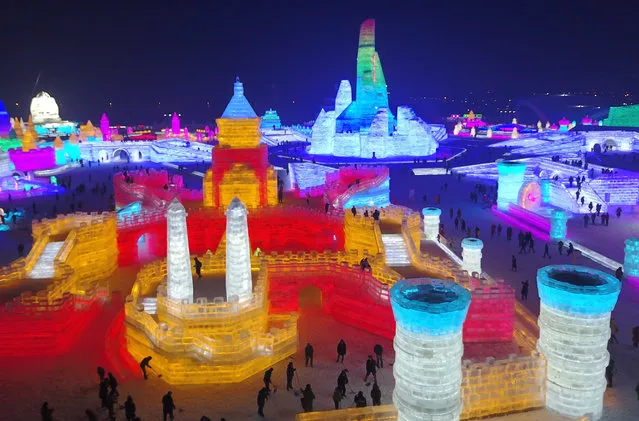
Tourists watch illuminated snow sculptures during the 31st Harbin Sun Island International Snow Sculpture Art Exposition on January 4, 2019 in Harbin, Heilongjiang Province of China. The 31st Sun Island International Snow Sculpture Art Exposition officially opened to public on December 29. (Photo by VCG/VCG via Getty Images)
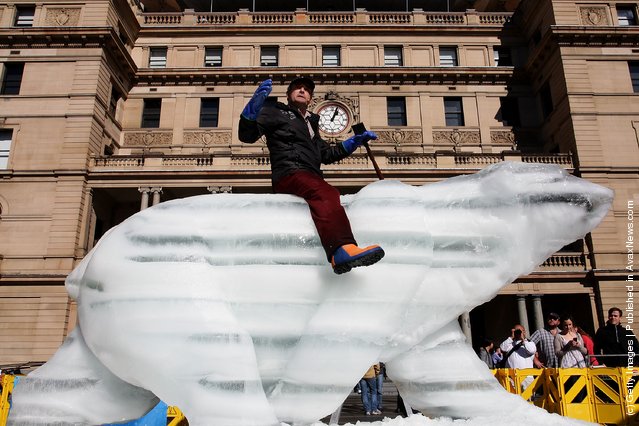
British artist, Mark Coreth sits on top of the “Sydney Ice Bear” carved from a 10 tonne block of ice to illustrate how humans affect climate change in the Arctic at Customs House on June 3, 2011 in Sydney, Australia. The public will be welcomed to touch the bear, and leave an imprint which will begin the melting process and act as a metaphor for how humans affect the environment. The ice bear's has visited six cities on it's global tour since 2009; the visit to Sydney coincides with World Environment Day on June 5. (Photo by Lisa Maree Williams/Getty Images)
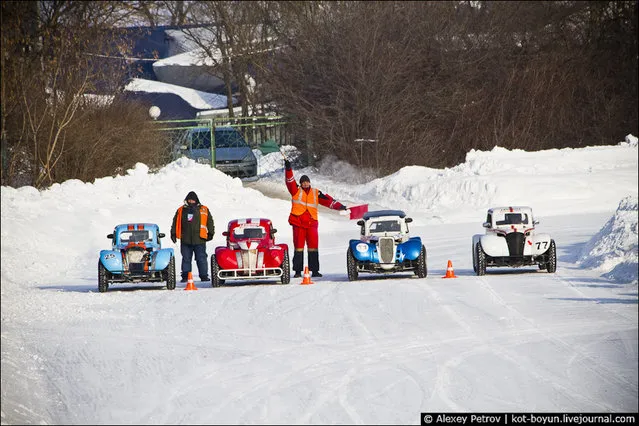
This is the Legends Russian Series. Legends car exceeds new Porsche 911 power-to-weight ratio – it is 260 hp per ton with the car weight of 500 kg. It’s been designed in the USA by 600 Racing Inc, a subsidiary of Speedway Motorsport, the largest motorsport holding company in America with the annual turnover of $567,000,000. Khimki, Moscow region. February 11, 2012. (Photo by Alexey Petrov)
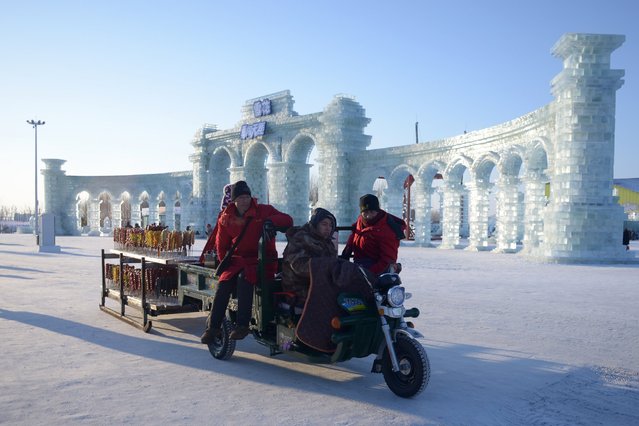
Vendors selling candied haws wait for customers at the Harbin Ice and Snow Festival in Harbin, China, January 4, 2016. The festival is open from Jan. 5 till Feb. 5, 2016, and is aimed at attracting both foreign and local visitors to experience the beauty of the ice and snow. (Photo by Wang Zhao/AFP Photo)
An aerial view shows people touring between the large-scale ice sculptures at the 18th Harbin Ice and Snow World during its trial run opening to public in Harbin city, Heilongjiang province, China, 21 December 2016. Some 180,000 cubic meters of ice and 150,000 cubic meters of snow were used to build the 800,000-square-meter ice wonderland. The 33rd Harbin International Ice and Snow Festival will kick off on 05 January 2017 that will last about three months. (Photo by Tian Weitao/EPA)
In one of the Museum’s courtyards is a swimming pool framed by a limestone deck. When seen from the deck, the pool appears to be filled with deep, shimmering water. In fact, however, a layer of water only some 10 centimeters deep is suspended over transparent glass. Below the glass is an empty space with aquamarine walls that viewers can enter. The work sets up an unfolding sequence of experiences—we view the pool through the glass wall enclosing the courtyard; from the deck, looking down into the pool; and from the interior of the pool, looking up. The Swimming Pool might hence be considered a place where, slowly, with time, different perspectives and perceptions of self and others all come to intersect.