Loading...
Done
Fans of the Brazilian heavy metal band Sepultura enjoy their showo at the main stage of Rock in Rio festival 2019 at the Olympic Park, Rio de Janeiro, Brazil, on October 4, 2019. The week-long Rock in Rio festival started September 27, with international stars as headliners, over 700,000 spectators and social actions including the preservation of the Amazon. (Photo by Mauro Pimentel/AFP Photo)

Fans of the Brazilian heavy metal band Sepultura enjoy their showo at the main stage of Rock in Rio festival 2019 at the Olympic Park, Rio de Janeiro, Brazil, on October 4, 2019. The week-long Rock in Rio festival started September 27, with international stars as headliners, over 700,000 spectators and social actions including the preservation of the Amazon. (Photo by Mauro Pimentel/AFP Photo)
Details
07 Oct 2019 00:07:00
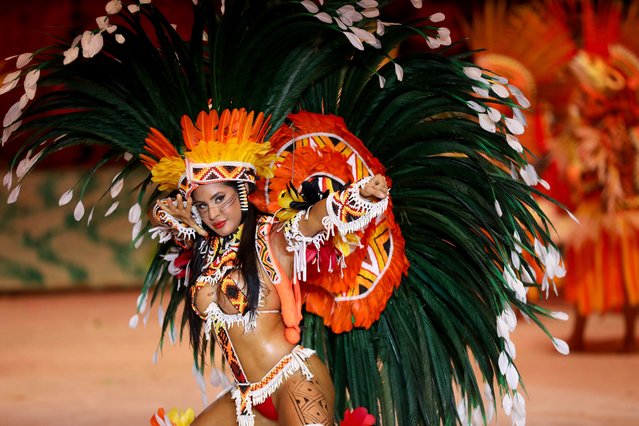
A member of the Boi Bumba Garantido association performs during the Boi Bumba folklore festival at the Bumbodromo in Parintins, Amazonas State, Brazil, on June 28, 2024. Parintins is well-known internationally for its Boi Bumba folklore festival, which lasts for three days in late June and whose themes, costumes, and songs are based on indigenous cultures of the Amazon rainforest. (Photo by Michael Dantas/AFP Photo)

A member of the Boi Bumba Garantido association performs during the Boi Bumba folklore festival at the Bumbodromo in Parintins, Amazonas State, Brazil, on June 28, 2024. Parintins is well-known internationally for its Boi Bumba folklore festival, which lasts for three days in late June and whose themes, costumes, and songs are based on indigenous cultures of the Amazon rainforest. (Photo by Michael Dantas/AFP Photo)
Details
23 Oct 2025 04:17:00
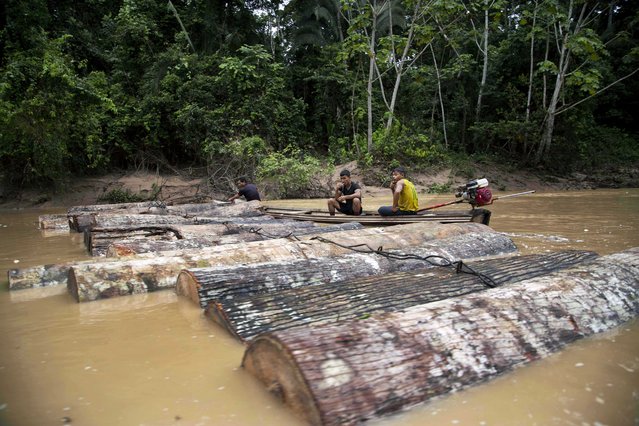
In this March 17, 2015 photo, Ashaninka Indian men, identified by locals as illegal loggers, tie tree trunks together to move them along the Putaya River near the hamlet of Saweto, Peru. Illegal logging persists unabated in this remote Amazon community where four indigenous leaders who resisted it were slain in September. The Putaya River is the waterway that transports felled trees, cut both legally and illegally, to the city of Pucallpa. (Photo by Martin Mejia/AP Photo)

In this March 17, 2015 photo, Ashaninka Indian men, identified by locals as illegal loggers, tie tree trunks together to move them along the Putaya River near the hamlet of Saweto, Peru. Illegal logging persists unabated in this remote Amazon community where four indigenous leaders who resisted it were slain in September. The Putaya River is the waterway that transports felled trees, cut both legally and illegally, to the city of Pucallpa. (Photo by Martin Mejia/AP Photo)
Details
27 Mar 2015 12:40:00
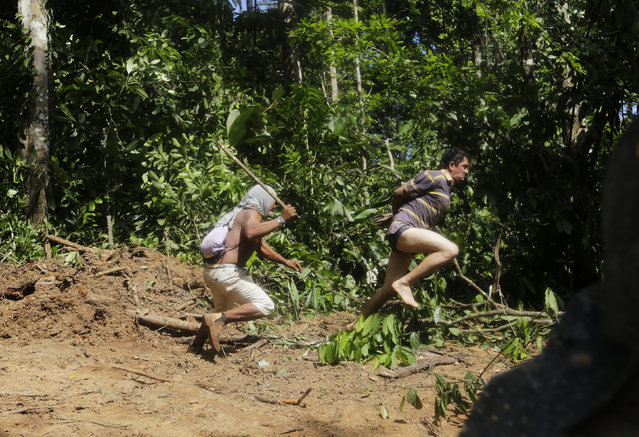
A Ka'apor Indian warrior (L) chases a logger who tried to escape after they captured him during a jungle expedition to search for and expel loggers from the Alto Turiacu Indian territory, near the Centro do Guilherme municipality in the northeast of Maranhao state in the Amazon basin, August 7, 2014. (Photo by Lunae Parracho/Reuters)

A Ka'apor Indian warrior (L) chases a logger who tried to escape after they captured him during a jungle expedition to search for and expel loggers from the Alto Turiacu Indian territory, near the Centro do Guilherme municipality in the northeast of Maranhao state in the Amazon basin, August 7, 2014. Tired of what they say is a lack of sufficient government assistance in keeping loggers off their land, the Ka'apor Indians, who along with four other tribes are the legal inhabitants and caretakers of the territory, have sent their warriors out to expel all loggers they find and set up monitoring camps in the areas that are being illegally exploited. (Photo by Lunae Parracho/Reuters)
Details
05 Sep 2014 11:41:00
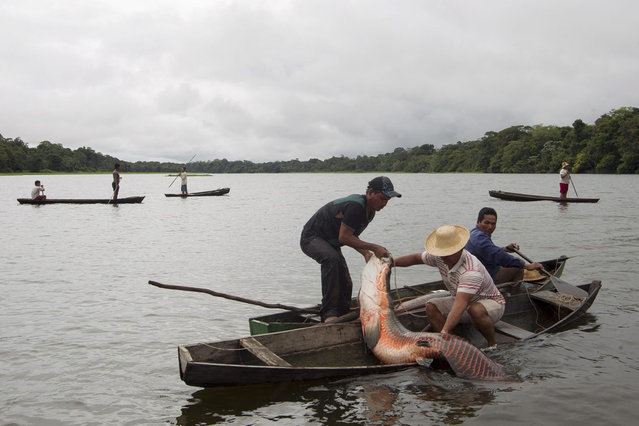
Villagers from the Porto Novo community load into their canoes arapaima or pirarucu, the largest freshwater fish species in South America and one of the largest in the world, while fishing in Poco Fundo lake along a branch of the Solimoes river, one of the main tributaries of the Amazon, in the Mamiraua nature reserve near Fonte Boa about 600 km (373 miles) west of Manaus, November 26, 2013. (Photo by Bruno Kelly/Reuters)

Villagers from the Porto Novo community load into their canoes arapaima or pirarucu, the largest freshwater fish species in South America and one of the largest in the world, while fishing in Poco Fundo lake along a branch of the Solimoes river, one of the main tributaries of the Amazon, in the Mamiraua nature reserve near Fonte Boa about 600 km (373 miles) west of Manaus, November 26, 2013. Catching the arapaima, a fish that is sought after for its meat and is considered by biologists to be a living fossil, is only allowed once a year by Brazil's environmental protection agency. The minimum size allowed for a fisherman to keep an arapaima is 1.5 meters (4.9 feet). (Photo by Bruno Kelly/Reuters)
Details
17 Dec 2013 08:03:00


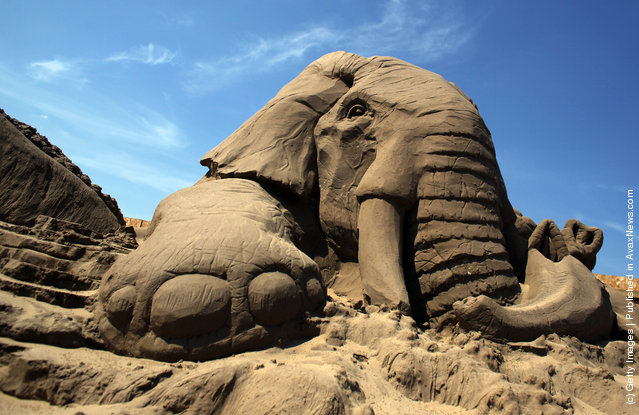
The sun shines on Weston-super-Mare's Sand Sculpture Festival and the sand art currently being displayed on July 4, 2011 in Weston-Super-Mare, England. Now in its fourth year and with a Amazon Jungle theme for 2011, the seaside resort's event attracts top sand sculptors from across the world and runs throughout the summer months. (Photo by Matt Cardy/Getty Images)
Details
05 Jul 2011 11:45:00


“Husky is a general term for several breeds of dogs used as sled dogs. Huskies were originally used as sled dogs in northern regions but are now also kept as pets. The word “husky” is a corruption of the derogative term “Eskie”, also given to the Esquimaux tribes that came into contact with Europeans who made early expeditions into their lands. The most common huskies are the Siberian Husky and the Alaskan Husky”. – Wikipedia

Photo: A husky looks out from his pen as competitors and teams prepare for the 27th annual Aviemore Husky Sled Dog Rally beside Loch Morlich on January 21, 2010 Aviemore, Scotland. (Photo by Jeff J Mitchell/Getty Images)
Details
21 Jul 2011 14:51:00
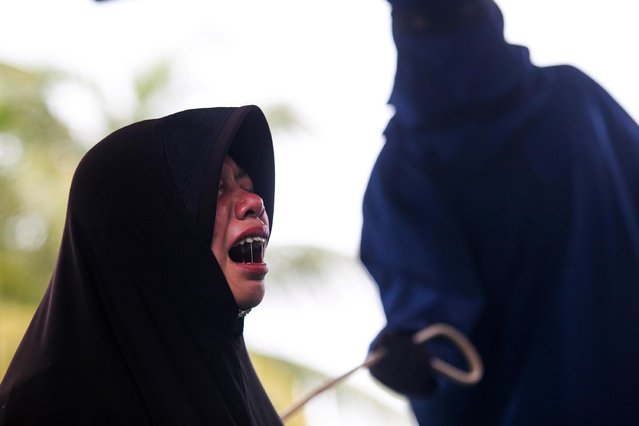
An Acehnese women is whipped in front of the public for violating sharia law in Pidie District on 14 July 2017, Aceh, Indonesia. (Photo by Oviyandi/Barcroft Images)

An Acehnese women is whipped in front of the public for violating sharia law in Pidie District on 14 July 2017, Aceh, Indonesia. Aceh is the only one province in Indonesia which has implemented sharia law, which bans sexual contact between men and women who are not married. Whipping is one form of punishment imposed in Aceh for violating Islamic sharia law. (Photo by Oviyandi/Barcroft Images)
Details
15 Jul 2017 08:18:00