Loading...
Done
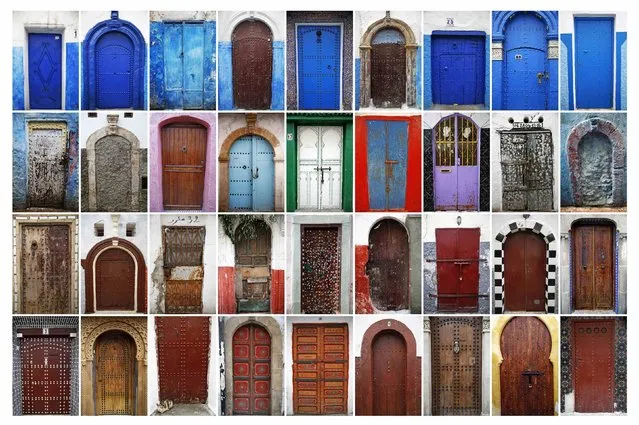
A combination photo shows some of the colourful doors seen in Rabat's Medina and Kasbah of the Udayas, September 2014. UNESCO made Rabat a World Heritage Site two years ago and media and tour operators call it a “must-see destination”. (Photo by Damir Sagolj/Reuters)

A combination photo shows some of the colourful doors seen in Rabat's Medina and Kasbah of the Udayas, September 2014. UNESCO made Rabat a World Heritage Site two years ago and media and tour operators call it a “must-see destination”. But it seems the tourist hordes have yet to find out. While visitors are getting squeezed through the better-known sites of Marrakesh and Fez, the old part of Rabat - with its beautiful Medina and Kasbah of the Udayas - remains an almost unspoiled oasis of calm. Smaller and more compact, its labyrinths of streets, passages and dead ends are a treasure trove of shapes and colours, of moments begging to be caught by the photographer's lens. (Photo by Damir Sagolj/Reuters)
Details
08 Oct 2014 12:08:00
Spring - Autumn By Cue Qozop

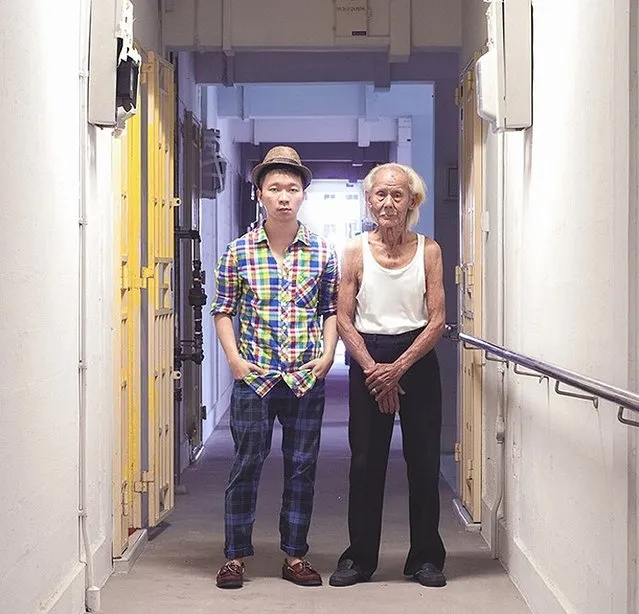
People don’t realize how much our exterior can affect our mood. If we make ourselves smile, we might feel a little better, yet if we frown, we soon get the irresistible urge to listen to Blues and weep over the days long gone. The same goes for our clothing. Many people, especially the elderly, tend to dress in the same old rags, without ever feeling the need to change something about their appearance. However, as Cue Qozop clearly demonstrates in his Spring – Autumn photoset, clothes can completely alter the appearance and the mood of the wearer. Elderly people dressed in young people’s clothes look much younger and happier. They look as if they are full of vigor and are about to set out on an amazing adventure.
Details
09 Apr 2015 09:50:00
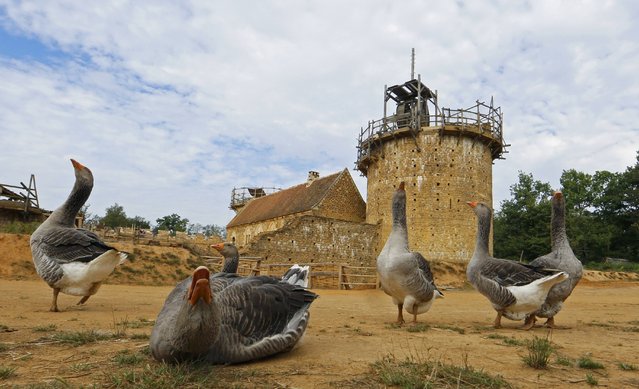
A view of the construction site of the Chateau de Guedelon near Treigny in the Burgundy region of France, September 13, 2016. Blacksmiths, stonemasons and quarry men are hard at work in a Burgundy forest building a 13th-century-style castle using the most basic tools and materials, replicating the methods used hundreds of years ago to better understand them. Forgoing all modern technology, workers use hammers to break stones and forge iron, operate wooden wheels to hoist their materials up to where they are needed, and rely on a quarry for stone, clay and sand as they build up a castle from scratch. Construction on Guedelon Castle in central France began in 1997 after an archaeological survey revealed a medieval fortress hidden inside the walls of nearby Chateau de Saint-Fargeau. Those behind the project hope to answer questions about medieval construction and provide lessons on sustainable building. (Photo by Jacky Naegelen/Reuters)

A view of the construction site of the Chateau de Guedelon near Treigny in the Burgundy region of France, September 13, 2016. Blacksmiths, stonemasons and quarry men are hard at work in a Burgundy forest building a 13th-century-style castle using the most basic tools and materials, replicating the methods used hundreds of years ago to better understand them. (Photo by Jacky Naegelen/Reuters)
Details
15 Sep 2016 09:43:00
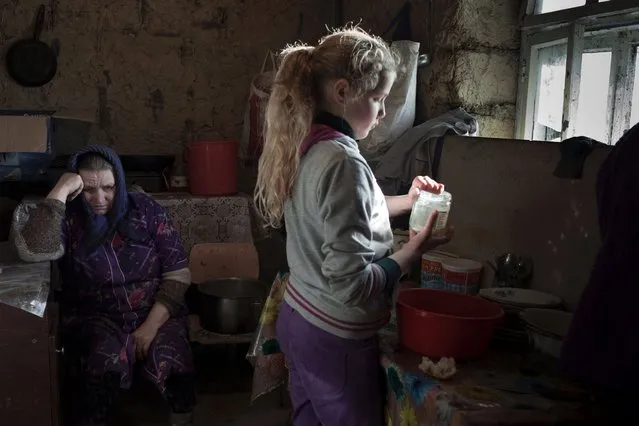
According to the U.S. government, Moldova, one of the poorest countries in Europe, depends on about $1.6 billion annually sent back from the roughly one million Moldovans who left for work in in Europe, Russia, and other former Soviet Bloc countries. Photographer Myriam Meloni went to Moldova to document what she refers to as “social orphans” – children whose parents have emigrated to another country in search of a job and a better future for their families. Here: Lulia is seen washing dishes in her grandmother's house, where she lives. (Photo by Myriam Meloni)

According to the U.S. government, Moldova, one of the poorest countries in Europe, depends on about $1.6 billion annually sent back from the roughly one million Moldovans who left for work in in Europe, Russia, and other former Soviet Bloc countries. Photographer Myriam Meloni went to Moldova to document what she refers to as “social orphans” – children whose parents have emigrated to another country in search of a job and a better future for their families. Here: Lulia is seen washing dishes in her grandmother's house, where she lives. (Photo by Myriam Meloni)
Details
12 Mar 2016 14:57:00
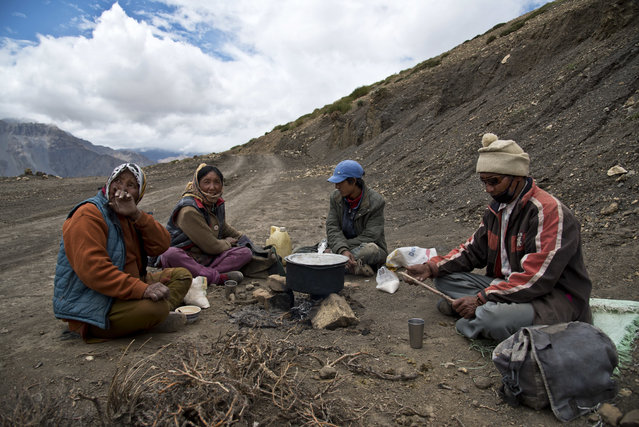
In this August 17, 2016, photo, from left to right, Chhering Chodom, 60, Tashi Yangzom, 50, Lobsang Chhering, 27, and Dorje Tandup, 58, drink milk tea on the side of the road. For centuries, the sleepy valley nestled in the Indian Himalayas remained a hidden Buddhist enclave forbidden to outsiders. Enduring the harsh year-round conditions of the high mountain desert, the people of Spiti Valley lived by a simple communal code – share the Earth's bounty, be hospitable to neighbors, and eschew greed and temptation at all turns. That's all starting to change, for better or worse. Since India began allowing its own citizens as well as outsiders to visit the valley in the early 1990s, tourism and trade have boomed. And the marks of modernization, such as solar panels, asphalt roads and concrete buildings, have begun to appear around some of the villages that dot the remote landscape at altitudes above 4,000 meters (13,000 feet). (Photo by Thomas Cytrynowicz/AP Photo)

In this August 17, 2016, photo, from left to right, Chhering Chodom, 60, Tashi Yangzom, 50, Lobsang Chhering, 27, and Dorje Tandup, 58, drink milk tea on the side of the road. For centuries, the sleepy valley nestled in the Indian Himalayas remained a hidden Buddhist enclave forbidden to outsiders. Enduring the harsh year-round conditions of the high mountain desert, the people of Spiti Valley lived by a simple communal code – share the Earth's bounty, be hospitable to neighbors, and eschew greed and temptation at all turns. That's all starting to change, for better or worse. (Photo by Thomas Cytrynowicz/AP Photo)
Details
15 Sep 2016 09:22:00
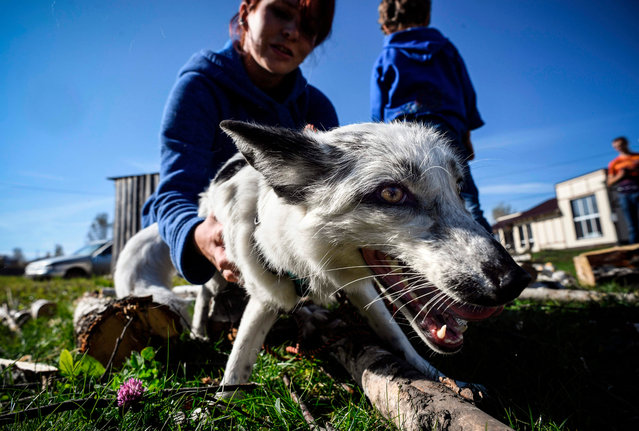
Tatyana Abramova, 33, plays with her home fox Plombir at her countryside house outside Siberian city of Novosibirsk on September 12, 2020. The official start of the Soviet experiment to better understand the domestication of animals by humans began in 1959, and was initiated by geneticists Dmitri Beliaiev and Lioudmila Trout on a farm in Akademgorodok, the scientific center of excellence in Siberia. Their primary objective was to domesticate foxes, to understand how the ancestor of wolves, another canine, evolved into a loyal and loving dog. And understand what this domestication tells us about the genetic evolution of species. (Photo by Alexander Nemenov/AFP Photo)

Tatyana Abramova, 33, plays with her home fox Plombir at her countryside house outside Siberian city of Novosibirsk on September 12, 2020. The official start of the Soviet experiment to better understand the domestication of animals by humans began in 1959, and was initiated by geneticists Dmitri Beliaiev and Lioudmila Trout on a farm in Akademgorodok, the scientific center of excellence in Siberia. Their primary objective was to domesticate foxes, to understand how the ancestor of wolves, another canine, evolved into a loyal and loving dog. And understand what this domestication tells us about the genetic evolution of species. (Photo by Alexander Nemenov/AFP Photo)
Details
25 Oct 2020 00:05:00
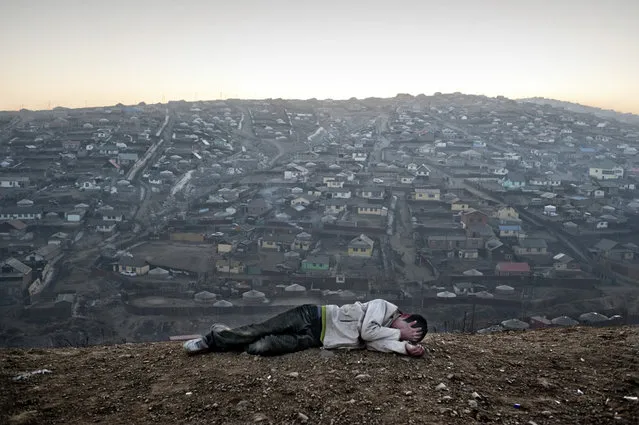
Asia, Mongolia, March 27, 2011. A view of Ulaan Baator over the shoulder of a slumbering drunk. Alcoholism is a huge problem in the city, home to almost half of Mongolia's people. The capital's population has doubled in the past two years, expanding outward in a haphazard sprawl, and many inhabitants live in slums known as the “Gher District”. (Photo by Alessandro Grassani)

“Environmental Migrants: The Last Illusion” by photographer Alessandro Grassani, documents the life of people in Kenya, Mongolia and Bangladesh who migrate to escape environmental stresses to the city of their own countries in hopes for a better life. Here: Asia, Mongolia, March 27, 2011. A view of Ulaan Baator over the shoulder of a slumbering drunk. Alcoholism is a huge problem in the city, home to almost half of Mongolia's people. The capital's population has doubled in the past two years. High levels of unemployment and poverty await herders who abandon rural areas and arrive in the city, illiterate and untrained in any skills necessary for urban jobs. (Photo by Alessandro Grassani)
Details
21 Jul 2015 10:10:00
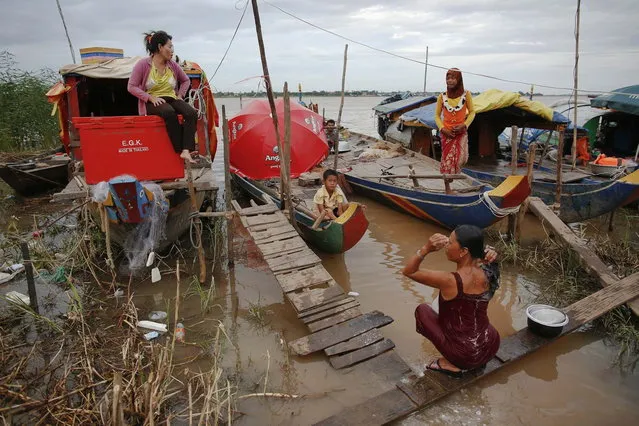
Ethnic Cham Muslim people pass the time near their boats on banks of Mekong river in Phnom Penh July 29, 2013. (Photo by Damir Sagolj/Reuters)

Ethnic Cham Muslim people pass the time near their boats on banks of Mekong river in Phnom Penh July 29, 2013. About 100 ethnic Cham families, made up of nomads and fishermen without houses or land who arrived at the Cambodian capital in search of better lives, live on their small boats on a peninsula where the Mekong and Tonle Sap rivers meet, just opposite the city's centre. The community has been forced to move several times from their locations in Phnom Penh as the land becomes more valuable. They fear that their current home, just behind a new luxurious hotel under construction at the Chroy Changva district is only temporary and that they would have to move again soon. (Photo by Damir Sagolj/Reuters)
Details
31 Jul 2013 06:34:00