Loading...
Done
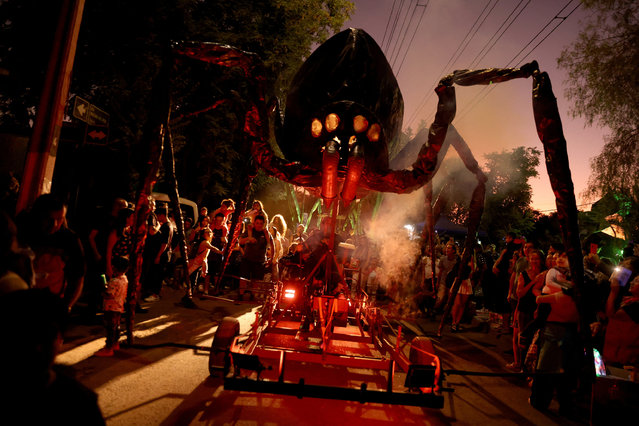
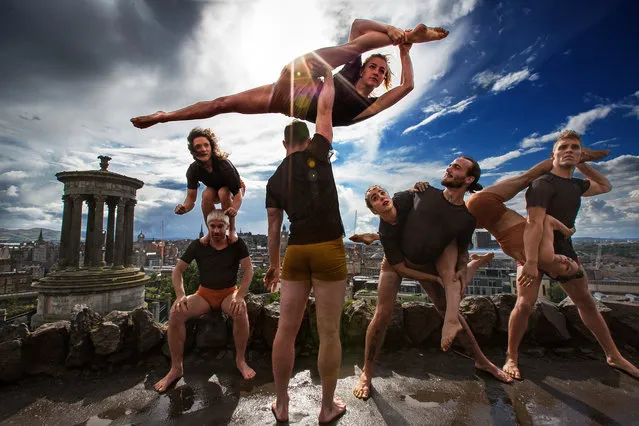
Road Trip! (Photo by Thad Lawrence)

Interesting photos which can't be united in a certain series quite often come across to me. Therefore I publish simply a small group of separate pictures – enjoy, if it's interesting to you. Photo: “Road Trip!” (Photo by Thad Lawrence)

Details
05 Oct 2012 09:58:00
In this photo taken on Tuesday, December 20, 2016, dancers of the U.S. company “Catapult” create a group of ostriches, during their show “Magic Shadows”, in Milan, Italy. (Photo by Luca Bruno/AP Photo)

In this photo taken on Tuesday, December 20, 2016, dancers of the U.S. company “Catapult” create a group of ostriches, during their show “Magic Shadows”, in Milan, Italy. Dancers in the company create shadow sculptures with their bodies, giving a contemporary twist to the ancient Chinese art of shadow theaters. (Photo by Luca Bruno/AP Photo)
Details
26 Dec 2016 06:31:00
Reem Fawzy (L), the director of the Pink Taxi company, stands with her drivers in a parking lot in Cairo, Egypt, September 6, 2015. (Photo by Amr Abdallah Dalsh/Reuters)

Reem Fawzy (L), the director of the Pink Taxi company, stands with her drivers in a parking lot in Cairo, Egypt, September 6, 2015. Pink uniforms, a pink logo on the cars, and even pink nail polish – it's all part of the look of women-drivers working for Egypt's first women-only taxi service. The Pink Taxi company hires only women drivers and gives rides to only female passengers. The company was started in an effort to provide a safe taxi service for women in a country with high rates of sexual harassment, said Reem Fawzy, the director of the company. (Photo by Amr Abdallah Dalsh/Reuters)
Details
09 Sep 2015 12:28:00
A woman wears roller skates with lights on the bottom at Rich City Skate in Richton Park, Illinois, January 12, 2015. (Photo by Jim Young/Reuters)

A woman wears roller skates with lights on the bottom at Rich City Skate in Richton Park, Illinois, January 12, 2015. A handful of decades-old skating venues put Chicago at the center of a vibrant African-American subculture of urban roller skate dancing that stretches from Atlanta to Detroit and from Los Angeles to New York. While mainstream roller skating has been on a long decline, a new generation of skaters travel a circuit of rinks around the country to compete and show off their moves. (Photo by Jim Young/Reuters)
Details
05 Feb 2015 13:00:00
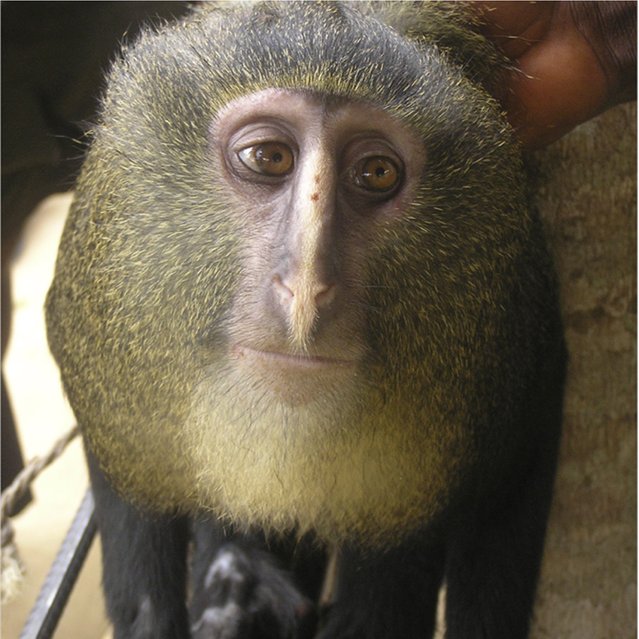
A new species of monkey found in the Democratic Republic of the Congo and identified as Lesula (Cercopithecus lomamiensis) is seen in this undated photograph from an article published September 12, 2012 in the science journal PLOS One. (Photo by Hart J. A., Detwiler K. M., Gilbert C. C./Reuters)

A new species of monkey found in the Democratic Republic of the Congo and identified as Lesula (Cercopithecus lomamiensis) is seen in this undated photograph from an article published September 12, 2012 in the science journal PLOS One. The monkey was first seen in 2007 by researchers John and Terese Hart of the Peabody Museum of Natural History at Yale Research Project. The finding of C. lomamiensis represents only the second new species of African monkey to be discovered in the past 28 years, according to the research article. (Photo by Hart J. A., Detwiler K. M., Gilbert C. C./Reuters)
Details
27 Sep 2012 08:17:00
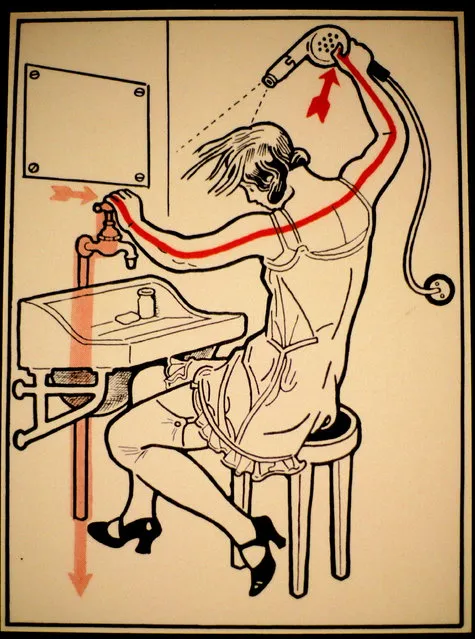
The book “Elektroschutz in 132 Bildern” (Electrical Protection in 132 Pictures) was published in Vienna in the early 1900s by a Viennese physician named Stefan Jellinek (1878-1968, a founder of the Electro-Pathological Museum). The pictures are nice and direct and unambiguous; they teach, graphically, that the surest way to kill yourself with electricity is to form a complete path from source (usually the bright red arrow) to ground (the screened back, pink arrow). Arrowheads provide the path for current flow. (Photo by The Vienna Technical Museum)

The book “Elektroschutz in 132 Bildern” (Electrical Protection in 132 Pictures) was published in Vienna in the early 1900s by a Viennese physician named Stefan Jellinek (1878-1968, a founder of the Electro-Pathological Museum). The pictures are nice and direct and unambiguous; they teach, graphically, that the surest way to kill yourself with electricity is to form a complete path from source (usually the bright red arrow) to ground (the screened back, pink arrow). Arrowheads provide the path for current flow. (Photo by The Vienna Technical Museum)
Details
11 Aug 2014 11:10:00
An undated handout picture released on January 10, 2017 by the Issekinicho publishing house shows an inter- species sexual behaviour between a male Japanese macaque and female sika deer, in Yakushima Scientists revealed on January 10, 2017 the “highly unusual” behaviour of a male monkey filmed trying to have s*x with female deer in Japan – a rare case of inter- species nookie. (Photo by Editions Issekinicho/AFP Photo)

An undated handout picture released on January 10, 2017 by the Issekinicho publishing house shows an inter- species sexual behaviour between a male Japanese macaque and female sika deer, in Yakushima Scientists revealed on January 10, 2017 the “highly unusual” behaviour of a male monkey filmed trying to have sеx with female deer in Japan – a rare case of inter- species nookie. (Photo by Editions Issekinicho/AFP Photo)
Details
15 Jan 2017 11:00:00
In this Wednesday, July 23, 2014 file photo, Omaha photographer Lane Hickenbottom photographs the night sky in a pasture near Callaway, Neb. With no moon in the sky, the Milky Way was visible to the naked eye. More than one-third of the world’s population can no longer see the Milky Way because of man-made lights, according to a scientific paper by Light Pollution Science and Technology Institute's Fabio Falchi and his team members, published on Friday, June 10, 2016. (Photo by Travis Heying/The Wichita Eagle via AP Photo)

In this Wednesday, July 23, 2014 file photo, Omaha photographer Lane Hickenbottom photographs the night sky in a pasture near Callaway, Neb. With no moon in the sky, the Milky Way was visible to the naked eye. More than one-third of the world’s population can no longer see the Milky Way because of man-made lights, according to a scientific paper by Light Pollution Science and Technology Institute's Fabio Falchi and his team members, published on Friday, June 10, 2016. (Photo by Travis Heying/The Wichita Eagle via AP Photo)
Details
11 Jun 2016 12:37:00