Loading...
Done
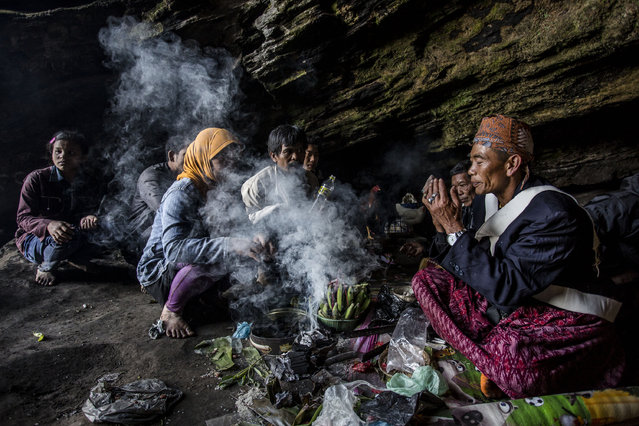
A Tenggerese shaman praying for worshippers at Widodaren cave during the Tenggerese Hindu Yadnya Kasada festival on July 31, 2015 in Probolinggo, East Java, Indonesia. The festival is the main festival of the Tenggerese people and lasts about a month. On the fourteenth day, the Tenggerese make the journey to Mount Bromo to make offerings of rice, fruits, vegetables, flowers and livestock to the mountain gods by throwing them into the volcano's caldera. (Photo by Ulet Ifansasti/Getty Images)

A Tenggerese shaman praying for worshippers at Widodaren cave during the Tenggerese Hindu Yadnya Kasada festival on July 31, 2015 in Probolinggo, East Java, Indonesia. The festival is the main festival of the Tenggerese people and lasts about a month. On the fourteenth day, the Tenggerese make the journey to Mount Bromo to make offerings of rice, fruits, vegetables, flowers and livestock to the mountain gods by throwing them into the volcano's caldera. The origin of the festival lies in the 15th century when a princess named Roro Anteng started the principality of Tengger with her husband Joko Seger, and the childless couple asked the mountain Gods for help in bearing children. The legend says the Gods granted them 24 children but on the provision that the 25th must be tossed into the volcano in sacrifice. The 25th child, Kesuma, was finally sacrificed in this way after initial refusal, and the tradition of throwing sacrifices into the caldera to appease the mountain Gods continues today. (Photo by Ulet Ifansasti/Getty Images)
Details
01 Aug 2015 12:07:00
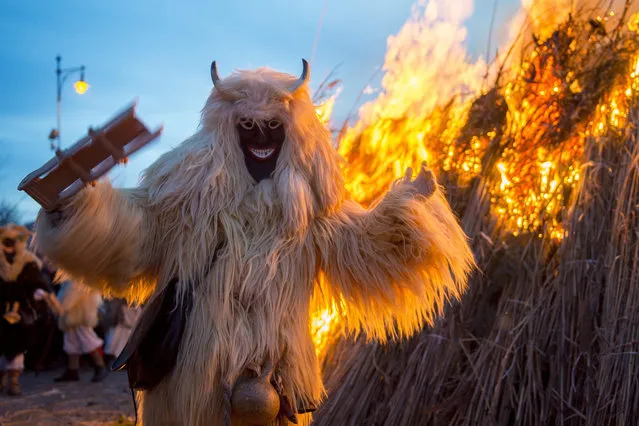
A reveler wearing sheepfur costume is seen in front of a bonfire on which they burn a coffin symbolizing winter during the closing ceremony of the traditional carnival parade in Mohacs, 189 kms south of Budapest, Hungary, 07 February 2016. (Photo by Tamas Soki/EPA)

A reveler wearing sheepfur costume is seen in front of a bonfire on which they burn a coffin symbolizing winter during the closing ceremony of the traditional carnival parade in Mohacs, 189 kms south of Budapest, Hungary, 07 February 2016. The carnival parade of people, the so-called busos, dressed in such costumes and frightening wooden masks, using various noisy wooden rattlers is traditionally held on the seventh weekend before Easter to drive away winter, and is a revival of a legend, which says that ethnic Croats ambushed the Osmanli Turkish troops, who escaped in panic seeing the terrifying figures during the Turkish occupation of Hungary. (Photo by Tamas Soki/EPA)
Details
09 Feb 2016 14:02:00
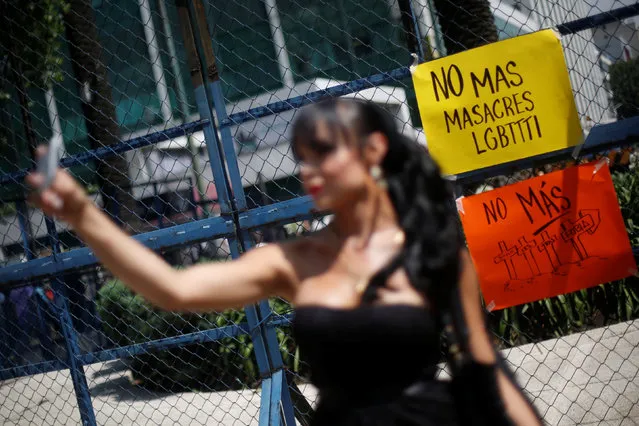
A sign that reads “No more massacres LGBT” is seen to remember the victims of the Pulse nightclub mass shooting in Orlando, near the U.S. Embassy in Mexico City, Mexico, June 14, 2016. (Photo by Edgard Garrido/Reuters)

A sign that reads “No more massacres LGBT” is seen to remember the victims of the Pulse nightclub mass shooting in Orlando, near the U.S. Embassy in Mexico City, Mexico, June 14, 2016. (Photo by Edgard Garrido/Reuters)
Details
16 Jun 2016 08:25:00
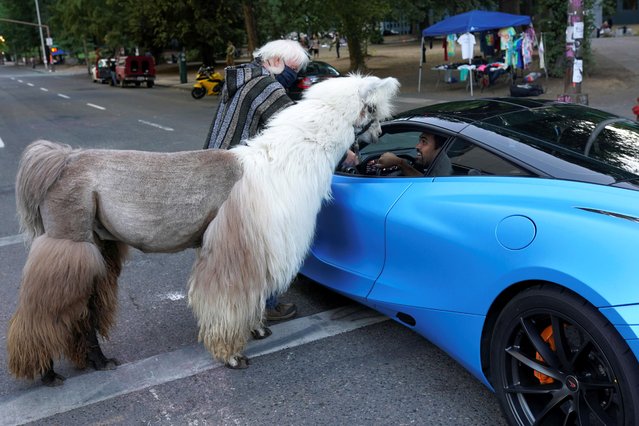
Caesar McCool, a therapy llama nicknamed the “No Drama Llama” and his handler Larry McCool greet a driver in a McLaren at the site of ongoing protests against police violence and racial inequality, in Portland, Oregon, U.S., August 6, 2020. (Photo by Nathan Howard/Reuters)

Caesar McCool, a therapy llama nicknamed the “No Drama Llama” and his handler Larry McCool greet a driver in a McLaren at the site of ongoing protests against police violence and racial inequality, in Portland, Oregon, U.S., August 6, 2020. (Photo by Nathan Howard/Reuters)
Details
11 Aug 2020 00:05:00
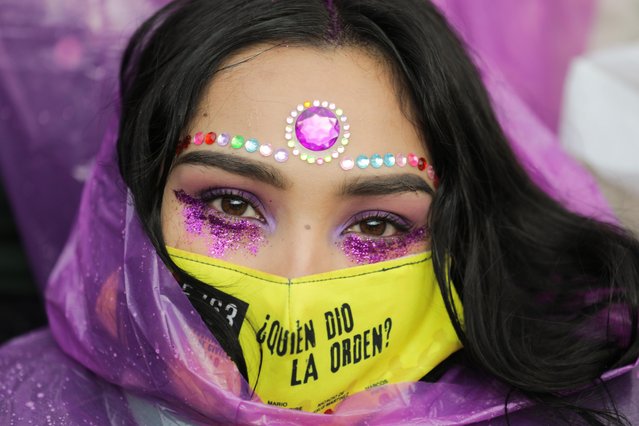
A demonstrator wearing a face mask reading “Who gave the order?” looks on during a protest to mark the International Day for the Elimination of Violence against Women, in Bogota, Colombia on November 25, 2020. (Photo by Luisa Gonzalez/Reuters)

A demonstrator wearing a face mask reading “Who gave the order?” looks on during a protest to mark the International Day for the Elimination of Violence against Women, in Bogota, Colombia on November 25, 2020. (Photo by Luisa Gonzalez/Reuters)
Details
20 Feb 2021 09:32:00
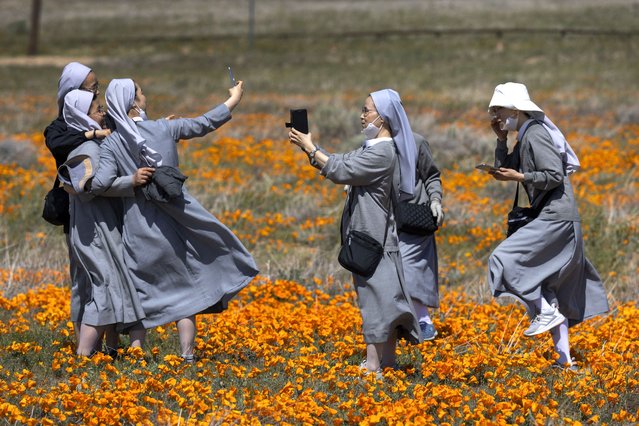
People walk in a field of California poppies and other wildflowers outside of the Antelope Valley California Poppy Reserve, after recent rains moved the region's second-driest winter on record up to its seventh-driest, near Lancaster, California, on April 2, 2022. The California Department of Water Resources reported that about one-third of the Sierra Nevada snowpack's water equivalency melted last week under higher-than-normal temperatures, leaving the statewide snow-water equivalent at 38% of normal for the date. (Photo by David Mcnew/AFP Photo)

People walk in a field of California poppies and other wildflowers outside of the Antelope Valley California Poppy Reserve, after recent rains moved the region's second-driest winter on record up to its seventh-driest, near Lancaster, California, on April 2, 2022. The California Department of Water Resources reported that about one-third of the Sierra Nevada snowpack's water equivalency melted last week under higher-than-normal temperatures, leaving the statewide snow-water equivalent at 38% of normal for the date. (Photo by David Mcnew/AFP Photo)
Details
12 Apr 2022 06:02:00
Air France airplane from Air France-KLM Group arriving at Princess Juliana International Airport, Sint Maarten, Dutch Carebbean Island on February 12, 2023, taken from Sunset Beach Bar at Maho Beach, Sint Maarten, known for the beach being very close to the runway. (Photo by Rex Features/Shutterstock)

Air France airplane from Air France-KLM Group arriving at Princess Juliana International Airport, Sint Maarten, Dutch Carebbean Island on February 12, 2023, taken from Sunset Beach Bar at Maho Beach, Sint Maarten, known for the beach being very close to the runway. (Photo by Rex Features/Shutterstock)
Details
22 Jun 2024 04:00:00
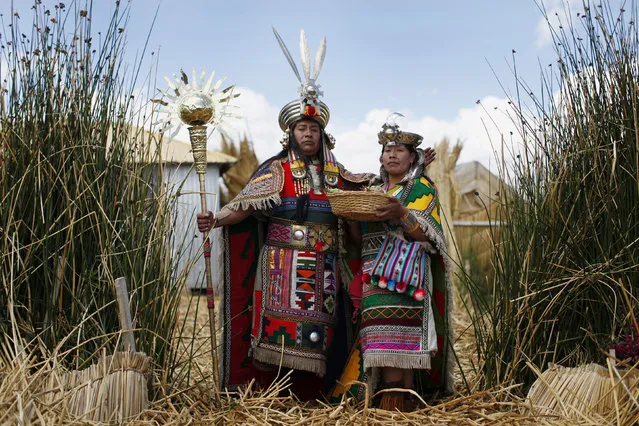
An Andean man and a woman, depicting Inca's legendary characters Manco Capac and Mama Ocllo, pose for a portrait in a Uros island at Lake Titicaca before a re-enactment in Puno November 5, 2014. The Uros islands are a group of 70 man-made totora reed islands floating on the lake, which according to Peru's tourism board iPeru is the world's highest navigable lake at over 4,000 meters above sea level. (Photo by Enrique Castro-Mendivil/Reuters)

An Andean man and a woman, depicting Inca's legendary characters Manco Capac and Mama Ocllo, pose for a portrait in a Uros island at Lake Titicaca before a re-enactment in Puno November 5, 2014. The Uros islands are a group of 70 man-made totora reed islands floating on the lake, which according to Peru's tourism board iPeru is the world's highest navigable lake at over 4,000 meters above sea level. The Uros people fish and hunt, but tourism is their main source of livelihood. (Photo by Enrique Castro-Mendivil/Reuters)
Details
07 Nov 2014 12:52:00