Loading...
Done
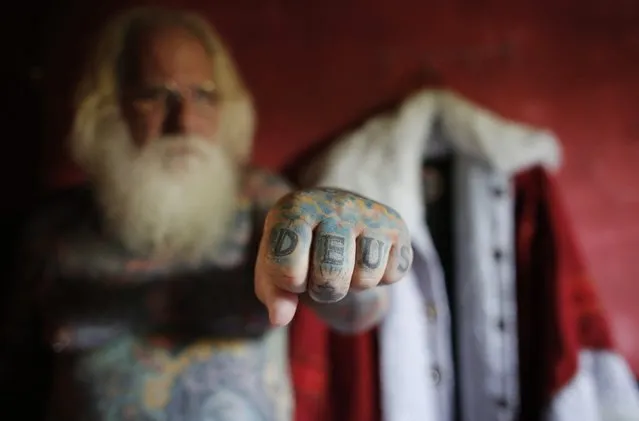
Vitor Martins puts forward his fist, that has the word “God” tattooed on it, in front of his Santa Claus outfit inside his house, before a performance with children in Sao Caetano do Sul's town square, near Sao Paulo, December 7, 2014. Martins has dressed as Santa Claus, working at shopping centres and various events, for fifteen years, and has 94 percent of his body covered in tattoos, with several in reference to Christmas. (Photo by Nacho Doce/Reuters)

Vitor Martins puts forward his fist, that has the word “God” tattooed on it, in front of his Santa Claus outfit inside his house, before a performance with children in Sao Caetano do Sul's town square, near Sao Paulo, December 7, 2014. Martins has dressed as Santa Claus, working at shopping centres and various events, for fifteen years, and has 94 percent of his body covered in tattoos, with several in reference to Christmas. (Photo by Nacho Doce/Reuters)
Details
09 Dec 2014 09:42:00
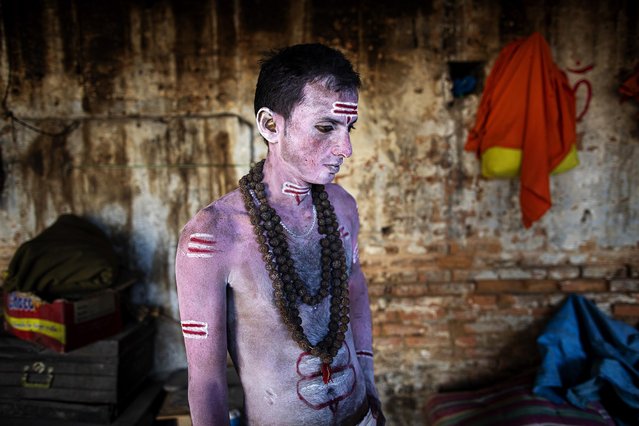
A Sadhu, Hindu holy person, prepares himself by smearing ashes on his body during the Maha Shivaratri festival at the Pashupati Temple in Kathmandu, Nepal, 11 March 2021. The Maha Shivratri festival, which is celebrated on 11 March, sees Hindu devotees, from across the country and neighboring India, gather to celebrate the birthday of Lord Shiva, the Hindu god of creation and destruction, by offering special prayers and fasting. (Photo by Narendra Shrestha/EPA/EFE)

A Sadhu, Hindu holy person, prepares himself by smearing ashes on his body during the Maha Shivaratri festival at the Pashupati Temple in Kathmandu, Nepal, 11 March 2021. The Maha Shivratri festival, which is celebrated on 11 March, sees Hindu devotees, from across the country and neighboring India, gather to celebrate the birthday of Lord Shiva, the Hindu god of creation and destruction, by offering special prayers and fasting. (Photo by Narendra Shrestha/EPA/EFE)
Details
24 Apr 2021 08:39:00
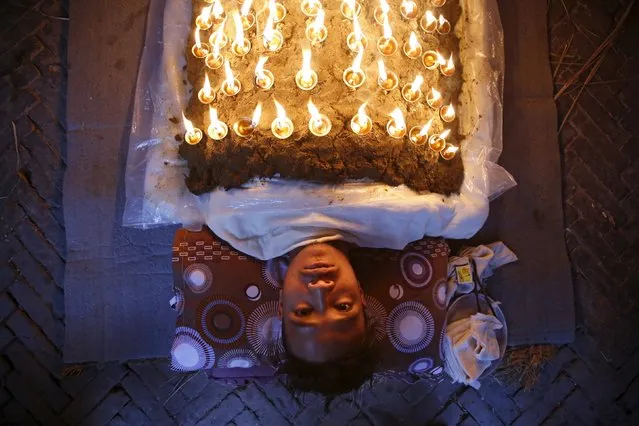
A devotee offers oil lamps on top of his body as part of a ritual during Dashain, the biggest religious festival for Hindus in Bhaktapur, Nepal, October 22, 2015. (Photo by Navesh Chitrakar/Reuters)

A devotee offers oil lamps on top of his body as part of a ritual during Dashain, the biggest religious festival for Hindus in Bhaktapur, Nepal, October 22, 2015. Hindus in Nepal celebrate victory over evil during the festival by flying kites, feasting, playing swings, sacrificing animals and worshipping the Goddess Durga as well as other gods and goddess as part of celebrations held throughout the country. (Photo by Navesh Chitrakar/Reuters)
Details
25 Oct 2015 08:02:00
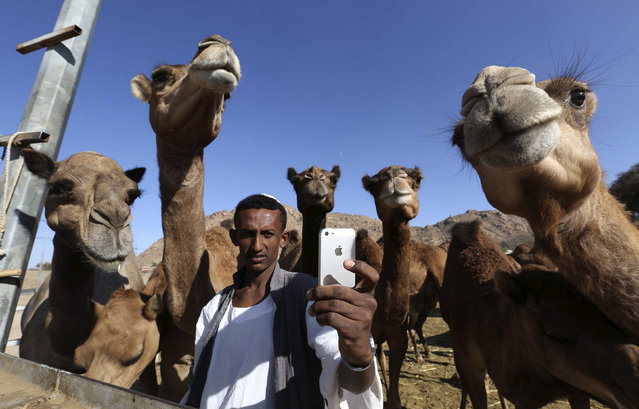
A man takes a “selfie” with camels at a farm in Taif November 1, 2014. Saudi Arabia said late on Wednesday it had detected six new cases of the deadly Middle East Respiratory Syndrome (MERS) in 24 hours, the biggest daily jump for months with officials blaming lax hospital procedures. (Photo by Mohamed Alhwaity/Reuters)

A man takes a “selfie” with camels at a farm in Taif November 1, 2014. Saudi Arabia said late on Wednesday it had detected six new cases of the deadly Middle East Respiratory Syndrome (MERS) in 24 hours, the biggest daily jump for months with officials blaming lax hospital procedures. Scientists are not sure of the origin of the virus, but several studies have linked it to camels and some experts think it is being passed to humans through close physical contact or through the consumption of camel meat or camel milk. (Photo by Mohamed Alhwaity/Reuters)
Details
08 Nov 2014 12:33:00
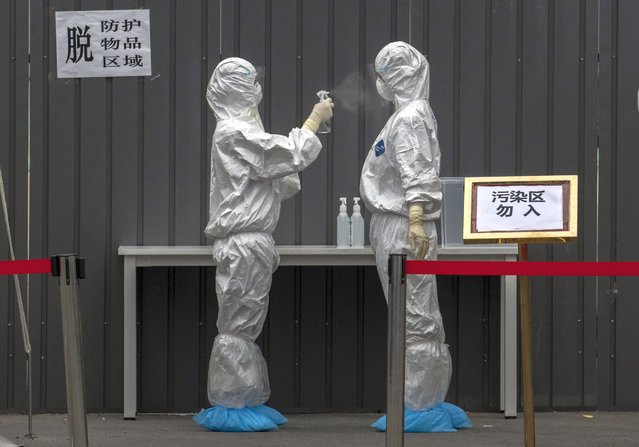
Chinese epidemic control workers wear protective suits as they disinfect each other after performing nucleic acid swab test for COVID-19 on citizens at a government testing site in Xicheng District during an organized tour on June 24, 2020 in Beijing, China. While Chinese government medical officials have said they believe they have controlled the spread, authorities are trying to contain the outbreak linked to the Xinfadi wholesale food market, Beijing's biggest supplier of produce and meat. More than 2.5 million people have undergone nucleic acid tests for COVID-19 at dozens of sites across the city in recent days, with officials using contact tracing to target high and middle risk areas and people who may have had contact with the market or food that came from there. Several neighborhoods have been locked down and a number of other food markets have been closed, The outbreak has triggered fears of a second wave of infection after 56 straight days with no domestically transmitted cases in the capital. (Photo by Kevin Frayer/Getty Images)

Chinese epidemic control workers wear protective suits as they disinfect each other after performing nucleic acid swab test for COVID-19 on citizens at a government testing site in Xicheng District during an organized tour on June 24, 2020 in Beijing, China. While Chinese government medical officials have said they believe they have controlled the spread, authorities are trying to contain the outbreak linked to the Xinfadi wholesale food market, Beijing's biggest supplier of produce and meat. (Photo by Kevin Frayer/Getty Images)
Details
26 Jun 2020 00:01:00
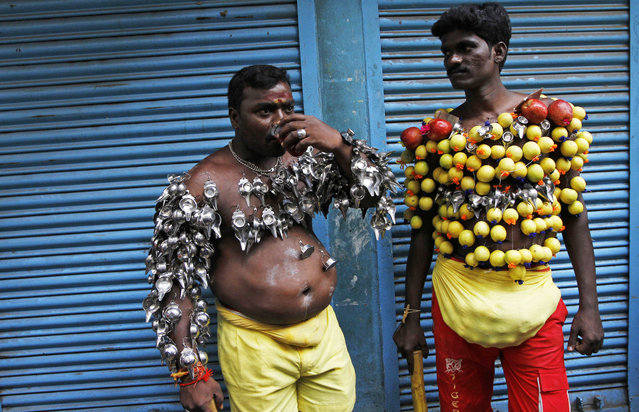
Hindu devotees, their bodies pierced with lemon and paladai, or bowl with a spout mainly used to feed milk to infants, wait to participate in a procession to mark Shivratri, or the night of Shiva, in Chennai, India, Wednesday, February 18, 2015. (Photo by Arun Sankar K./AP Photo)

Hindu devotees, their bodies pierced with lemon and paladai, or bowl with a spout mainly used to feed milk to infants, wait to participate in a procession to mark Shivratri, or the night of Shiva, in Chennai, India, Wednesday, February 18, 2015. Such processions are held as an offering and show of devotion by devotees on the day dedicated to the worship of Lord Shiva, the Hindu god of destruction. (Photo by Arun Sankar K./AP Photo)
Details
21 Feb 2015 11:41:00
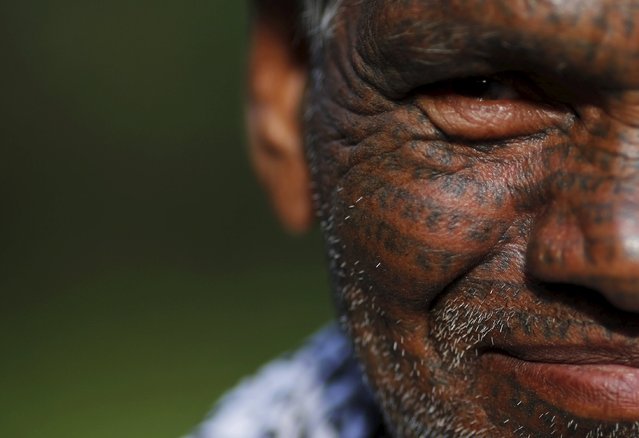
Tiharu Ram, 70, a follower of Ramnami Samaj, who has tattooed the name of the Hindu god Ram on his face, poses for a picture outside his house in the village of Chandlidi, in the eastern state of Chhattisgarh, India, November 16, 2015. (Photo by Adnan Abidi/Reuters)

Tiharu Ram, 70, a follower of Ramnami Samaj, who has tattooed the name of the Hindu god Ram on his face, poses for a picture outside his house in the village of Chandlidi, in the eastern state of Chhattisgarh, India, November 16, 2015. Denied entry to temples and forced to use separate wells, low-caste Hindus in the eastern state of Chhattisgarh first tattooed their bodies and faces more than 100 years ago as an act of defiance and devotion. (Photo by Adnan Abidi/Reuters)
Details
14 Jan 2016 08:05:00
An Indian artist gives the finishing touches to a figure of the elephant-headed Hindu god Ganesha at a workshop ahead of the Ganesh Chaturthi festival in New Delhi on September 15, 2015. (Photo by Sajjad Hussain/AFP Photo)

An Indian artist gives the finishing touches to a figure of the elephant-headed Hindu god Ganesha at a workshop ahead of the Ganesh Chaturthi festival in New Delhi on September 15, 2015. The idol is meant for the forthcoming festival Ganesha Chaturthi, a ten-day long event which is celebrated all over India. During the Ganpati festival, that is celebrated as the birthday of Lord Ganesha, idols of the Hindu deity are worshipped at hundreds of pandals or makeshift tents before they are immersed into water bodies. This year, the festival starts on 17 September 2015. (Photo by Sajjad Hussain/AFP Photo)
Details
17 Sep 2015 10:38:00