Loading...
Done
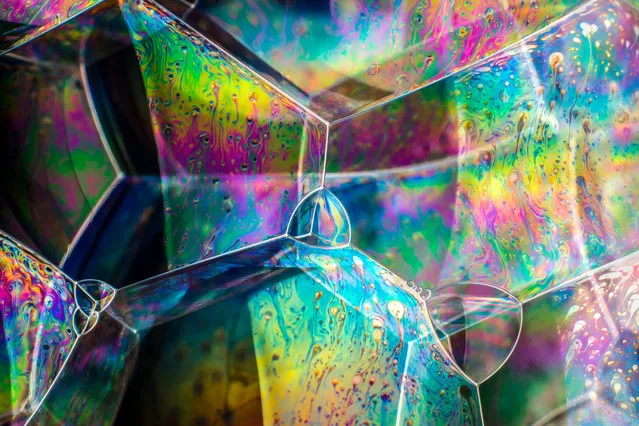
Soap Bubble Structures by Kym Cox. Bubbles optimise space and minimise their surface area for a given volume of air. This phenomenon makes them a useful tool in many areas of research, in particular, materials science and ‘packing’ – how things fit together. Bubble walls drain under gravity, thin at the top, thick at the bottom, which interferes with travelling lightwaves to create bands of colour. Black spots show the wall is too thin for interference colours, indicating the bubble is about to burst. (Photo by Kym Cox/2019 Science Photographer of the Year/RPS)

Soap Bubble Structures by Kym Cox. Bubbles optimise space and minimise their surface area for a given volume of air. This phenomenon makes them a useful tool in many areas of research, in particular, materials science and “packing” – how things fit together. Bubble walls drain under gravity, thin at the top, thick at the bottom, which interferes with travelling lightwaves to create bands of colour. Black spots show the wall is too thin for interference colours, indicating the bubble is about to burst. (Photo by Kym Cox/2019 Science Photographer of the Year/RPS)
Details
15 Aug 2019 00:03:00
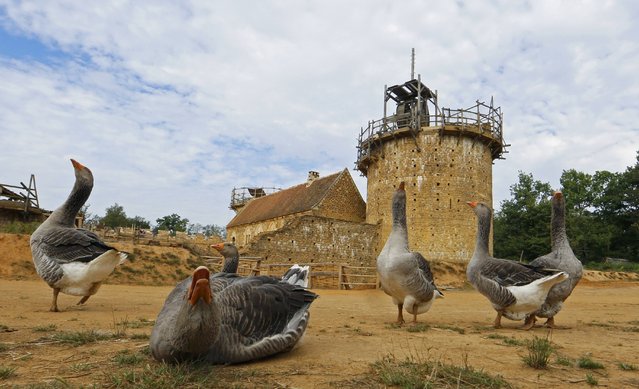
A view of the construction site of the Chateau de Guedelon near Treigny in the Burgundy region of France, September 13, 2016. Blacksmiths, stonemasons and quarry men are hard at work in a Burgundy forest building a 13th-century-style castle using the most basic tools and materials, replicating the methods used hundreds of years ago to better understand them. Forgoing all modern technology, workers use hammers to break stones and forge iron, operate wooden wheels to hoist their materials up to where they are needed, and rely on a quarry for stone, clay and sand as they build up a castle from scratch. Construction on Guedelon Castle in central France began in 1997 after an archaeological survey revealed a medieval fortress hidden inside the walls of nearby Chateau de Saint-Fargeau. Those behind the project hope to answer questions about medieval construction and provide lessons on sustainable building. (Photo by Jacky Naegelen/Reuters)

A view of the construction site of the Chateau de Guedelon near Treigny in the Burgundy region of France, September 13, 2016. Blacksmiths, stonemasons and quarry men are hard at work in a Burgundy forest building a 13th-century-style castle using the most basic tools and materials, replicating the methods used hundreds of years ago to better understand them. (Photo by Jacky Naegelen/Reuters)
Details
15 Sep 2016 09:43:00
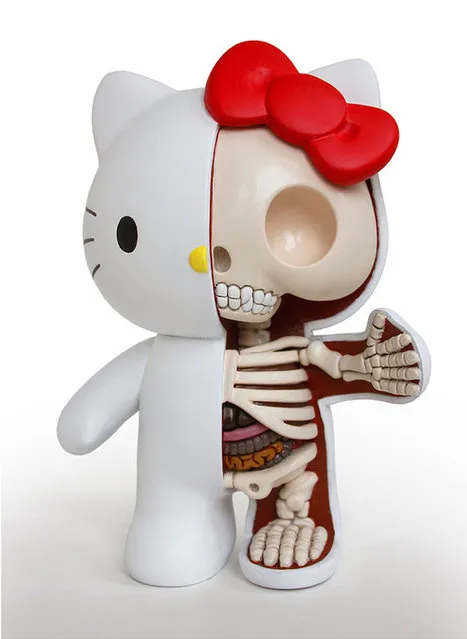
Anatomical Toys By Jason Freeny

New York based artist Jason Freeny slices open pop-culture characters to reveal their insides. He takes vinyl toys of annimated icons such as Stewie Griffin, Nemo and Mario, and stuffs them with Sculpey modelling clay. He then carves out bones aqnd organs using dental tools.
Details
17 Aug 2013 07:10:00
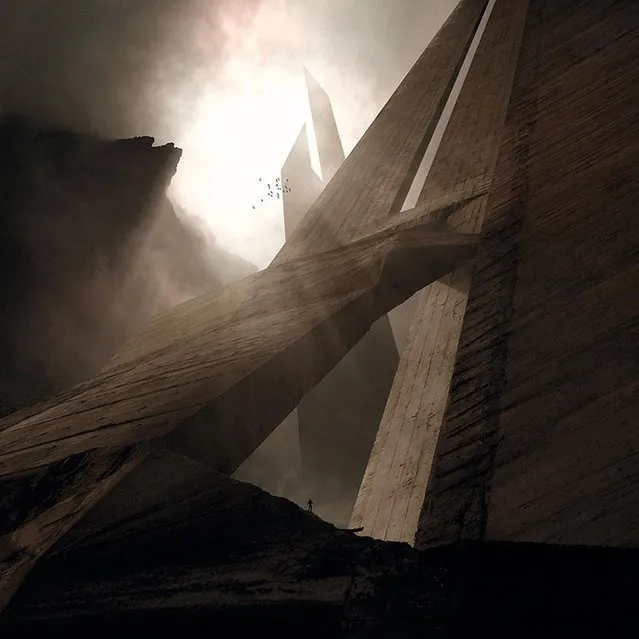
Parallel Worlds By Karezoid Michal Karcz

Karezoid Michal Karcz is a photographer from Warsaw, Poland. He first started with painting, which helped him to develop a vision that was hard to create with other visual techniques. Then in early 90s discovered photography. His early fascinations of painting and photography have been combined into one piece, with the use of digital tools. Digital photography gave him the opportunity to generate unique realities that were impossible to be created with an ordinary dark room techniques.
Details
20 Jul 2013 18:06:00
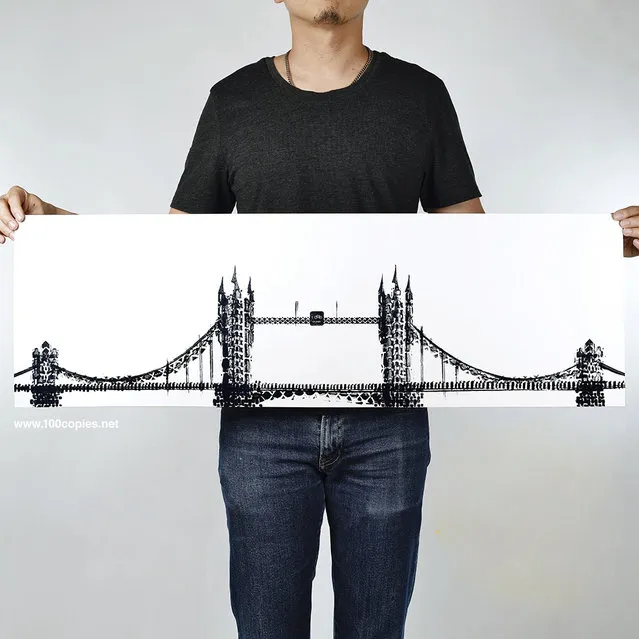
The Unforbidden Cyclist By Thomas Yang

Image patterning has existed for hundreds of years; however, before Thomas Yang no one has ever thought of putting paint on the bicycle wheels and using it as a patterning tool to create very interesting-looking pictures. Being an avid cyclist and an artist, Thomas Yang has decided to combine the two, creating the 100copies. The name of this project not only alludes to the fact that only one hundred copies of those pictures were going to be made, but also to the fact that the pictures themselves consist of hundreds of repeating shapes. And even though the project is called 100copies, no two pictures are alike due to the nature of their creation, making them truly unique. (Photo by Thomas Yang)
Details
11 Nov 2014 12:00:00
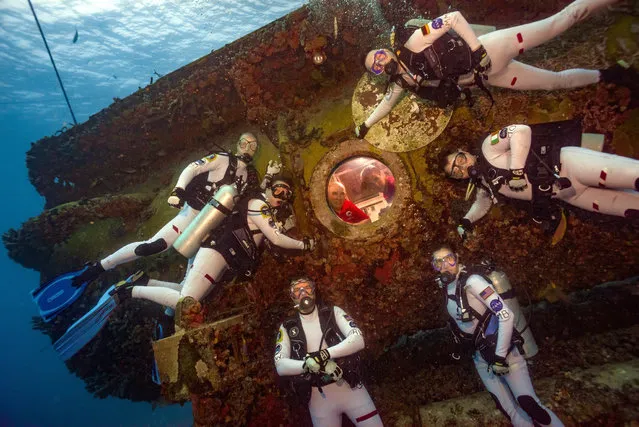
The NASA Extreme Environment Mission Operations (NEEMO) 21 mission began on July 21 as an international crew of aquanauts splashed down to the undersea Aquarius Reef Base, located 62 feet below the surface of the Atlantic Ocean in the Florida Keys National Marine Sanctuary. The NEEMO 21 crew will perform research both inside and outside the habitat during a 16-day simulated space mission. During simulated spacewalks carried out underwater, they will evaluate tools and mission operation techniques that could be used in future space missions, including journeys to Mars. (Photo by Karl Shreeves/NASA)

The NASA Extreme Environment Mission Operations (NEEMO) 21 mission began on July 21 as an international crew of aquanauts splashed down to the undersea Aquarius Reef Base, located 62 feet below the surface of the Atlantic Ocean in the Florida Keys National Marine Sanctuary. The NEEMO 21 crew will perform research both inside and outside the habitat during a 16-day simulated space mission. During simulated spacewalks carried out underwater, they will evaluate tools and mission operation techniques that could be used in future space missions, including journeys to Mars. (Photo by Karl Shreeves/NASA)
Details
31 Jul 2016 11:29:00
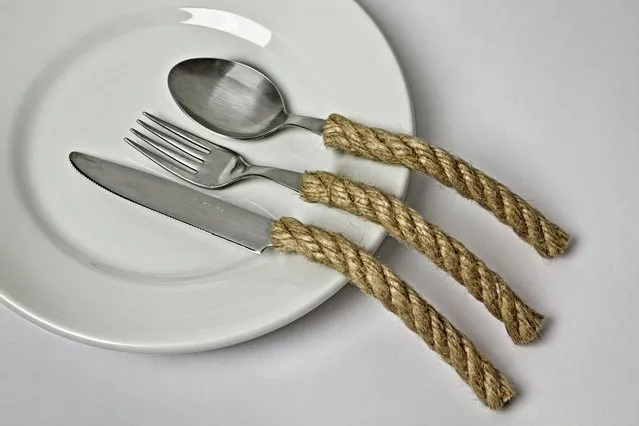
Cuttlery with rope handles. (Photo by Giuseppe Colarusso/Caters News)

An artist has created series of wacky images turning everyday items into hilarious and all but impossible to use objects. Giuseppe Colarusso, 49, fashioned the unique work to make people question the functionality of the likes of cutlery, garden tools and office equipment. The set of playful pictures, entitled “Improbabilita”, makes some items impossible to use, others improbable and some given a completely new function altogether. From a dice with no spots, to a ping pong paddle with a hole in it, the items have all been given a quirky twist. Photo: Cuttlery with rope handles. (Photo by Giuseppe Colarusso/Caters News)
Details
27 Jun 2013 07:37:00
Glass Art By Kiva Ford

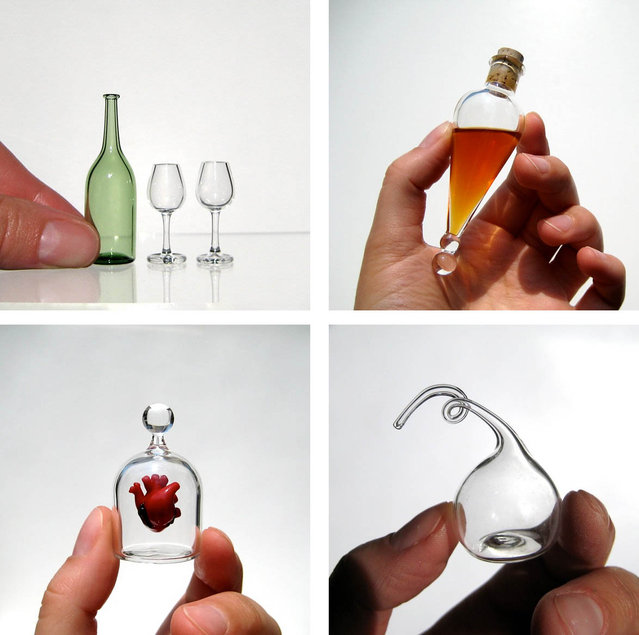
Glass artist Kiva Ford draws from his vast experience in scientific glassblowing to create perfect miniatures of wine glasses, beakers, and ribbon-striped vases, some scarcely an inch tall. A member of the American Scientific Glassblowers Society, Kiva creates instruments for scientists who require one-of-a-kind designs for various experiments. The same techniques and tools used for scientific equipment also apply to his artistic practice including the miniature works you see here, as well as larger sculptures, and ornate drinkware.
Details
21 Jul 2015 10:31:00