Loading...
Done
In this undated handout photo taken by mrwed54, a woman poses for a photo by a lake in the Siberian city of Novosibirsk, about 2,800 kilometers (1,750 miles) east of Moscow, Russia. Thousands of Novosibirsk residents, from scantily clad women to newlyweds have been instagramming selfies near the lake nicknamed the “Siberian Malvides” after the far-flung tropical islands in the Indian Ocean. This is in fact is a man-made dumb of coal from a nearby power station that provides for most of Novosibirsk’s energy needs. Environmentalists are warning people against coming into contact with the water. (Photo by mrwed54 via AP Photo)

In this undated handout photo taken by mrwed54, a woman poses for a photo by a lake in the Siberian city of Novosibirsk, about 2,800 kilometers (1,750 miles) east of Moscow, Russia. Thousands of Novosibirsk residents, from scantily clad women to newlyweds have been instagramming selfies near the lake nicknamed the “Siberian Malvides” after the far-flung tropical islands in the Indian Ocean. This is in fact is a man-made dumb of coal from a nearby power station that provides for most of Novosibirsk’s energy needs. Environmentalists are warning people against coming into contact with the water. (Photo by mrwed54 via AP Photo)
Details
15 Jul 2019 00:07:00


Meet Tardar Sauce, The Internet’s Favorite Grumpy Cat
Details
02 Oct 2012 12:10:00
Shi Yongxin, abbot of the Shaolin Temple, works on the computer

“The popularity of the Internet in China has driven the explosive growth of profitable Web companies and made fortunes for some Chinese entrepreneurs despite government controls on what the public can see online. The number of mainland Internet users rose to 513 million in December, up 12 percent from a year earlier, the government-sanctioned China Internet Network Information Center said”. – AP Business Writer

Photo: Shi Yongxin, abbot of the Shaolin Temple, works on the computer April 8, 2005 in Dengfeng, Henan Province, China. (Photo by Cancan Chu/Getty Images)
Details
16 Jan 2012 13:19:00
Carolina Gutierrez (center L), 17, and Neuil Valdez, 18, use mobile phones to connect to the internet at a hotspot in downtown Havana, Cuba, December 12, 2016. (Photo by Alexandre Meneghini/Reuters)

Carolina Gutierrez (center L), 17, and Neuil Valdez, 18, use mobile phones to connect to the internet at a hotspot in downtown Havana, Cuba, December 12, 2016. (Photo by Alexandre Meneghini/Reuters)
Details
12 Jan 2017 11:42:00
A staff member sets up a ROBOTLEO robot  at the Global Mobile Internet Conference (GMIC) 2017 in Beijing, China April 28, 2017. (Photo by Jason Lee/Reuters)

A staff member sets up a ROBOTLEO robot at the Global Mobile Internet Conference (GMIC) 2017 in Beijing, China April 28, 2017. (Photo by Jason Lee/Reuters)
Details
28 Apr 2017 08:17:00
“Shoot Me to the Stars”. (Photo and comment by Dave Morrow)

“Shoot Me to the Stars”. (Photo and comment by Dave Morrow)

Details
22 Feb 2013 16:23:00
“Don't look at me, I'm not ready!!!!” (Photo and caption by Yves Lecoq)

“Don't look at me, I'm not ready!!!!” (Photo and caption by Yves Lecoq)
Details
11 Apr 2015 09:25:00
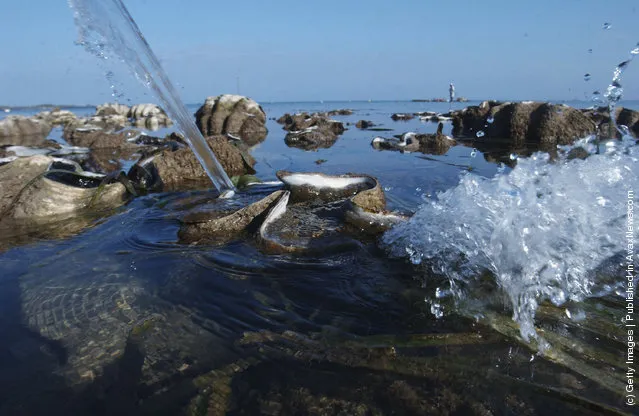
Tridacna Gigas, or Giant Clams

“The giant clam, Tridacna gigas (known as pā’ua in Cook Islands Māori), is the largest living bivalve mollusc. T. gigas is one of the most endangered clam species. It was mentioned as early as 1825 in scientific reports. One of a number of large clam species native to the shallow coral reefs of the South Pacific and Indian oceans, they can weigh more than 200 kilograms (440 lb) measure as much as 120 cm (47 in) across, and have an average lifespan in the wild of 100 years or more”. – Wikipedia

Photo: Tridacna Gigas, or Giant Clams spew water as a traditional fisherman passes by a small sanctuary on January 23, 2004 near Bolinao in the Northern Philippines. The clams, prime builders for coral reefs and providing shelter for spawning fish and other marine life, are exposed by low tides in the sanctuary. Overfishing and pollution throughout the country are not only threatening food security, but are also starting to choke one of the few working clam sanctuaries in the world. (Photo by David Greedy/Getty Images)
Details
01 Oct 2011 13:10:00