Loading...
Done
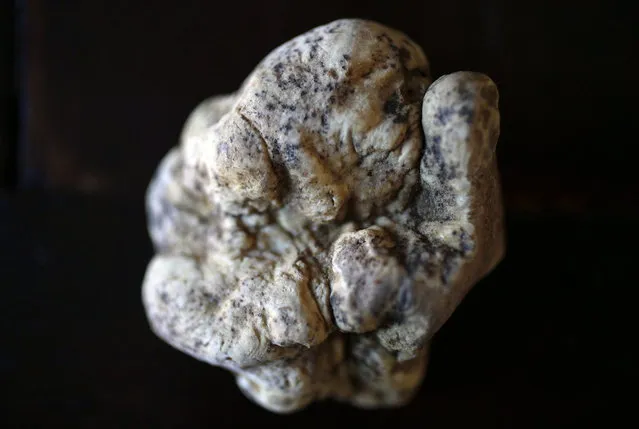
A truffle is seen on a table in Alba, north-western Italy November 11, 2013. Located in the heart of the Langhe – the hilly southern area of Italy's northwestern Piedmont region – Alba is the country's capital of white truffles, a variety of the prized fungus which grows underground. Truffles are found two to eight inches (5-20cm) below the ground near the roots of trees. (Photo by Stefano Rellandini/Reuters)

A truffle is seen on a table in Alba, north-western Italy November 11, 2013. Located in the heart of the Langhe – the hilly southern area of Italy's northwestern Piedmont region – Alba is the country's capital of white truffles, a variety of the prized fungus which grows underground. Truffles are found two to eight inches (5-20cm) below the ground near the roots of trees. They give off an odour which lasts for a limited period of time and can be detected with the assistance of well-trained dogs and experienced hunters. Output of white truffles, which are not cultivated and only grow naturally in forests, has fallen in Italy over the past few years, largely because climate change has brought a damaging mix of drought and torrential rains. (Photo by Stefano Rellandini/Reuters)
Details
31 Dec 2013 11:22:00
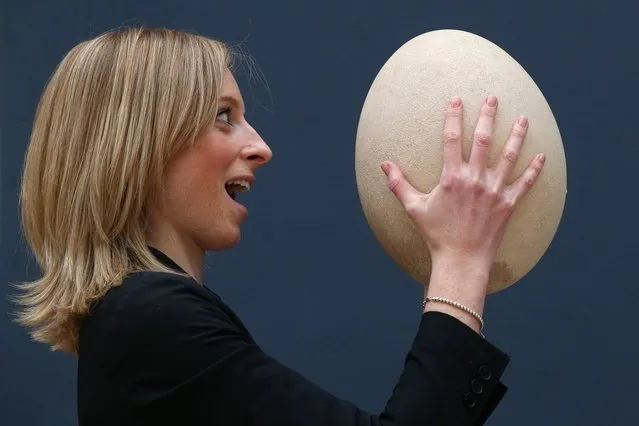
An employee at Christie's auction house examines a complete sub-fossilised elephant bird egg on March 27, 2013 in London, England. The elephant bird egg is expected to fetch 30,000 GBP when it features in Christie's “Travel, Science and Natural History” sale, which is to be held on April 24, 2013 in London.  (Photo by Oli Scarff)

An employee at Christie's auction house examines a complete sub-fossilised elephant bird egg on March 27, 2013 in London, England. The elephant bird egg is expected to fetch 30,000 GBP when it features in Christie's “Travel, Science and Natural History” sale, which is to be held on April 24, 2013 in London. (Photo by Oli Scarff)
Details
28 Mar 2013 12:16:00
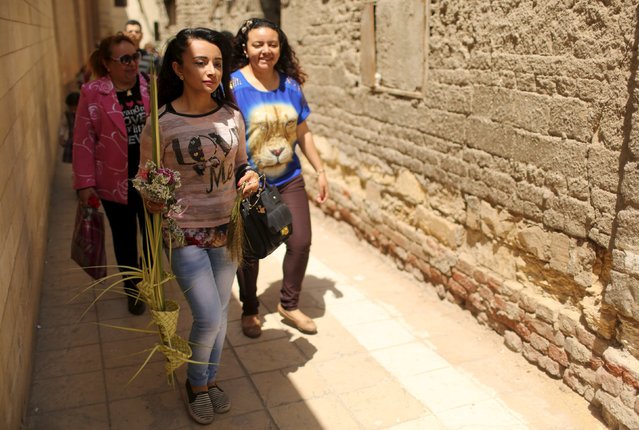
An Egyptian Coptic Christian girl carries palm decoration during Palm Sunday inside a church in Old Cairo, April 5, 2015. (Photo by Asmaa Waguih/Reuters)

An Egyptian Coptic Christian girl carries palm decoration during Palm Sunday inside a church in Old Cairo, Egypt, April 5, 2015. For Christians worldwide, Palm Sunday marks Jesus Christ's entrance into Jerusalem, when his followers laid palm branches in his path, prior to his crucifixion. Western Christian churches and most Orthodox Christian churches follow different calendars and observe Easter on different dates. (Photo by Asmaa Waguih/Reuters)
Details
06 Apr 2015 09:20:00
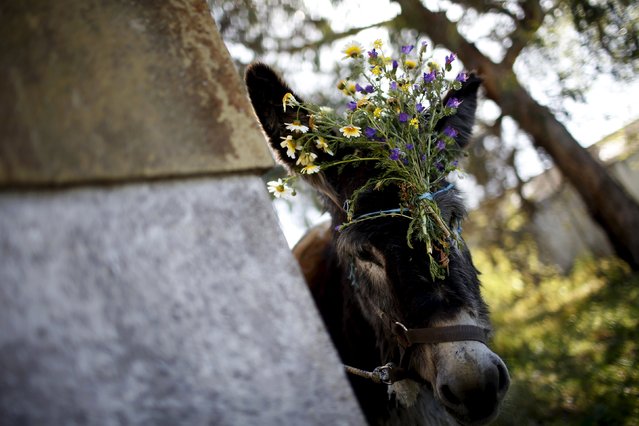
A donkey is seen before the start of the procession of the “Virgem da Atalaia” during Holy Week at Alcochete, near Lisbon April 5, 2015. (Photo by Rafael Marchante/Reuters)

A donkey is seen before the start of the procession of the “Virgem da Atalaia” during Holy Week at Alcochete, near Lisbon April 5, 2015. Women ride donkeys during the “Virgem da Atalaia” procession, that has been held annually for about 400 years. In the past, only single women rode the donkeys to ask for help from the Virgin to find a husband. (Photo by Rafael Marchante/Reuters)
Details
06 Apr 2015 09:43:00
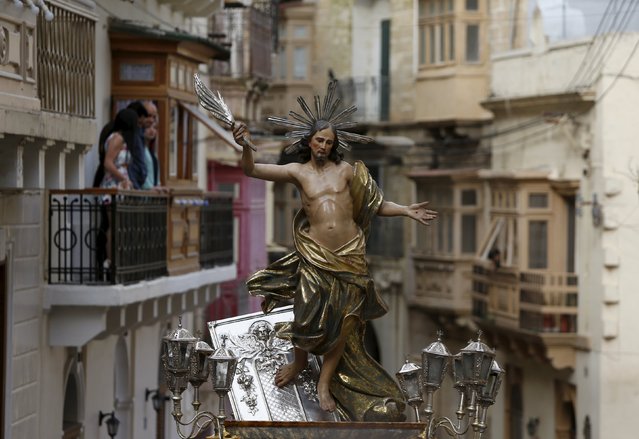
A statue of the Risen Christ is carried during an Easter Sunday procession in Cospicua, outside Valletta April 5, 2015. (Photo by Darrin Zammit Lupi/Reuters)

A statue of the Risen Christ is carried during an Easter Sunday procession in Cospicua, outside Valletta, Malta April 5, 2015. (Photo by Darrin Zammit Lupi/Reuters)
Details
06 Apr 2015 09:31:00
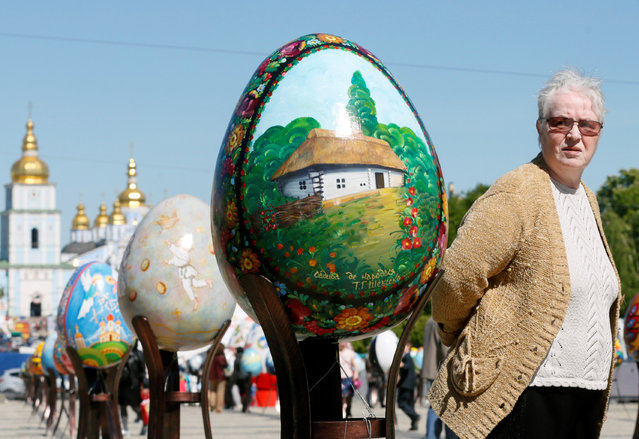
A woman looks at traditional Ukrainian Easter eggs “Pysanka”, installed as part of the upcoming celebrations of Easter, in central Kiev, Ukraine, April 29, 2016. A pysanka is a Ukrainian Easter egg, decorated with traditional Ukrainian folk designs using a wax-resist (batik) method. The word pysanka comes from the verb pysaty, “to write”, as the designs are not painted on, but written with beeswax. Many other eastern European ethnic groups decorate eggs using wax resist for Easter. These include the Belarusians, Bulgarians, Croats, Czechs, Hungarians, Lithuanians, Poles, Romanians, Serbs, Slovaks, Slovenes and Sorbs. (Photo by Valentyn Ogirenko/Reuters)

A woman looks at traditional Ukrainian Easter eggs “Pysanka”, installed as part of the upcoming celebrations of Easter, in central Kiev, Ukraine, April 29, 2016. A pysanka is a Ukrainian Easter egg, decorated with traditional Ukrainian folk designs using a wax-resist (batik) method. The word pysanka comes from the verb pysaty, “to write”, as the designs are not painted on, but written with beeswax. Many other eastern European ethnic groups decorate eggs using wax resist for Easter. These include the Belarusians, Bulgarians, Croats, Czechs, Hungarians, Lithuanians, Poles, Romanians, Serbs, Slovaks, Slovenes and Sorbs. (Photo by Valentyn Ogirenko/Reuters)
Details
30 Apr 2016 09:00:00
A young girl takes selfie with Easter rabbit sculpture during the Easter eggs (Pysanka) and rabbit exhibition in front of St. Sophia Cathedral in Kiev, Ukraine, 05 April 2018. Ukrainians will mark Orthodox Easter on 08 April 2018, according to Julian calendar. (Photo by Sergey Dolzhenko/EPA/EFE/Rex Features/Shutterstock)

A young girl takes selfie with Easter rabbit sculpture during the Easter eggs (Pysanka) and rabbit exhibition in front of St. Sophia Cathedral in Kiev, Ukraine, 05 April 2018. Ukrainians will mark Orthodox Easter on 08 April 2018, according to Julian calendar. (Photo by Sergey Dolzhenko/EPA/EFE/Rex Features/Shutterstock)
Details
10 Apr 2018 09:03:00
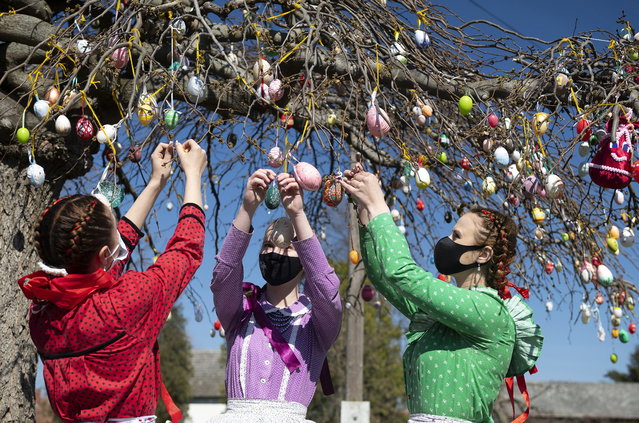
Dressed in folk costumes, young women decorate a tree with painted Easter eggs in Dombrad, Hungary, Monday, April 5, 2021. (Photo by Attila Balazs/MTI via AP Photo)

Dressed in folk costumes, young women decorate a tree with painted Easter eggs in Dombrad, Hungary, Monday, April 5, 2021. (Photo by Attila Balazs/MTI via AP Photo)
Details
06 Apr 2021 10:30:00