Loading...
Done
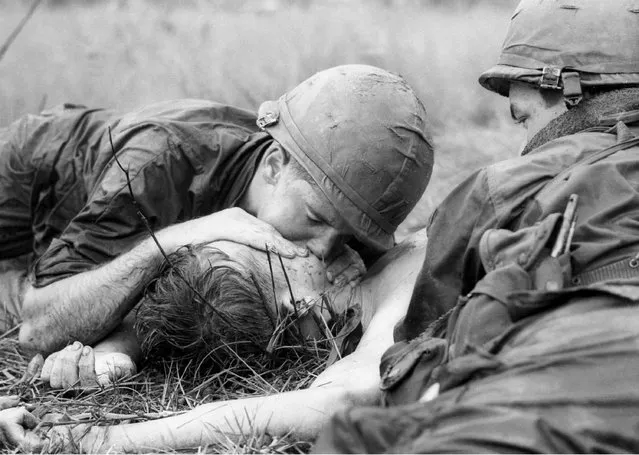
Medic James E. Callahan of Pittsfield, Mass., gives mouth-to-mouth resuscitation to a dying soldier in war zone D, about 50 miles northeast of Saigon, June 17, 1967. Thirty-one men of the 1st Infantry Division were reported killed in the guerrilla ambush, with more than 100 wounded.  (Photo by Henri Huet/AP Photo)

Medic James E. Callahan of Pittsfield, Mass., gives mouth-to-mouth resuscitation to a dying soldier in war zone D, about 50 miles northeast of Saigon, June 17, 1967. Thirty-one men of the 1st Infantry Division were reported killed in the guerrilla ambush, with more than 100 wounded. (Photo by Henri Huet/AP Photo)
Details
27 Jun 2017 08:38:00
In this August 17, 2016, photo, from left to right, Chhering Chodom, 60, Tashi Yangzom, 50, Lobsang Chhering, 27, and Dorje Tandup, 58, drink milk tea on the side of the road. For centuries, the sleepy valley nestled in the Indian Himalayas remained a hidden Buddhist enclave forbidden to outsiders. Enduring the harsh year-round conditions of the high mountain desert, the people of Spiti Valley lived by a simple communal code – share the Earth's bounty, be hospitable to neighbors, and eschew greed and temptation at all turns. That's all starting to change, for better or worse. Since India began allowing its own citizens as well as outsiders to visit the valley in the early 1990s, tourism and trade have boomed. And the marks of modernization, such as solar panels, asphalt roads and concrete buildings, have begun to appear around some of the villages that dot the remote landscape at altitudes above 4,000 meters (13,000 feet). (Photo by Thomas Cytrynowicz/AP Photo)

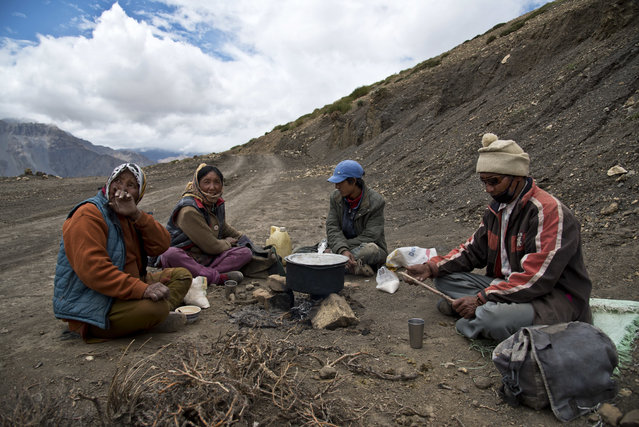
In this August 17, 2016, photo, from left to right, Chhering Chodom, 60, Tashi Yangzom, 50, Lobsang Chhering, 27, and Dorje Tandup, 58, drink milk tea on the side of the road. For centuries, the sleepy valley nestled in the Indian Himalayas remained a hidden Buddhist enclave forbidden to outsiders. Enduring the harsh year-round conditions of the high mountain desert, the people of Spiti Valley lived by a simple communal code – share the Earth's bounty, be hospitable to neighbors, and eschew greed and temptation at all turns. That's all starting to change, for better or worse. (Photo by Thomas Cytrynowicz/AP Photo)
Details
15 Sep 2016 09:22:00
Fighters from Germany take up position before competing in the Medieval Combat World Championship at Malbork Castle, northern Poland, April 30, 2015. (Photo by Kacper Pempel/Reuters)

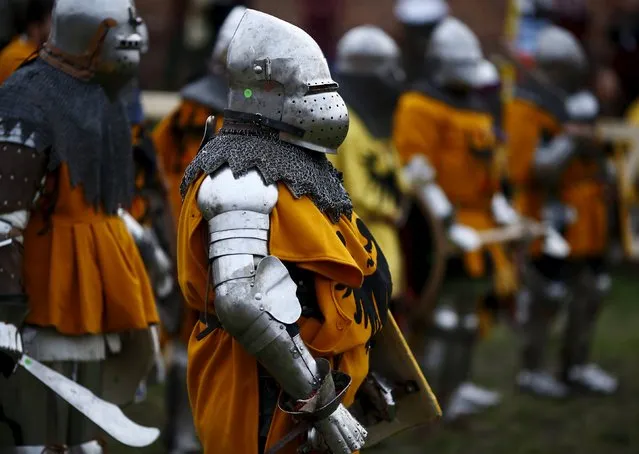
Fighters from Germany take up position before competing in the Medieval Combat World Championship at Malbork Castle, northern Poland, April 30, 2015. Medieval combat is a full contact sport that revives the foot based tournament fighting of medieval Europe. Countries fight in refereed matches where the objective is to get the opposing team to the floor. There are also duels with polearms, swords and shields where the number of hits landed are scored. The fighters, both male and female, wear heavy armours and weapons, mostly replicas of authentic pieces, and fight following the knights code of conduct. According to organizers, 25 nations from 6 continents are taking part in the Championships, which started on April 30 and will go on until May 3. (Photo by Kacper Pempel/Reuters)
Details
03 May 2015 12:02:00
Wang uses a mobile phone as she take a rest in her room at the accommodation where patients and their family members stay while seeking medical treatments in Beijing, China, June 23, 2016. Wang, who suffers from cervical cancer, came from Inner Mongolia to seek treatment at a specialist hospital in Beijing. (Photo by Kim Kyung-Hoon/Reuters)

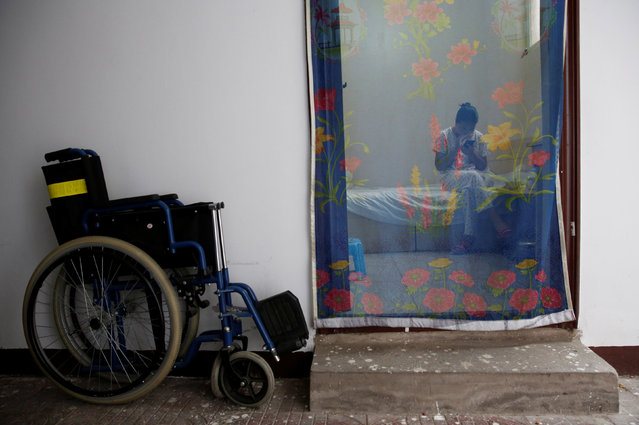
Wang uses a mobile phone as she take a rest in her room at the accommodation where patients and their family members stay while seeking medical treatments in Beijing, China, June 23, 2016. Wang, who suffers from cervical cancer, came from Inner Mongolia to seek treatment at a specialist hospital in Beijing. (Photo by Kim Kyung-Hoon/Reuters)
Details
30 Sep 2016 09:03:00
This photo taken on January 30, 2020 shows officials in protective suits checking on an elderly man wearing a facemask who collapsed and died on a street near a hospital in Wuhan. AFP journalists saw the body on January 30, not long before an emergency vehicle arrived carrying police and medical staff in full-body protective suits. The World Health Organization declared a global emergency over the new coronavirus, as China reported on January 31 the death toll had climbed to 213 with nearly 10,000 infections. (Photo by Hector Retamal/AFP Photo)

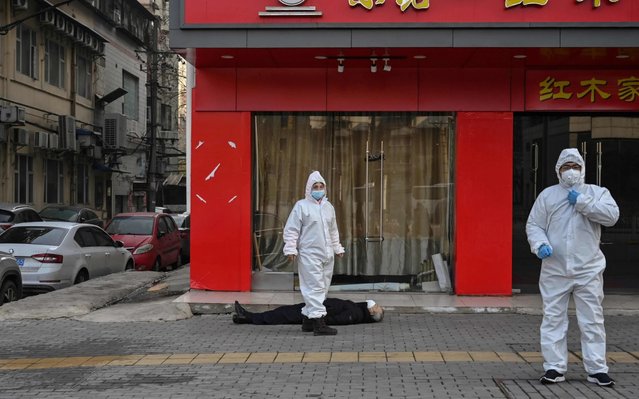
This photo taken on January 30, 2020 shows officials in protective suits checking on an elderly man wearing a facemask who collapsed and died on a street near a hospital in Wuhan. AFP journalists saw the body on January 30, not long before an emergency vehicle arrived carrying police and medical staff in full-body protective suits. The World Health Organization declared a global emergency over the new coronavirus, as China reported on January 31 the death toll had climbed to 213 with nearly 10,000 infections. (Photo by Hector Retamal/AFP Photo)
Details
02 Feb 2020 00:07:00
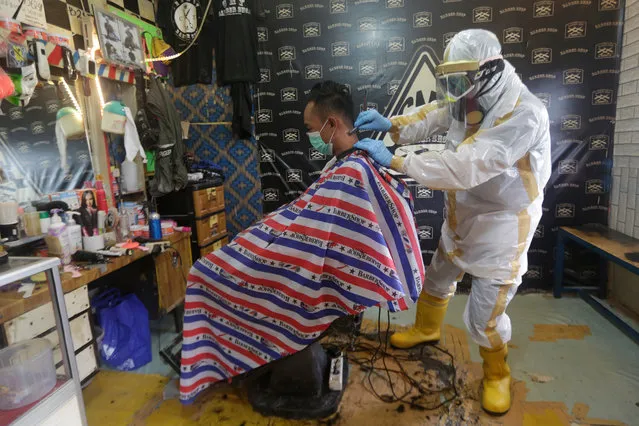
Barber Herman Mulyana (R) gives a haircut to a customer while wearing protective attire made from plastic garbage bags at a barbershop in Bogor, Indonesia, 06 April 2020. The Trade Ministry of Indonesia issued a regulation temporarily recinding all requirements for the import of protective gear and medical equipment, to counter shortages of many items used to treat COVID-19 patients and prevent the further spread of the disease. (Photo by Adi Weda/EPA/EFE)

Barber Herman Mulyana (R) gives a haircut to a customer while wearing protective attire made from plastic garbage bags at a barbershop in Bogor, Indonesia, 06 April 2020. The Trade Ministry of Indonesia issued a regulation temporarily recinding all requirements for the import of protective gear and medical equipment, to counter shortages of many items used to treat COVID-19 patients and prevent the further spread of the disease. (Photo by Adi Weda/EPA/EFE)
Details
08 Apr 2020 00:07:00
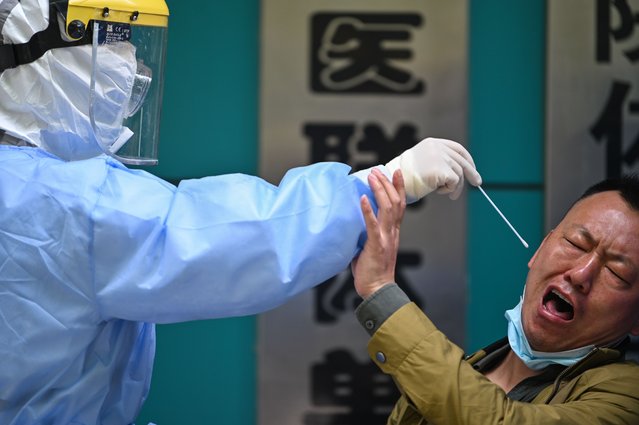
A man being tested for the COVID-19 novel coronavirus reacts as a medical worker takes a swab sample in Wuhan in China's central Hubei province on April 16, 2020. China has largely brought the coronavirus under control within its borders since the outbreak first emerged in the city of Wuhan late last year. (Photo by Hector Retamal/AFP Photo)

A man being tested for the COVID-19 novel coronavirus reacts as a medical worker takes a swab sample in Wuhan in China's central Hubei province on April 16, 2020. China has largely brought the coronavirus under control within its borders since the outbreak first emerged in the city of Wuhan late last year. (Photo by Hector Retamal/AFP Photo)
Details
18 Apr 2020 00:03:00
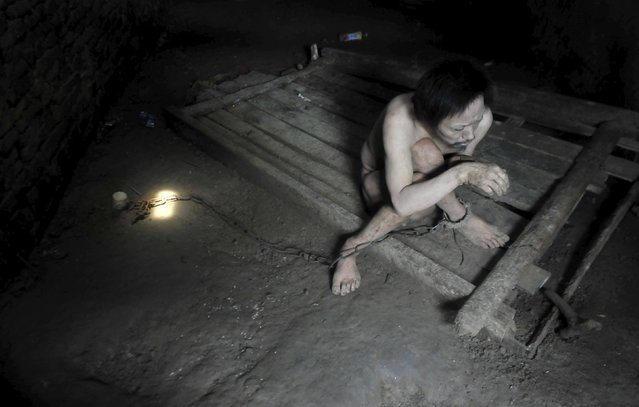
Tong Jieping, 44-year-old mentally disabled patient, is chained by his foot inside his room, in Qunxing village of Wangjiang county, Anhui province, China, July 14, 2015. Tong was diagnosed mentally ill when he was in his 20s. His parents, both in their 70s, could not afford the medical treatments so they had to lock him up in chains to prevent him from running away, according to Tong's family. (Photo by Reuters/Stringer)

Tong Jieping, 44-year-old mentally disabled patient, is chained by his foot inside his room, in Qunxing village of Wangjiang county, Anhui province, China, July 14, 2015. Tong was diagnosed mentally ill when he was in his 20s. His parents, both in their 70s, could not afford the medical treatments so they had to lock him up in chains to prevent him from running away, according to Tong's family. (Photo by Reuters/Stringer)
Details
15 Jul 2015 11:33:00