Loading...
Done
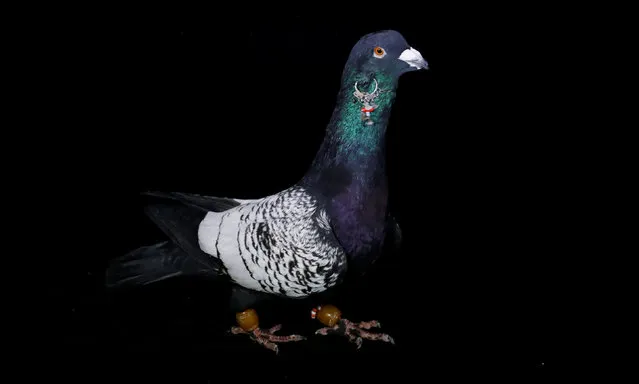
A pigeon, known as Siyah Kinifirli, with an approximate market value of 1000 Turkish Lira ($263), bred by 23-year-old Ismail Ozbek, is pictured in Sanliurfa, Turkey, December 23, 2016. As night-time approaches in Sanliurfa, southeastern Turkey, most of the alleyways of the city's old bazaar are emptying out of buyers and vendors, except for one. The bustle of daytime trading has died down, but on this little street, a stream of men carry cardboard boxes filled with pigeons to a cluster of three teahouses. Here, they sell the birds at Sanliurfa's famed auctions to a dedicated band of pigeon keepers and breeders, a pastime that has been thriving for hundreds of years across the region and over the nearby border into war-torn Syria. In a country where the minimum wage is about 1,400 Liras ($367) a month, enthusiasts regularly easily spend hundreds of dollars for one bird. “I once sold a pair of pigeons for 35,000 Turkish Lira”, says auctioneer Imam Dildas. “This is a passion, a hobby you cannot quit. I've been known to sell the fridge and my wife's gold bracelets to pay for pigeons”. (Photo by Umit Bektas/Reuters)

A pigeon, known as Siyah Kinifirli, with an approximate market value of 1000 Turkish Lira ($263), bred by 23-year-old Ismail Ozbek, is pictured in Sanliurfa, Turkey, December 23, 2016. As night-time approaches in Sanliurfa, southeastern Turkey, most of the alleyways of the city's old bazaar are emptying out of buyers and vendors, except for one. (Photo by Umit Bektas/Reuters)
Details
17 Jan 2017 12:05:00
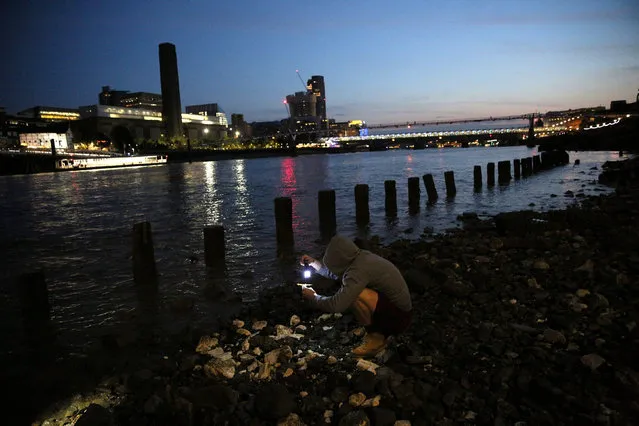
A mudlark uses a torch to look for items on the bank of the River Thames in London, Britain June 06, 2016. Mudlarking is believed to trace its origins to the 18th and 19th century, when scavengers searched the Thames' shores for items to sell. These days, history and archaeology fans are the ones hoping to find old relics such as coins, ceramics, artifacts or everyday items from across centuries. They wait for the low tide and then scour specific areas of exposed shores. "If you're in a field you could be out all day long, with the river you're restricted to about two or three hours," mudlark Nick Stevens said. While many just use the naked eye for their searches, others rely on metal detectors for which a permit from the Port of London Authority is needed. Digging also requires consent. (Photo by Neil Hall/Reuters)

A mudlark uses a torch to look for items on the bank of the River Thames in London, Britain June 06, 2016. Mudlarking is believed to trace its origins to the 18th and 19th century, when scavengers searched the Thames' shores for items to sell. These days, history and archaeology fans are the ones hoping to find old relics such as coins, ceramics, artifacts or everyday items from across centuries. their finds with the Portable Antiquities Scheme. Any item over 300 years old must be recorded. (Photo by Neil Hall/Reuters)
Details
27 Aug 2016 10:43:00
In this photograph taken on May 20, 2014 nine year old Indian boy Lakhan Kale is tied with a cloth rope around his ankle, to a bus-stop pole in Mumbai. (Photo by Punit Paranjpe/AFP Photo)

In this photograph taken on May 20, 2014 nine year old Indian boy Lakhan Kale is tied with a cloth rope around his ankle, to a bus-stop pole in Mumbai. The nine-year-old boy dressed in blue lay listlessly on the pavement in the scorching Mumbai summer afternoon, his ankle tethered with rope to a bus stop, unheeded by pedestrians strolling past. Lakhan Kale cannot hear or speak and suffers from cerebral palsy and epilepsy, so his grandmother and carer tied him up to keep him safe while she went to work, selling toys and flower garlands on the city's roadsides. (Photo by Punit Paranjpe/AFP Photo)
Details
04 Jul 2014 09:54:00
Tank crew standing in front of M-4 tank, Ft. Knox, Kentucky, June, 1942

Tank crew standing in front of M-4 tank, Ft. Knox, Kentucky, June, 1942. (Alfred Palmer/OWI/LOC)
Details
04 May 2012 12:12:00
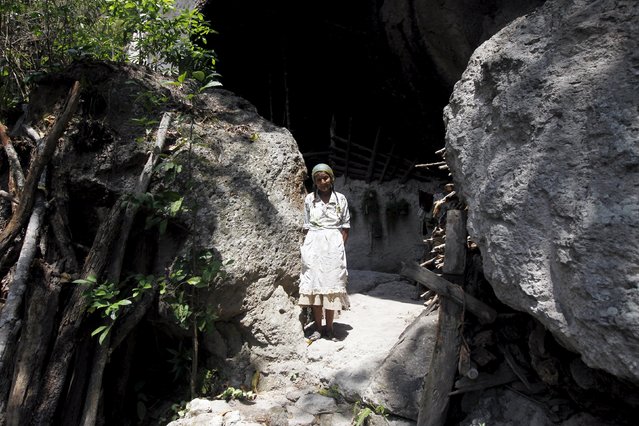
Francisca Gomez stands at an entrance to her home, a cave where she has been living for the past 50 years, in the mountains on the outskirts of Chusmuy April 21, 2015. (Photo by Jorge Cabrera/Reuters)

Francisca Gomez stands at an entrance to her home, a cave where she has been living for the past 50 years, in the mountains on the outskirts of Chusmuy, Honduras April 21, 2015. The 75-year old widow receives help from neighbors and friends and she makes a little money by selling wood she collects, according to a local newspaper. (Photo by Jorge Cabrera/Reuters)
Details
24 Apr 2015 10:38:00
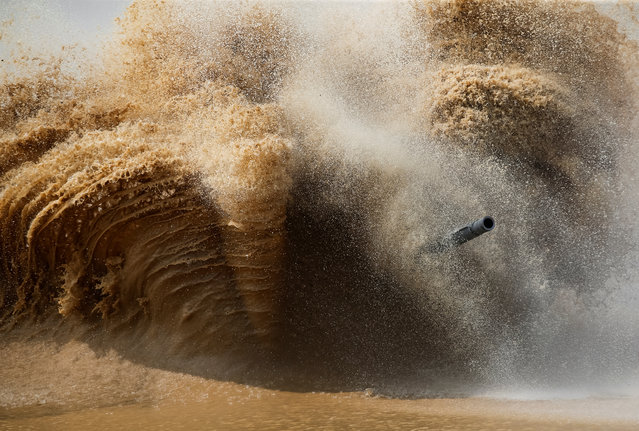
A tank's barrel is seen on the course of the Tank Biathlon competition during the International Army Games 2016 in Alabino, outside Moscow, Russia, July 30, 2016. (Photo by Maxim Zmeyev/Reuters)

A tank's barrel is seen on the course of the Tank Biathlon competition during the International Army Games 2016 in Alabino, outside Moscow, Russia, July 30, 2016. (Photo by Maxim Zmeyev/Reuters)
Details
01 Aug 2016 09:56:00
A Manipuri woman sells smoked and dry fish in Ima market - the world's largest all women market - in Imphal city, Manipur state, 06 January 2016. The 150-year-old Ima Keithel or 'Mothers's market' complex, which is run exclusively by women and was damaged in the 04 January 2016 earthquake, is returning back to normal. Nine deaths have been reported from in and around Imphal due to falling debris. (Photo by EPA/Stringer)

A Manipuri woman sells smoked and dry fish in Ima market - the world's largest all women market – in Imphal city, Manipur state, 06 January 2016. The 150-year-old Ima Keithel or “Mothers's market” complex, which is run exclusively by women and was damaged in the 04 January 2016 earthquake, is returning back to normal. Nine deaths have been reported from in and around Imphal due to falling debris. Imphal has a population of some 270,000 and people were jolted from their sleep and ran out of their homes in panic when the earth shook 04 January, reports say. (Photo by EPA/Stringer)
Details
08 Jan 2016 08:04:00
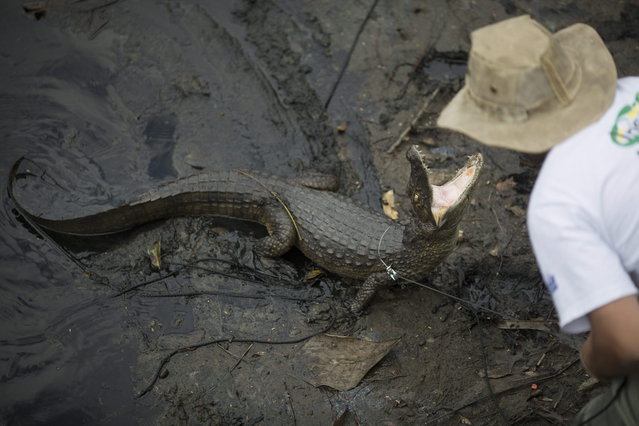
In this October 14, 2013 photo, ecology professor Ricardo Freitas catches a broad-snouted caiman to examine, then release back into the water channel in the affluent Recreio dos Bandeirantes suburb of Rio de Janeiro, Brazil. (Photo by Felipe Dana/AP Photo)

In this October 14, 2013 photo, ecology professor Ricardo Freitas catches a broad-snouted caiman to examine, then release back into the water channel in the affluent Recreio dos Bandeirantes suburb of Rio de Janeiro, Brazil. Caimans are like tanks, a very old species with a remarkable capacity for renovation that allows them to survive under extreme conditions where others couldn't, said Freitas, who runs the Instituto Jacare, or the Caiman Institute, which aims to protect the reptiles. (Photo by Felipe Dana/AP Photo)
Details
18 Oct 2013 09:05:00