Loading...
Done


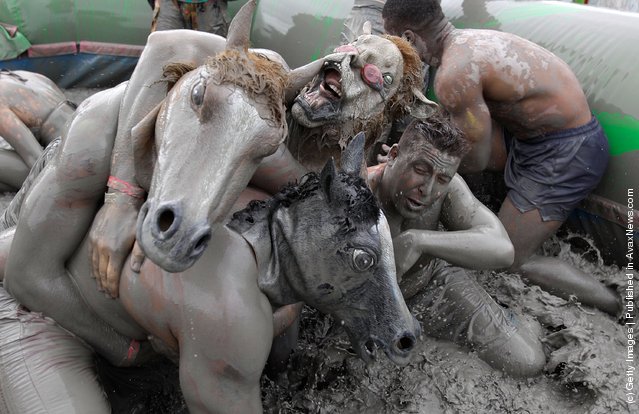
Participants enjoy mud during the 14th Annual Boryeong Mud Festival at Daecheon Beach on July 16, 2011 in Boryeong, South Korea. The mud, which is believed to have beneficial effects on the skin due to its mineral content, is sourced from mud flats near Boryeong and transported to the beach by truck. (Photo by Chung Sung-Jun/Getty Images)
Details
17 Jul 2011 11:20:00
Police officers carry an opposition activist, who was detained while taking part in an unauthorized rally, at the Triumfalnaya Square in central Moscow

Police officers carry an opposition activist, who was detained while taking part in an unauthorized rally, at the Triumfalnaya Square in central Moscow, late on December 6, 2011.

Photo by: Sergey Muhamedov; Source: LiveJournal
Details
07 Dec 2011 12:35:00
Russian oppostion activists take part in a rally and march to Bolotnaya Square on February 4, 2012 in Moscow, Russia

Russian oppostion activists take part in a rally and march to Bolotnaya Square on February 4, 2012 in Moscow, Russia. Demonstrators braved temperatures as low as -20 degrees celsius as they took to the streets exactly one month before the presidential elections in protest against Vladimir Putin's efforts to return to the Kremlin for an unprecedented third term as President. (Photo by: Ilya Varlamov; Source: LiveJournal)
Details
05 Feb 2012 13:07:00
A sales assistant poses for photographs with a mealworm cookie in Seoul, South Korea, August 8, 2016. (Photo by Kim Hong-Ji/Reuters)

A sales assistant poses for photographs with a mealworm cookie in Seoul, South Korea, August 8, 2016. Insect-eating, or entomophagy, has long been common in much of the world, including South Korea, where boiled silky worm pupae, or beondegi, are a popular snack. Now, South Korea is looking to expand its insect industry as a source of agricultural income. (Photo by Kim Hong-Ji/Reuters)
Details
13 Aug 2016 11:06:00
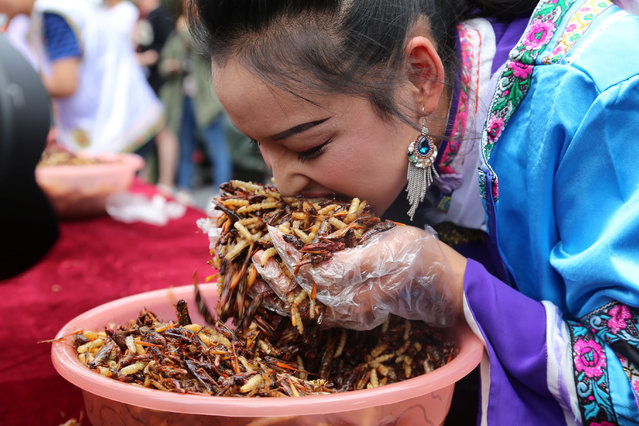
A woman participates in an insect-eating competition at a scenic spot in Lijiang, Yunnan province, China June 25, 2017. (Photo by Reuters/Stringer)

A woman participates in an insect-eating competition at a scenic spot in Lijiang, Yunnan province, China June 25, 2017. Insects have been a part of Yunnan cuisine for centuries, long before their potential as sustainable sources of protein caught the eye of the Western world. Bee larvae, grasshoppers and cicadas are just some items found on menus in the region. (Photo by Reuters/Stringer)
Details
13 Jul 2017 07:41:00
A 40-tonne humpback launching out of the water in an incredible breach in New South Wales, Australia on October 2022 in front of a sunset. The humpback whale can grow up to 56 feet long and typically covers 9,900 miles a year as it travels through the oceans of the world. Humpback whales are a species of Baleen whale, meaning they don't have teeth. Instead, they have baleen which helps them to filter feed. Their main source of food is krill or tiny bait fish. (Photo by Jodie Lowe/Media Drum Images)

A 40-tonne humpback launching out of the water in an incredible breach in New South Wales, Australia on October 2022 in front of a sunset. The humpback whale can grow up to 56 feet long and typically covers 9,900 miles a year as it travels through the oceans of the world. Humpback whales are a species of Baleen whale, meaning they don't have teeth. Instead, they have baleen which helps them to filter feed. Their main source of food is krill or tiny bait fish. (Photo by Jodie Lowe/Media Drum Images)
Details
30 Oct 2022 04:28:00
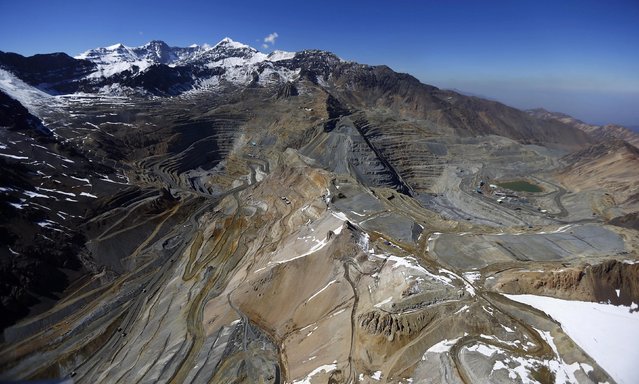
An aerial view of open pits of CODELCO's Andina (L) and Anglo American's Los Bronces copper mines with Olivares glaciers in the background (top L) at Los Andes Mountain range, near Santiago city, November 17, 2014. The rock glaciers of the Chilean central zone, a huge source of water for the basins of the capital, are said to be threatened by the environmental impacts of hydroelectric and mining projects, according to environmental activists Greenpeace. (Photo by Ivan Alvarado/Reuters)

An aerial view of open pits of CODELCO's Andina (L) and Anglo American's Los Bronces copper mines with Olivares glaciers in the background (top L) at Los Andes Mountain range, near Santiago city, November 17, 2014. The rock glaciers of the Chilean central zone, a huge source of water for the basins of the capital, are said to be threatened by the environmental impacts of hydroelectric and mining projects, according to environmental activists Greenpeace. (Photo by Ivan Alvarado/Reuters)
Details
19 Nov 2014 14:06:00
Thai vendors stand next to edible insects for sale at Talad Thai market in Pathum Thani province on the outskirts of Bangkok, Thailand, 15 July 2013. Insects have long been on the menu in Thailand, but academics and the United Nation's Food and Agriculture Organization (FAO) officials are hoping they will become a more common global source of protein and nutrients to meet the need for growing world food requirements in the future. (Photo by Narong Sangnak/EPA)

Thai vendors stand next to edible insects for sale at Talad Thai market in Pathum Thani province on the outskirts of Bangkok, Thailand, 15 July 2013. Insects have long been on the menu in Thailand, but academics and the United Nation's Food and Agriculture Organization (FAO) officials are hoping they will become a more common global source of protein and nutrients to meet the need for growing world food requirements in the future. (Photo by Narong Sangnak/EPA)
Details
22 May 2014 08:51:00