People travel by tube on the London Underground to take part in the Pride in London parade, London, Saturday, July 1, 2023. (Photo by Jordan Pettitt/PA Wire via AP Photo)
Female labourers wearing helmets take a break from laying underground electricity cables in Ahmedabad, India, March 7, 2016. (Photo by Amit Dave/Reuters)
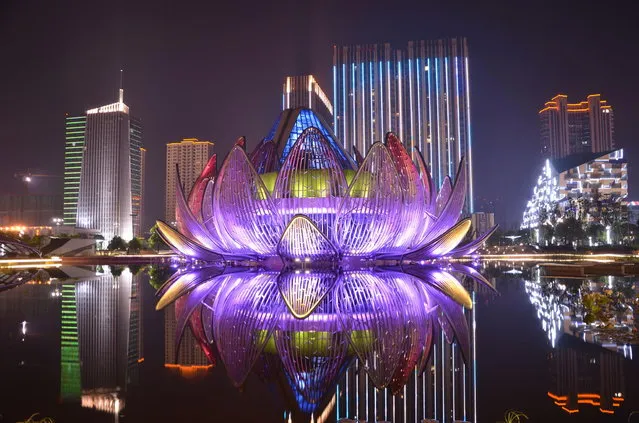
The Lotus Exhibition Center is an icon for the city of Wujin. Conceived as an addition to an existing underground building with a lake top, the center is a sculptural and ethereal lotus flower displaying the three stages of the lotus bloom life.
An injured young woman is led away after an incident at Parsons Green underground tube station in west London on September 15, 2017. Police and ambulance services said they were responding to an “incident” at Parsons Green underground station in west London on Friday, following media reports of an explosion. A Metro. co. uk reporter at the scene was quoted by the paper as saying that a white container exploded on the train and passengers had suffered facial burns. (Photo by Luke MacGregor/Reuters)
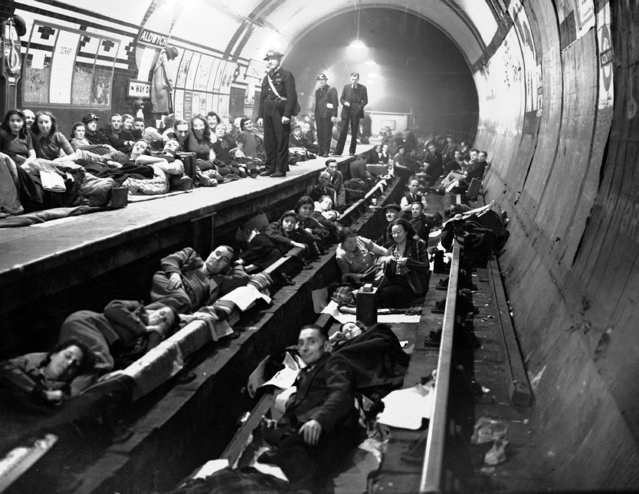
Londoners sleep on the platform and on the train tracks at Aldwych Underground station,London, during heavy all night Nazi bombing raids, October 8, 1940. (Photo by AP Photo)
Sam Warren climbs in to a prototype combat vehicle during the PrepperCon expo Friday, April 24, 2015, in Sandy, Utah. Hundreds of survivalists and “preppers” are gathering in the Salt Lake City suburb of Sandy for the first annual PrepperCon, featuring demonstrations of underground bunkers, food storage, and armored vehicles. (Photo by Rick Bowmer/AP Photo)
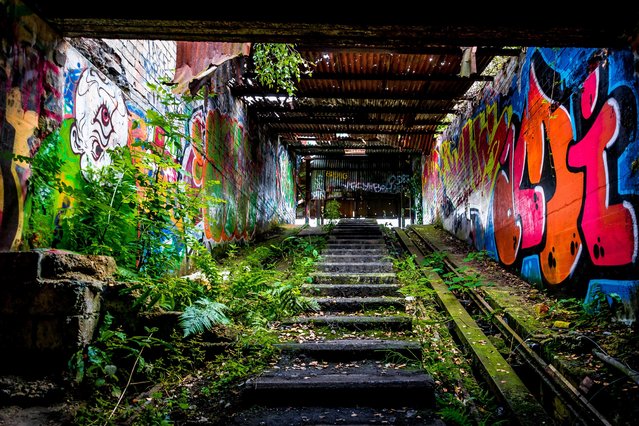
The series of shots show the bare steel infrastructure of the Bushfield army training camp near Winchester which was in operation during World War Two and was used to train Royal Green Jackets recruits in the sixties. The spectacular images were taken by an urban explorer who wished to remain anonymous. Here: A railway siding in Wiltshire, UK where ammunition was transferred by tunnel to an underground storage facility. (Photo by MediaDrumWorld.com)
A cenote is a natural phenomenon, a sinkhole in the Earth’s surface. The Yucatan Peninsula in Mexico has an estimated 7,000 cenotes because it is primarily made up of porous limestone. For millions of years, rainfall slowly ate away at the limestone and a huge system of underground caves and caverns was formed. Many filled with water from rain or from the underground water table. When the roof of a water filled cave collapses, a cenote is born. The water found in a cenote may be fresh water, salt water, or both. Structurally it may be completely open, like a lake, almost completely closed with just a small opening at the top, or somewhere in between.